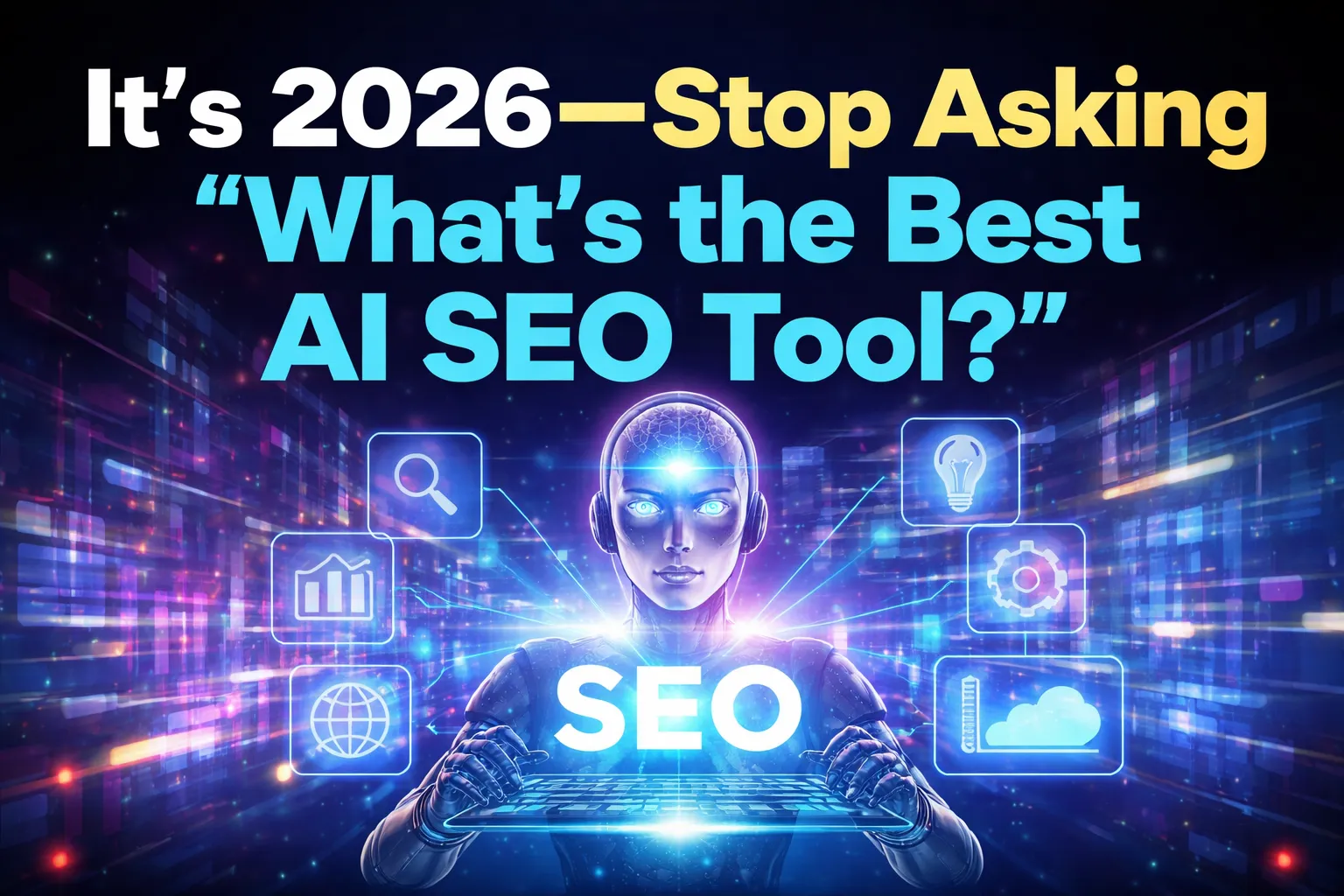
It's 2026, Stop Asking "What's the Best AI SEO Tool?"
In recent years, this question has been popping up with frightening frequency. Whether at industry meetups, in backend inquiries, or even during onboarding training for new colleagues, discussions inevitably circle back to this seemingly simple question: “What is the best AI SEO tool right now?” Or, more specifically, “What are the best AI SEO tools on the market in 2026?”
Initially, I would meticulously compile a list, analyzing the pros and cons of each. Later, I realized that the question itself might be more interesting than the answer. The fact that it’s repeatedly asked highlights a common anxiety within our industry during a period of rapid technological iteration: we’re constantly searching for a “magic bullet,” an ultimate solution that will solve all problems once and for all. But reality often proves disappointing.
Why Are We Always Searching for “The Best”?
Several realistic driving factors lie behind this. First is information overload. Since the explosion of AI writing tools in 2023, new products and features have been launched almost every month. Market hype is louder than ever, with each claiming to have “revolutionarily” solved a particular pain point. Practitioners, especially those in operations or marketing roles directly responsible for results, can easily feel lost. Finding a “universally acknowledged best” becomes a shortcut to reduce decision-making risk.
Second is the desire for certainty. SEO work is fraught with uncertainty: algorithms change, user behavior shifts, and competitors evolve. When AI tools emerged, our subconscious hoped they would bring some kind of “scientific,” replicable certainty. It’s as if simply using “the best” tool would inevitably lead to improved rankings and traffic, akin to a law of physics. This desire itself isn’t problematic, but projecting it onto a single tool can lead to issues.
Third, and most subtly, is the psychology of responsibility transfer. Choosing “the industry’s recognized best tool” means that if the results aren’t satisfactory, at least the responsibility isn’t entirely yours – “Everyone uses it, it’s the market’s fault, not mine.” This mindset is particularly common in large teams; the longer the decision-making chain, the heavier the reliance on “safe bets.”
The “Seemingly Effective” Traps
Based on this mindset, we can easily fall into several typical traps.
Trap 1: Feature Juggling Equals Cumulative Effectiveness. Many tool reviews focus on comparing feature lists: one can generate 1,000 words, another can analyze 100 keywords, and a third supports 30 languages. Consequently, we instinctively gravitate towards the “Swiss Army knife” with the most comprehensive features. However, in practical work, a “small tool” that perfectly integrates into your existing workflow and solves your core pain point is far more valuable than a “behemoth” that is feature-rich but cumbersome to operate and has a steep learning curve. I’ve seen teams purchase incredibly powerful suites only to use less than 20% of their features due to complexity, with the remaining 80% becoming an annual renewal burden.
Trap 2: Pursuing “Full Automation,” Neglecting the Value of “Semi-Automation.” We constantly fantasize about a tool that, upon keyword input, can automatically handle research, writing, optimization, publishing, and even link building, and then we can just wait for traffic to surge. The allure of this “black box magic” is immense. But the reality is that any “perfect SEO content” generated by current tools still requires human judgment, editing, and calibration. Overly pursuing full automation often leads to highly homogenized output, lacking genuine insight and brand voice, ultimately failing to impress search engines. The truly efficient model is “human-AI collaboration” – letting AI handle data, provide drafts, and expand ideas, while humans provide the final strategic judgment and creative touch.
Trap 3: Using Tactical Tools to Solve Strategic Problems. This is the most dangerous trap. When website traffic declines or brand term rankings drop, we instinctively think, “Is our AI tool not good enough? Let’s try a more powerful one.” However, the root issues are often a lost content strategy, a chaotic website architecture, or diluted brand value. No matter how good a writing tool is, it cannot craft compelling content for a website lacking a clear positioning. Tools are magnifying glasses; they can amplify your strengths and your weaknesses.
Thinking Closer to the Essence: From “Tool” to “System”
Around late 2024 to early 2025, my thinking began to shift. I stopped focusing on comparing the feature differences between Tool A and Tool B and started pondering: What kind of “system” is truly needed for effective content production and SEO optimization?
This system should encompass several layers at least:
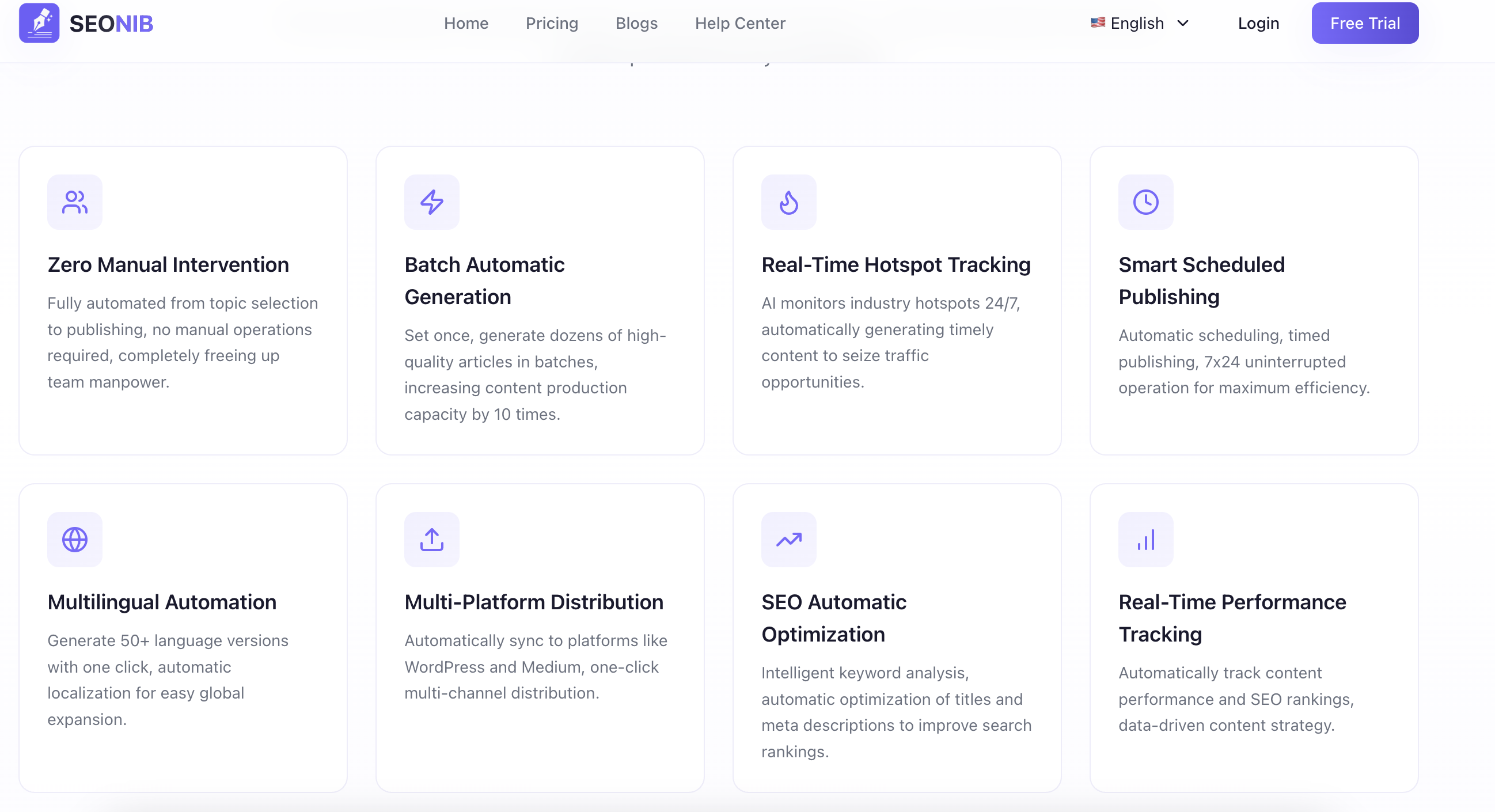
- Information Input and Trend Perception Layer: How do you continuously and efficiently acquire industry dynamics, user feedback, and changes in search engine rules? This doesn’t necessarily require a complex tool; it could be a few high-quality RSS subscriptions, a competitor monitoring dashboard, or a tool like SEONIB that helps you track real-time industry hot topics. Its value lies not in “generation” but in “discovery” and “提示 (prompting),” helping you break out of your information cocoon.
- Content Strategy and Framework Layer: Based on the input information, your team decides what to write, what not to write, from what angle, and for whom. At this stage, AI can assist with keyword clustering and content planning, but the core decisions – such as the brand’s narrative arc and differentiated content positioning – must be made by humans.
- Content Production and Optimization Layer: This is where most AI writing tools play their main role. The key is not how “human-like” it writes, but whether it can efficiently produce drafts aligned with your established strategy and framework, and whether it facilitates subsequent optimization. For example, we need it to be able to flexibly adjust tone, easily insert data points, and adhere to our internal content guidelines. In this layer, we internally use SEONIB to quickly generate SEO-friendly drafts for multilingual blogs, as it integrates smoothly with our multi-region publishing workflow, but we also use other tools for specific types of copy (like ad copy or product descriptions).
- Publishing, Monitoring, and Iteration Layer: After content is published, how does it perform? Which assumptions are validated, and which are debunked? How do these insights feed back into the first layer (information input) and the second layer (strategy)? This is a closed loop. The tool’s role here is to provide clear, reliable data dashboards and to provide timely alerts when anomalies are detected (e.g., a sharp drop in rankings).
When viewed from a “system” perspective, the so-called “best tool” becomes “the solution that best fills a blank in the current system’s constraints.” It may not be one, but a suite of tools.
Specific Scenarios and Judgments
- For startup teams or individual bloggers with limited budget and energy, choosing a tool with high integration, a low learning curve, and that covers the main processes from ideation to publishing might be a more pragmatic choice. Here, “best” equals “most hassle-free and comprehensive.”
- For medium-sized or larger enterprises and content teams, which often already have some infrastructure (like CMS, data analytics platforms). At this point, the “best” tool should be the one that is API-friendly and can be seamlessly embedded into the existing workflow, even if it’s not the top-ranked in any single feature. Forcing a team to adapt to a closed new system incurs extremely high costs.
- For businesses with multilingual, multi-region operations, the “best” tool must elegantly handle language and localization issues, not just translation. It needs to understand the search habits and cultural contexts of different markets. This is one reason why we opt for SEONIB in certain scenarios; it is efficient in generating SEO content frameworks tailored for specific regions.
- For brands that deeply rely on content quality, the tool’s “controllability” and “guidability” are more important than its “degree of automation.” You need to be able to easily input brand guidelines, tone examples, and ensure consistent output that meets requirements.
Persistent Uncertainties
Even by 2026, this field remains full of variables. The biggest uncertainty comes from search engines themselves (especially Google) and their ongoing evolution in their stance on AI-generated content. Their technologies are also advancing, and their criteria for judging content value may become more complex and subtle. This means some SEO techniques or tool features that we consider “effective” today might become obsolete tomorrow.
Therefore, a more robust mindset is: Don’t get too deeply tied to tools; tie yourself to your audience and your value. Tools are transient soldiers, while the problems you solve for your readers and the unique value you provide are the indestructible fortress.
FAQ (Answering Frequently Asked Questions)
Q: So, is there a list of recommended tools for 2026? A: Yes, but my list will be scenario-based: if you need X, consider A, B; if you face problem Y, C might be more suitable. And I update this list quarterly because the market changes too quickly. There’s no “one-size-fits-all” ranking.
Q: If I use the best tool, do I still need professional SEO personnel? A: Quite the opposite. The more powerful the tool, the higher the level of SEO personnel required to wield it. Tools are for execution and scaling; humans are for judgment, strategy, and dealing with uncertainty. Future SEO professionals will be more like architects and commanders of “human-AI collaborative content systems.”
Q: How do I judge if a tool is suitable for me? A: Abandon the one-time purchase mindset. Make good use of tool trials and conduct a real “small project test.” Use the tool to complete a full small cycle of your content production (from topic selection to publishing) and see if it genuinely improves efficiency or quality, and if the team is willing to use it. Real-world feel is more reliable than any review.
Ultimately, asking “What is the best AI SEO tool?” is like asking “What is the best kitchenware?” The answer will be vastly different for a Michelin three-star chef and a home cook making weekend meals. The truly important question is: “What kind of meal am I planning to make? What is my existing kitchen (workflow) like? Where do I need help?”
Once you clarify these points, the choice of tools will naturally become clear.
Share Article