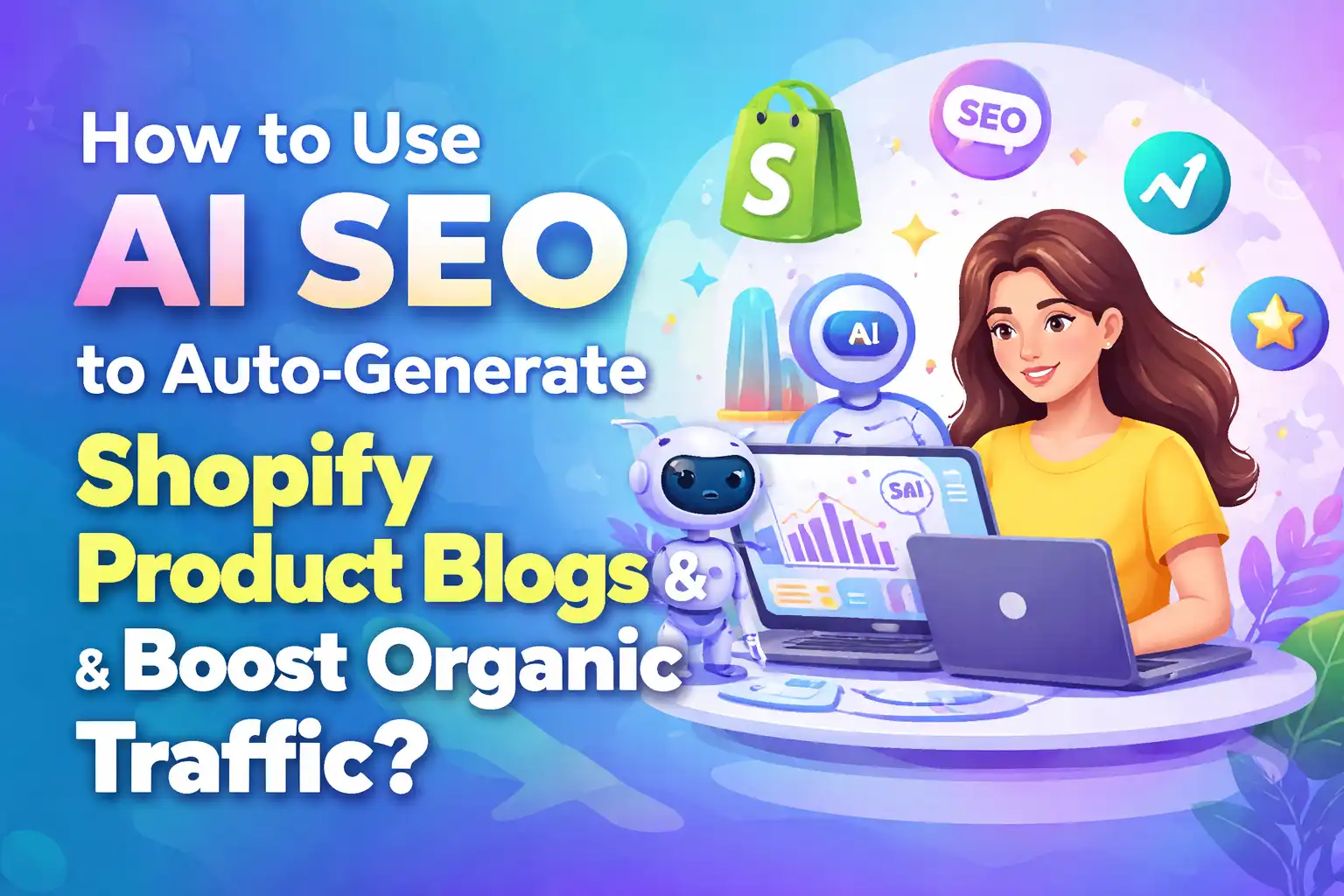
How to Use AI SEO to Automatically Generate Shopify Product Blogs and Boost Organic Traffic?
Many Shopify sellers spend weeks writing over a dozen product description pages, only to open Google Search Console a month or two later and see zero indexed pages. Organic traffic stays at zero for months, with only a few visitors occasionally coming from social channels; the store has almost no search exposure. Writing blogs manually is too slow—getting one out per week is already a win—while search engines need a steady stream of content to recognize the store’s theme. This vicious cycle traps many Shopify stores with over a hundred listed products but no organic traffic.
If you want to grow your store through search traffic, the key isn’t a single well‑written article but the ability to consistently and steadily produce SEO‑focused content related to your products. For most sellers, writing a blog post manually every day is unsustainable. What’s needed is a workflow that can automatically turn product links into SEO blogs and schedule them for regular publishing.
Why Do Shopify Sellers Need AI‑Generated SEO Blogs?
The inefficiency of manual blog writing isn’t just about time; it also hurts the amount of content, which affects search engine trust. Google tends to view a store as “topic authoritative” when it has many pieces of content on a subject, updates frequently, and has a complete structure. A Shopify store with only a few dozen product pages gets very little related information from search engines, making it hard to rank for long‑tail keywords.
The long‑term value of organic traffic isn’t built on one or two viral posts. The real traffic drivers are dozens or even hundreds of articles that each get only a few clicks but together generate thousands of clicks over time. This accumulation requires a solid content volume. AI SEO automation isn’t about “helping you write one article”; it turns content production from a bottleneck into an automated assembly line. The tool supports 40 languages, meaning you can cover long‑tail search needs in any market the store serves.
Even with AI, a single blog may still bring modest traffic, but dozens or hundreds of topics accumulated will raise the overall authority of the store. The biggest benefit isn’t saving writing time; it’s building a deep content foundation that turns a “single‑page product site” into a “vertical store with rich content” in the eyes of search algorithms.
Automated Workflow from Product to Blog
Turning a Shopify product link directly into a blog is the most practical part of this workflow. Users simply paste the product link into SEONIB, and the tool automatically extracts the product name, feature description, attributes, and price, then generates three common content types: buyer guides, product reviews, and comparison articles. Built‑in SEO optimization automatically configures title tags, meta descriptions, and keyword placement—no manual tweaking needed.
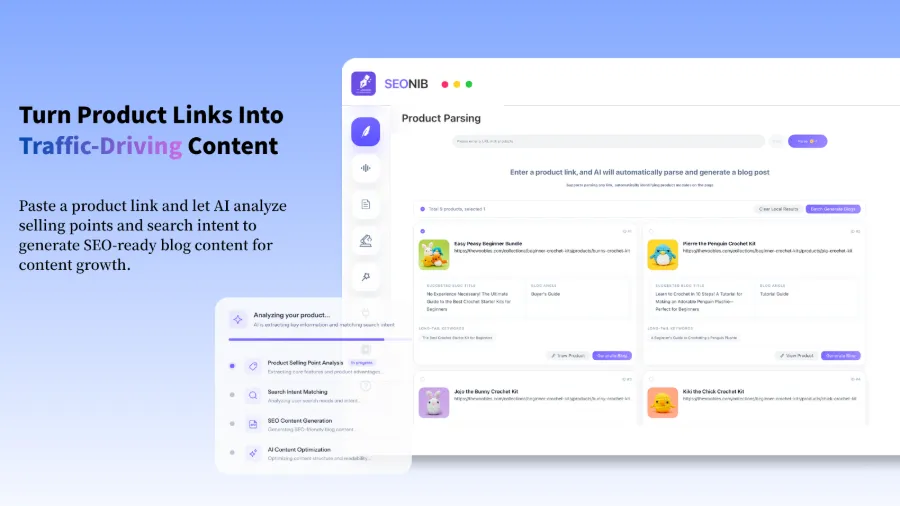
In practice, it takes less than a minute from pasting the link to generating a complete SEO blog. If the store has many products to cover, you can process them in bulk. Besides product links, the tool also supports content generation from keywords or turning social media topics into blog posts—e.g., extracting information from Twitter or YouTube and converting it into an indexable blog. Some users even feed published industry article links as references, letting AI generate a clearer‑structured SEO article based on the topic.
A detail that’s easy to overlook: the blog generated from a product link shouldn’t be copied verbatim for title and description; you need to verify that AI correctly identified the product’s core selling points. Especially for size, material, and use‑case information that must be precise, AI sometimes mis‑summarizes. A quick read‑through after generation takes less than two minutes but prevents post‑publish inconsistencies that confuse users. For a more detailed conversion process, see third‑party tutorials such as Use SEONIB to turn a product page into a blog with one click.
Content Scheduling and Automatic Publishing
Content generation is only half the battle; the real impact comes from consistent publishing. Most sites update their blog once a month, a frequency that doesn’t convince search engines the store is actively producing content. Automated scheduling solves the cadence problem, not the quality issue—publishing 3–5 posts per week is more aligned with search engine preferences for a stable content source than dumping 20 posts in a single month.

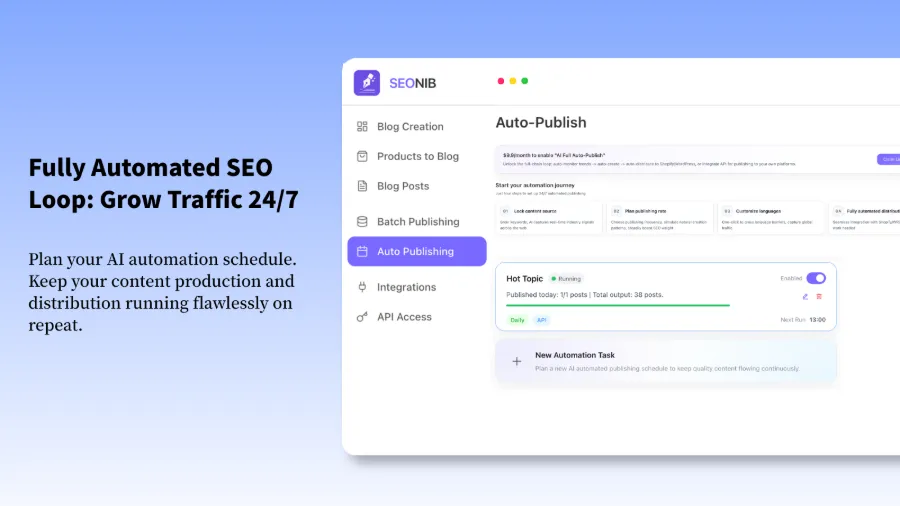
In SEONIB’s scheduling settings, you can set daily or weekly publishing frequencies, such as automatically publishing one post per day. The system completes generation, optimization, and publishing at the designated time. The content calendar shows upcoming posts and allows preview and tweaks before publishing. This means users don’t need to log in daily; the system runs on the preset rhythm.
A practical issue with automatic publishing is that overly dense scheduling can cause multiple posts to be crawled on the same day, leading to internal competition. For example, publishing similar‑topic articles on consecutive days under the same keyword may confuse search engines about which one should rank. It’s advisable to review 1–2 posts per week to confirm they’re indexed correctly and that titles and excerpts aren’t overly repetitive.
Cross‑Platform Sync and AI Search Optimization
If you operate multiple platforms—Shopify, WordPress, Shopline—manual uploads and duplicate content generation waste a lot of time. One‑click generation followed by automatic syncing to all platforms saves sellers from this repetitive work. Shopline users can find the relevant configuration in the Shopline AI SEO App.
However, cross‑platform sync carries a often‑overlooked risk: handling canonical tags. If the same article appears on both Shopify and WordPress without a designated primary version, search engines may treat it as duplicate content, hurting rankings for both. When setting up multi‑platform sync, first set a canonical link on the source platform or check each platform’s SEO settings before publishing.
Another change many sellers miss is that search engines are shifting from “indexing pages” to “indexing entities.” Tools like Perplexity, ChatGPT, and Google AI Overviews now extract structured entity data rather than whole articles when generating answers. This is why the concept of AEO (AI Engine Optimization) is gaining traction. The tool can automatically create Q&A pages and structure product information according to Schema.org, making AI search more likely to cite these pages when answering user queries.
For step‑by‑step configuration of each sync option, consult the SEONIB Help Documentation.

FAQ
Q1: Will AI‑generated product blogs contain duplicate content?
When multiple products share the same function, AI‑generated buyer guides can indeed have similar structures and overlapping content. After each generation, check the differentiated parts of the product features—e.g., swap out different use‑case descriptions or add a unique comparison paragraph.
Q2: How can I ensure AI content matches my brand tone and style?
Most AI SEO tools let you configure brand descriptions and tone preferences. Fill in brand guidelines and industry terminology in the backend before generation; the AI’s tone will then be closer to your usual product copy. Still, it’s recommended to audit 1–2 posts per week because the AI may sometimes produce overly formal or overly casual language.
Q3: What specific benefits does automatically publishing blogs bring to Shopify SEO?
The biggest benefit isn’t the ranking of a single article, but sustained coverage of long‑tail keywords. Experiments show that after three months of continuous automated blog updates, with total article count exceeding 50, the number of indexed product pages also begins to rise because search engines grant higher crawl rates to sites with active content.
Q4: Does the generated content need human review?
Yes, but not every single post. A practical approach is: review every post for the first two weeks to confirm AI correctly identified product features; thereafter, randomly check 2–3 posts per week, focusing on titles, meta descriptions, and correct canonical tag configuration.
Q5: Will using AI to automatically generate blogs get penalized by search engines?
Google currently does not penalize AI‑generated content per se; it penalizes low‑value, low‑quality content. If AI‑generated articles have accurate titles, structured layouts, and consistent product information without fabricated facts, they won’t lose rank. A 2025 case study showed that sites overly reliant on automation, publishing large volumes of homogeneous articles without verification, experienced significant drops in indexing and rankings. The key isn’t whether you use AI, but whether you apply basic factual checks and quality controls to the output.
分享本文