
The Content Factory's Idle Spin: The Scaled SEO Pitfall I Fell Into in 2026
In 2023, my goal was to publish a new blog post every day.
By the end of 2025, every morning I would open the dashboard and stare at the neatly arranged publication timestamps. My first thought wasn’t “the efficiency is amazing” but rather—does anyone actually read these things?
About two months in a row, the situation was like this: using a fairly complex AI orchestration pipeline, I produced 10–12 blog posts per week, each 1,500–3,000 words, with titles containing the target keyword, opening with statistics, and internal links arranged in a T‑shaped distribution. The word count was fine, the ideas were mature, but the traffic curve was terrible. Monthly organic search traffic grew less than 4% during that period—a figure that didn’t even recoup the time invested. The day that truly alarmed me was a Thursday afternoon when I discovered that an article posted forty‑three days ago had zero total impressions in Google Search Console. Yes, zero. Not even a crawl record.
I wrote a post‑mortem at the time, blaming content quality, topic selection, and keyword density. Later I gradually realized that the problem wasn’t a deviation in any single variable, but a flaw in the underlying logic of the workflow.
Generation ≠ Publication, Publication ≠ Ranking, Ranking ≠ Traffic
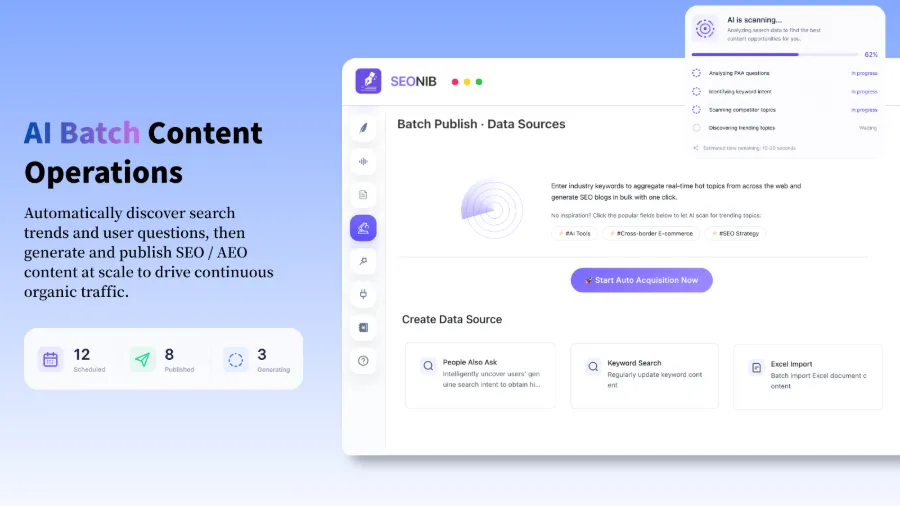
My initial design wasn’t particularly aggressive; it was even reasonable: use AI to handle the entire pipeline from topic selection to outline, draft, illustration, formatting, and multi‑platform posting. Run it on a schedule each night, and the next morning the inbox would contain a new article and a publishing confirmation email. Sounds industrial and sleek, right?
After a month, I observed an awkward statistic—the average lifespan of those thirty‑plus articles (the number of days they remained indexed after being crawled) was about 11 days. What does that mean? Some pages were indexed early, but because the content was too thin or not substantially different from existing results, they were de‑indexed. Other pages were never indexed at all—not ignored, but never entered the crawl queue.
My debugging approach at the time was: manually click “Request Indexing” in Search Console, wait two days, no response. Tried different crawl frequency settings; the server logs showed Googlebot lingering on the homepage but not crawling deep into the paths of those hundreds of articles. Then I ran a full site scan with Screaming Frog and found that the content depth wasn’t shallow, yet the average page authority of these articles was heavily diluted by the homepage and internal link count.
This is essentially a classic indexing budget problem, but if you step back, the real contradiction is that AI content generation outpaces the crawl resources search engines are willing to allocate to my site. I built an output machine, but its output requires capacity to process, and that capacity didn’t grow in sync.
Looking back at the most complex experiment I ran while writing articles, I set a specific entity coverage standard to make the content appear “substantial”—each article had to mention 12–15 competitors, tool names, protocol names, and specification names. This indeed improved indexing performance in Search Console, but that wasn’t the core issue. The core insight, which took me a long time to realize, is the Illusion of Efficiency: Scaled SEO Content Creation in 2026.
Why “The More You Publish, The Faster It Dies” Is True, Yet Not That Simple
Here’s a concrete failure case.
One month I targeted the “AI SEO” category (yes, by 2025 that niche was already saturated) and created a series of 23 content topics, each built around a long‑tail keyword. The long‑tail logic was: start with a head keyword, use AI to generate 300 long‑tail variations, run them through Semrush, then select phrases with difficulty 15–25 and monthly search volume 200–800, assigning each phrase its own article.
It looked fine.
Three months later I reran the analysis. The best‑ranked of the 23 articles appeared on the last position of page 9 on Baidu. None entered the top 50 on Google. It wasn’t that the rankings were pushed down; the pages never entered the ranking system for those keywords. I tried a specific path: searching with one article’s title yielded no results in the list. Even searching a single sentence from the full text returned a competitor’s site explanation, not my article.
Later I ran Ahrefs core ranking analysis and found that those pages had zero referring domains, zero natural backlinks, and the subpages beyond the domain’s root authority received virtually no external link juice. This wasn’t a content quality issue; it was 23 seeds planted on zero‑authority soil—genes similar, soil identical, no fertilizer, no water—so not even weeds could grow.
During that period I read an article stating that 84 % of SEO professionals think AI has already impacted their strategies. That’s a number prone to illusion: engagement doesn’t equal results. You can use AI to assist thinking at the strategic level, but if you let AI run the entire chain unsupervised, what you get looks like “output” but is more like “late‑night idle spinning”—noisy, but search engines will eventually stop playing along.
You Might Think You’re Running, but the Wheels Could Be Airborne
I’m not trying to convince anyone not to use AI for large‑scale content. I just want to distinguish one thing: scaling does not equal end‑to‑end automation. From topic selection to final draft, each step involves an independent judgment. AI excels at parts of it—trend analysis, word‑count frameworks, metadata generation—but there are things it can’t do, or when it does, you immediately need manual fixing.
Take Schema markup as an example. I added an experimental Article schema to those 23 articles, using AI‑generated JSON‑LD snippets that looked perfectly compliant and passed Google’s Rich Results Test. Yet in Search Console, none of those pages triggered any enhanced results. When I manually inspected five of them, each had an empty author field, and the publisher field was mechanically generated without a logo object. In theory, these details shouldn’t be missed by AI, but they were, and there was no feedback indicating the omission.
When such issues accumulate, the effect isn’t a cliff drop but a frustrating, piecemeal degradation: each tiny deviation alone isn’t fatal, but publishing 20 at once multiplies them, eroding even the content’s credibility.
I kept a habit from that period: under each H2 heading, I write a sentence to myself indicating which common view the paragraph intends to refute, placed at the top of the draft. Not for decoration, but to avoid the “praise‑then‑criticize” tone of industry analysis. For example, this paragraph: returning to the idle spin topic, many articles discussing AI content scaling talk about “increasing efficiency” and “reducing manual work.” But they rarely mention that once content generation is automated, the truly time‑consuming task becomes “deciding which content is worth generating.” That’s actually more cognitively taxing than writing the article itself.
What Happened to That Thing Later
The 23 articles weren’t removed. I spent a few weeks categorizing them, originally thinking that manually revising the most readable pieces, adding real external data source links, and updating outdated sections might revive some pages. However, because there were already so many unindexed pieces, changing indexing budget allocation by editing old pages was inefficient. Ultimately, the growth came not from old pages but from the “explanatory” content I later rewrote—each answering a real user query, without forcing a long‑tail structure or obsessing over word count and entity coverage.
Another adjustment was to abandon the habit of “one article, multiple platforms.” I used to post the same article to WordPress and Medium, aiming to cover different channels. Later I found that the weight accounts of the two platforms cannibalized each other, making it hard for either to match the performance of a dedicated posting. In hindsight, that multi‑platform sync strategy wasn’t worth maintaining—it wasn’t simply double output, but two sets of copyright issues waiting to be resolved.
Did I continue using that AI content pipeline? Yes, but with two changes: first, a human must read the entire article before publishing, even if just a skim. Second, every sixty days I conduct a data review—not focusing on traffic, but on the proportion of published yet unindexed pages. If that figure exceeds 25 %, new content generation is paused until old pages are cleaned up.
This threshold is my own creation; there’s no formula, but at least it’s a concrete baseline.
Frequently Asked Questions
Does AI‑generated SEO content actually work?
It works, but under conditions. The core rule is that AI text cannot replace your understanding of user intent. The best results I’ve seen were not articles completed solely by AI, but human‑edited versions where the AI‑generated framework underwent two rounds of deep revision. There’s no universal success‑rate statistic, but from three tests each with over 40 articles, AI‑generated content left unmodified entered Google’s top 30 within six months at roughly an 8 % rate.
How many pieces of content per day is healthy?
It depends on your domain authority’s crawl budget. For a small‑to‑medium site, publishing 1–2 articles per day is safe. If at any point the number of indexed pages drops more than 20 % relative to published pages, you need to pause. Accumulating over 100 pieces of content without being crawled leads to a period of indexing stagnation. I learned this after falling into the 23 zero‑index trap.
Must large‑scale SEO content rely on paid tools?
Not necessarily, but you need a few things to work together: content production speed, accumulation of search‑engine recognition of your site, and persistent data tracking (at least Search Console plus a third‑party ranking tool). Without this infrastructure, you can’t measure output. The workflow I eventually returned to integrates these components with a standardized content dashboard, ensuring each piece is continuously monitored after publishing until it either truly “lives” in the search system or is abandoned.
分享本文