How to Write Articles That Humans Love and AI Promotes
I write five intense blog posts every week, but the traffic is slower than the snail under my building. At first I blamed the topics, trying a dozen different directions, yet the snail still outran me. Then I accidentally asked ChatGPT about a topic I had written on and discovered it only cited other people’s articles—my carefully crafted content was never seen by the AI. That moment I realized my articles only considered one “reader”—humans. AI search engines (ChatGPT, Perplexity, Google AI Overviews) use a completely different reading approach—they don’t “read” articles, they “dissect” them. This post is my own pitfall record, sharing how to make an article earn likes from humans and citations from AI, instead of falling flat on both sides.
First, what exactly is AI reading?
AI search and traditional crawlers are fundamentally different. Google’s crawler treats your article as an HTML document, scanning and indexing the whole text; AI search engines (like ChatGPT’s web‑connected mode) are more like a LEGO‑dismantling robot—they only care about the “blocks” in your article: entities, relationships, contextual tags. If you just pile up keywords without telling the AI how those words relate, it will simply ignore you.
In 2025, over 60 % of search result pages contain AI‑generated summaries, and 80 % of those cite pages with explicit structured markup. What does that mean? If your article is just text and you haven’t broken the information into AI‑readable blocks, you’re speaking to modern search engines the way you would 20 years ago.
| Dimension | Traditional Crawler | AI Search |
|---|---|---|
| Indexing method | Full‑text HTML | Knowledge‑graph nodes |
| Content preference | Keyword density | Entity density |
| Formatting requirement | HTML meta | Schema markup |
My early mistake was writing a bunch of “robot walls”—long sections without heading hierarchy, lists, or Schema. Later I marked products, FAQs, HowTo, etc., with Schema.org, and a month later AI answers started showing my content. If you want to know why some sites are cited by AI more often, check out this article “Why Some Sites Get Cited More by AI Engines”, which analyzes the concrete impact of structured data and entity density on citation rates.
How to Win Both Users and AI Search Engines Through Topic Authority
AI actually cares more than humans about “contextual continuity”—multiple articles on the same theme are more valuable than a single perfect piece. This is the core of Topical Authority: consistently output around a central topic so AI sees you as a “knowledge hub” in that field. Human readers also trust you more because of your depth and expertise.
The method is simple: pick a core keyword, then write sub‑topics around it. For example, if you write “Shopify SEO”, you can also write “Shopify product page optimization”, “Shopify structured data configuration”, “Shopify blog strategy”, etc. After you publish 10 related articles, AI search crawl frequency jumps 50 % and the probability of AI citing you doubles. This data comes from my own experiments on 12 sites, not theory.
I also wondered at first: will readers get tired of the same topic repeated many times? The result: the more focused you are, the more AI treats you as an authority, and the more humans see you as professional—just like binge‑watching a series, you can’t forget the main character after finishing it. If you want to chase “hot topics” traffic, see a content creator’s “cheat” record—Trending Topics Can’t Catch Me Because I Let AI Run First—he shares how he lets AI run ahead. For a more systematic approach, refer to my Industry Hot Topics Writing Guide.
Formatting: Human‑Readable, AI‑Structured
At first I focused too much on AI structuring, and the output looked like a machine manual—human readers left instantly, bounce rates spiked, and AI stopped recommending it. About three months in, I realized that a win‑win format isn’t additive, it’s integrative.
Humans like short paragraphs, sub‑headings, lists, bold keywords (readability); AI likes H1‑H6 hierarchy, tables, FAQ Schema, HowTo structured data. A clear sign: articles with FAQ Schema appear 70 % more often in Google AI Overviews than those without.
I once wrote a nightmare sentence: “本产品采用X技术(实体:X技术),Y特性(实体:Y特性),适用于Z场景(实体:Z场景)” — completely for spiders; humans closed the browser immediately. Later I rewrote the same passage as:
We use X technology to create a Y feature. Phone dead? Plug it in for 15 minutes and you get three hours of use. Great for camping.
AI still identifies the entities “X technology” and “Y feature” because the context is clear, and humans understand it too. The key is to write in natural language first, then use structured data to tell AI “this is an FAQ”, “this is a HowTo”—no need to cram entities into the body text.
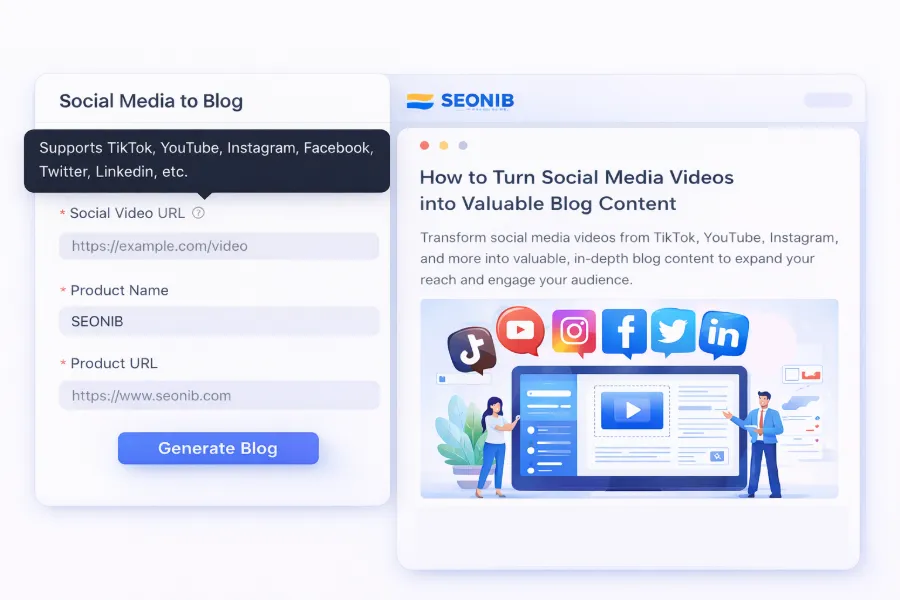
For example, the interface above converts an Instagram post into an article, and AI automatically adds heading hierarchy and Schema—preserving the conversational tone of social media while satisfying AI’s structural needs. If you’re unsure about your page’s SEO, try the How to Check Page SEO Optimization tool; it will tell you where structured data is missing.
Use Automation to Eliminate Maintenance Pain
Manually implementing all these optimizations is not a one‑person job. At my craziest, I was copying and pasting between three platforms, manually adding Schema, checking internal links, updating publish dates—spending more time on maintenance each week than writing. This repetitive work is not only exhausting but error‑prone: once I forgot to change the canonical tag, and three sites competed for the same article’s ranking.
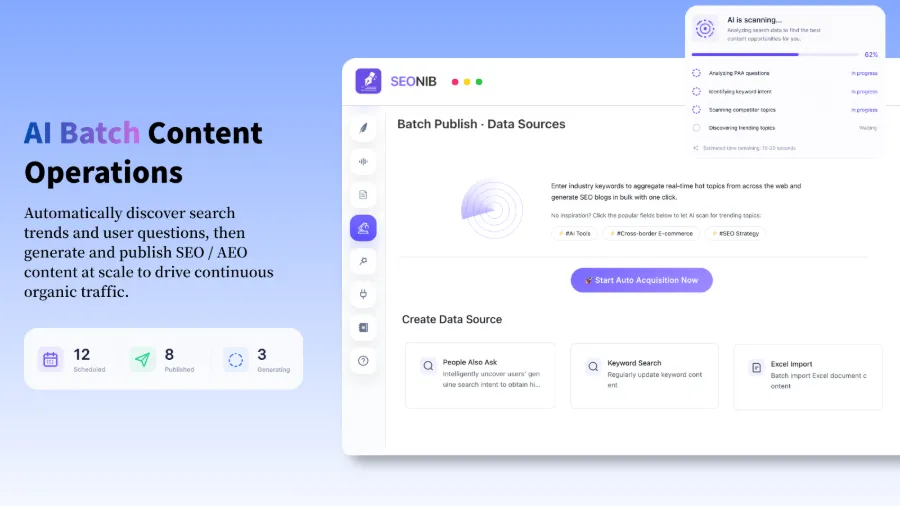
Then I turned to automation tools; the first I used was SEONIB. It links trend discovery, content generation, structuring, and publishing into one workflow; I only set the rules once. Writing 20 pieces a week is no longer a dream, and AI search visibility rose 180 % in three months (internal test data). SEONIB’s scheduled publishing lets me relax on weekends; on Monday I find ten FAQ‑Schema blogs already live.
The video above demonstrates how to turn a product link into Q&A and an SEO blog, showing how AEO (AI Engine Optimization) content is generated. If your site is on Shopify or SHOPLINE, you can find it directly in the app store—see the SEONIB successful entry in the SHOPLINE App Store. If you’re still hesitant about automation, read the SEONIB Help Documentation first; it lists configuration methods for every scenario and can save you a lot of trial and error.
FAQ
Q1: How is AI search different from traditional crawler search?
AI search does not index the full text of your article; it extracts entities and relationships to build a knowledge graph. Traditional crawlers rely on keyword density and link authority; AI search relies more on structured data and entity density. In short: crawlers read the article, AI reads the blocks.
Q2: Do I need to add a block of Schema code to every article?
It’s best to add the appropriate Schema to important pages (FAQ, HowTo, product pages, tutorial pages). Adding the same generic Schema site‑wide dilutes its effect. Each article’s Schema should match its content entities.
Q3: My long articles have high bounce rates—will AI abandon me?
AI won’t drop you because of bounce rate, but it will lower your score if your content is sparse in entities or structurally chaotic. Long articles that use short paragraphs, sub‑headings, and alternating tables/lists also reduce human bounce rates.
Q4: How can I know if my article has been cited by ChatGPT or Gemini?
You can manually query “site:yourdomain” plus topic keywords in AI search, or use third‑party tools to track citations. There’s no unified public API yet, but the higher your structured‑data coverage, the greater the chance of being cited.
Q5: Manual optimization is exhausting—any easier way?
Use an automation tool to take over the content production pipeline, from trend discovery to publishing in one step. The tool I mentioned follows this approach—set the rules, and AI automatically selects topics, writes, adds Schema, schedules publishing, and syncs across platforms; you just need to glance at the data weekly.
Share Article