SEO Isn’t Dead, It Just Changed Its Death Method — A Mid‑Year 2026 Summary from a Practitioner

I know you’ve seen it too. Open any SEO group and the daily vibe flips between “AI will kill search” and “content marketing is dead.” I’m so anxious I’ve gotten a neck‑bone issue. To be honest, I’ve been anxious for a while myself—last year I finished reading that AI overview report, even seriously flipped through an old programming tutorial, wondering whether I should switch careers. Then I thought: writing code is even more competitive than writing SEO articles, so I stuck with the grind.
Here’s the story. In May 2026 Google officially published an optimization guide for generative‑AI search. The official docs are clear: SEO is still important; AI overviews and AI modes aren’t brand‑new systems—they still rely on core search ranking and quality frameworks. Guess what? After reading the guide I felt less panicked. Not because there’s a secret hack to copy, but because it confirmed one thing—after ten years of work, the foundation is still there. It’s like knowing your old house’s structure is sound; an earthquake might crack the plaster, but it won’t collapse.
But here’s the problem. If the foundation hasn’t changed, why have we been so anxious the past six months? Have you noticed that the real headache isn’t a new feature itself, but not knowing who to trust? Some tutorial sites say you need structured data, a Google meetup says it’s unnecessary, forums are all testing llms.txt files. Everyone sounds reasonable, you try a few things, and the SERP doesn’t move at all.
What to do? Lying flat isn’t an option. In this post I’ll lay out the experience, the pitfalls we’ve tripped over, and the solutions we tried and abandoned. These are hard‑won insights, not something you can get by tossing a prompt into an AI tool.
Google AI Overview: It Didn’t Kill Search, It Just Renovated the Entrance
I remember when SGE testing first launched in 2023, I wrote a test article that naturally embedded the long‑tail keyword “best email marketing tools.” That article used to get about 150 clicks per day; after SGE rolled out, the first two weeks dropped to 50. I felt my confidence crumble and thought, “This industry is over.” Then I did what every competent SEO does—took a screenshot of the data, posted it in the team chat, and complained for an hour. No action, just venting.
Three weeks later the keyword started climbing again, eventually stabilizing around 110. Not the original 150, but not the 50 either. I still don’t fully understand what caused the rebound—maybe Google adjusted the overview trigger, maybe other sites dropped harder and I got a lift, maybe pure luck. That’s the reality of SEO: many changes have opaque causes; you can only observe, record, and keep working.
Data from 2025 shows that only about 8 % of people click through from an AI overview to the original site. As a content creator that number looks grim. But if you stretch the timeline, you’ll see a pattern. In the mobile‑search era, people said “nobody clicks websites anymore”; in the featured‑snippet era, they said “traffic is dying.” The result? Total traffic volume kept growing each time. The pie gets bigger, your slice may be smaller, but your absolute numbers don’t necessarily drop. In 2026, 15 % of search results will include an AI overview, and that share will keep rising—this isn’t a reason to stop optimizing; it’s a condition for getting started.
My current approach is simple and blunt: craft a summary. For every core long‑form article, make sure the first three paragraphs contain a ≤ 60‑character paragraph that directly answers the search intent. That paragraph isn’t for users—it’s for the AI overview to scrape. No matter how fancy you write, the AI will extract the most concise, fluent, and “reasonable” sentence. Internally we call this “writing for your machine god.” It sounds superstitious, but if you follow that logic, your article’s citation probability actually goes up.
Google’s own guide also says you don’t need a special version for AI tools, you don’t need to chunk content, nor do you need special Markdown or schema. A regular long‑form page with multiple topics can be parsed by the AI system to pull relevant sections. That’s a relief—imagine maintaining five versions of the same article on a site; maintenance would explode.
LLMs Steal Traffic? Admit It, You’re Already Using ChatGPT Instead of Search
There’s a thing people don’t say out loud but all know: you’re already using AI search instead of Google. For example, today I wanted to look up “Supabase Row Level Security best practices.” I didn’t open Google and click a doc; I just asked GPT or Claude. It’s faster, ad‑free, supports multi‑turn dialogue, and doesn’t ramble on irrelevant stuff. That’s how I work. So when Google’s search market share fell below 90 % in October 2024, I wasn’t surprised atAll.
this raises a paradox. Why do large models still end up citing your site when they call search results in the background? Because, as smart as they look, they have no “first‑hand experience.” They can’t open your backend, check your server logs, or compare cache hit rates across three tools. All they can do is digest existing text. If your article’s technical details are solid, the steps are concrete, and the timeline and configuration descriptions are precise, the model will naturally treat your content as a high‑authority source when handling related queries.
I ran a test. One month I dramatically expanded the “troubleshooting” section of a technical article, adding a strange 500 error I encountered and a two‑day investigation process. Then I republished the article. A month later, out of curiosity, I used Semrush’s AI Visibility feature and saw that three different platforms’ LLMs had each cited the article once. I only did this once, didn’t track long‑term data, and didn’t develop a repeatable methodology—just a case study.
Back to strategy. If your content can’t even break into the top 10 of ordinary search, don’t expect AI to “grant” you a citation. Google’s guide makes it clear: AI products use the same core ranking and spam‑filtering systems. In other words, spam stays out of AI’s view.
That’s why many people asked me in 2025, “Should I rewrite my content specifically for AI?” My answer has always been the same: no. Just raise the quality level a notch; if the tech is sound, AI will naturally pick it up. If it doesn’t, the keyword wasn’t yours to begin with.
UGC Is the New Gold Mine, but I Really Don’t Want to Run a Community
The trend was unmistakable by 2025. Reddit traffic grew over 600 % in the past two years, Quora over 300 %. The search interest term “UGC” jumped 575 % in five years. It’s not hype—Google is actively boosting user‑generated content because AI‑generated “AI articles” are flooding the web, and Google needs genuine user experience, real feedback, emotional criticism, and recommendations.
The problem? I really don’t want to run a community. I’m too lazy to even glance at my company’s Discord once a week. How can an SEO professional also be an active Reddit moderator? Not realistic. So I found a compromise: I don’t manage the community myself, but I copy community content into my articles.
What’s the logic? Go to a relevant SaaS discussion board on Reddit, find three to five natural discussion threads about your industry, see what users complain about, how they compare competitors, how they evaluate missing features. Then directly quote those “real user voices” in your blog post. Don’t polish them too much—keep a bit of colloquial emotion, spelling errors, grammatical quirks, and those “this feature is just hilarious” remarks. That gives your article a human touch that AI can’t generate because it lacks authentic grievances.
Of course, there’s a trade‑off. Some readers will think your article is “too wordy” or “loose” compared to the crisp, structured output of AI‑generated pieces. That’s true. But my audience is SaaS professionals, not casual searchers. They hate “well‑structured but shallow” content. The more human‑like you write, the more they trust you.
Side note: If manually curating community content feels too slow, you can use fully automated tools to run the workflow. My own method is to write a core logic piece, then set up an automatic publishing schedule. No need to log into the backend daily, no need to repeatedly add images or edit meta descriptions. The machine handles the “hands,” and you free up the “brain” for topic selection, tone, and storytelling. This isn’t a perfect solution, but it’s far better than manual copy‑pasting.
FAQ
Will AI overviews permanently reduce my site’s traffic?
They may affect some short‑tail queries, like pure “definition” or knowledge‑type searches. In practice, long‑tail keywords, transactional intent queries, comparison content, and experience‑driven guides are much harder for AI overviews to replace. Overall search volume is growing, so total clicks don’t necessarily fall. The informational sites I’ve tracked over the long term have seen traffic fluctuations between –15 % and +20 %, and none have been wiped out by AI.
Do I need a separate article version for AI search?
Not at this point. Google’s official guide clearly states its AI system can understand multi‑topic pages and automatically extract relevant sections. I tried creating a stripped‑down version, only to have Google treat it as duplicate content and ignore it. A better strategy is to make a single page deeper and more specific. It’s better to write one 2,500‑word article covering five related questions than five 500‑word pieces each covering one.
Must I create my own community posts for UGC to be useful?
No. Quoting existing community content in your blog already works. Or, when you build a product page, include a “real user feedback” snippet (ideally with a screenshot or original quote). That’s easier for the search system to treat as a “real signal” than hiring someone to write a soft‑sell article.
Can content automation fully replace human writers?
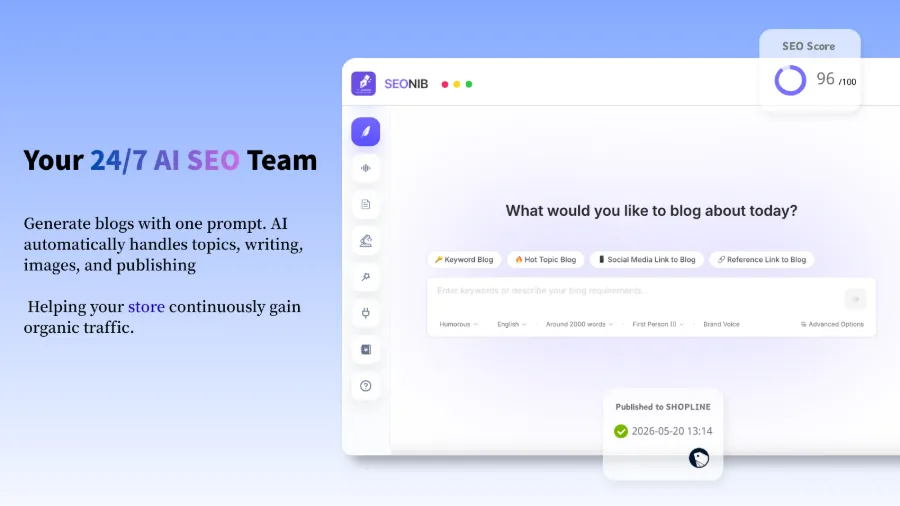
Not completely. Automation can handle the most tedious parts: scheduled publishing, formatting standardization, multi‑platform syncing, keyword insertion. But topic selection, specific technical steps, and deep personal experience still require a human. The optimal combo is human direction + machine execution. For example, I use SEONIB for daily article generation and publishing, saving about two hours of manual work each day, but I still edit and final‑review everything myself. It’s not revolutionary, just more time for sleep.
分享本文