2026 Shopify Keyword Mapping Guide: From Chaos to Order – Practical Experience
In the first quarter of 2026, the team took over a Shopify store with an annual GMV of about $2.3 M. The product line spanned four categories, but organic search traffic had been falling steadily over the past six months, dropping from an average of 42,000 visits per month to under 31,000. A preliminary audit quickly revealed the problem: the store’s keyword strategy was virtually nonexistent. More precisely, they had a keyword list but had never performed systematic mapping—no logic about which words should land on product pages, which should go to collection pages, and which should be covered by blog content. As a result, the same set of core keywords appeared on six or seven pages simultaneously, and Google could not determine which page was authoritative.
The real confirmation of the keyword mapping came after analyzing Search Console data. The team found that the search term “organic coffee beans” was being ranked by four pages within the store: the homepage, a category collection page, a specific product page, and a blog post written three years ago. None of the four pages achieved a satisfactory ranking; the best position was #8. This was not an isolated case but a widespread phenomenon. The core issue was that the store’s content strategy and SEO strategy were misaligned—content creators wrote topics they found interesting, while product teams optimized pages they thought were important, each operating independently.
Mapping roughly 40–60 keywords can fundamentally resolve this chaos. The core of keyword mapping is a systematic allocation action: assign keywords with the same search intent to the most appropriate page level in Shopify, eliminate internal competition, and give each page a clear thematic focus.
Although this store’s case occurred in 2026, the mapping methodology is still current—only the tools and efficiency methods have changed.
Diagnosis Phase: Why Keywords “Fight”
Before getting hands‑on, you need to understand where the problem originates. Shopify’s page structure naturally creates a risk of keyword cannibalization because the platform automatically creates multiple entry points: product pages, collection pages, tag pages, blog pages, and the homepage. If a store’s theme template automatically fills product titles into H1 tags while the collection page description contains the same keyword phrase, conflict is almost inevitable.
When diagnosing this store, we used three data sources: Google Search Console query reports, Semrush rank tracking, and a manually compiled URL‑level keyword mapping table.
Step 1: Export queries from Search Console that rank between positions 3 and 20 and have a click‑through rate below 2 %. These queries are usually over‑distributed across different pages of the same store. Then, for each query, record all URLs participating in the ranking. The result was surprising: on average, each query corresponded to 3.2 different pages.
Step 2: Tag each page with its intent type. For the query “organic coffee beans,” user intent is clear: they want to buy coffee beans, or at least compare options. This intent should be handled by a category collection page or a product page. In reality, the homepage and a blog post were also competing— the homepage tried to use the keyword for brand storytelling, while the blog post was a factual piece about coffee bean varieties. Neither page satisfied the purchase intent, so Google gave none a good ranking.
The diagnostic process took about two weeks—pure manual work with no shortcuts.
Mapping Matrix: Assigning an “Address” to Each Keyword
Keyword mapping is not a guess‑work exercise; it requires logical, reproducible rules. We designed the following rules for this store:
- High‑purchase intent, core brand terms → Assign to product pages or category collection pages
- Mid‑to‑long tail, comparison intent, question‑oriented → Assign to blog content
- Broad category terms, seasonal traffic → Assign to collection pages, with structured data
- Brand + functional terms → Assign to product pages and ensure the page has the appropriate FAQ schema
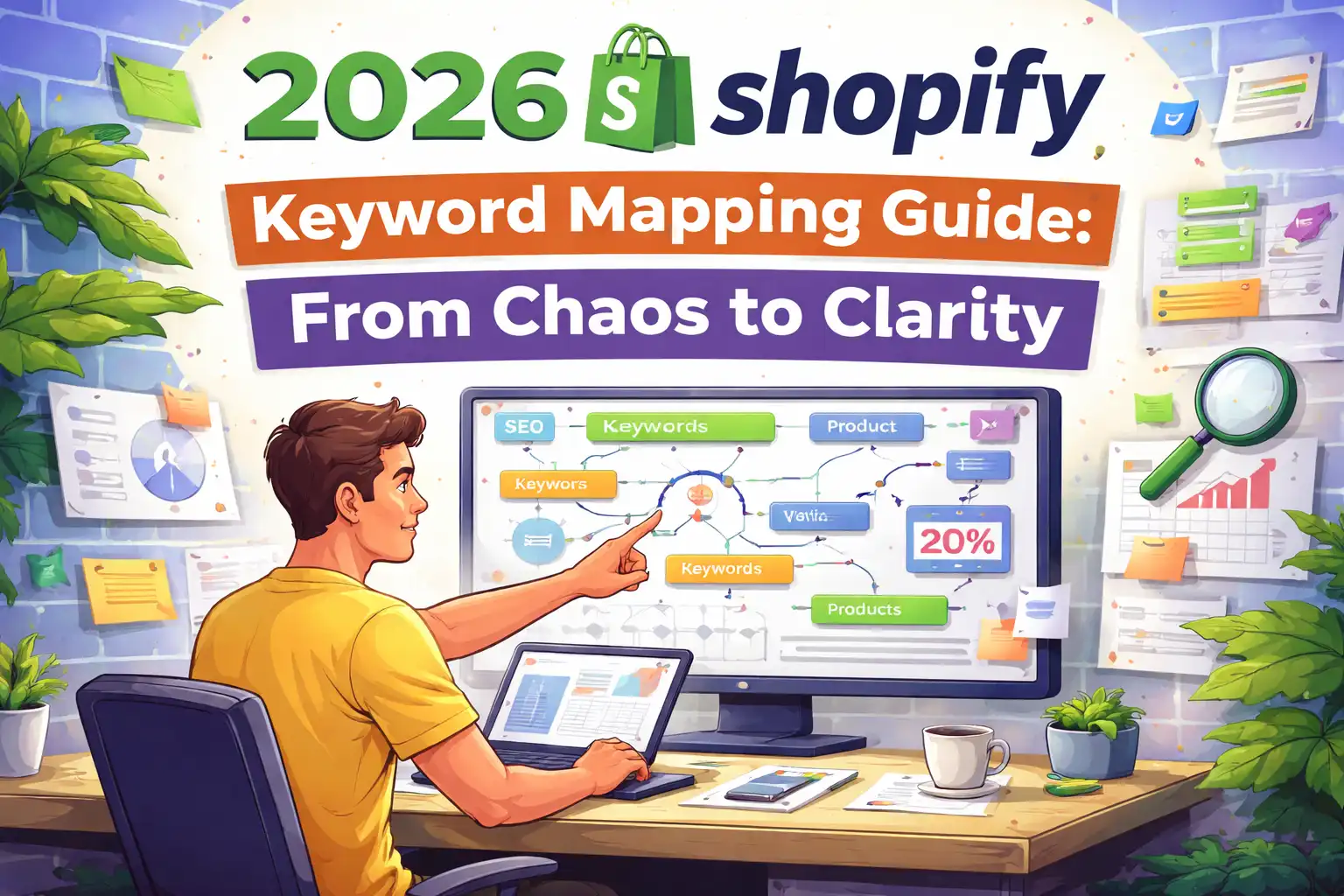
After finalizing the rules, the team built a mapping matrix in a spreadsheet. It contains seven columns: keyword, monthly search volume, search intent, target page type, assigned URL, current rank, and priority tag. The process covered roughly 350 core keywords and 2,100 extended long‑tail keywords.
A few unexpected situations arose during mapping. Some keywords had no matching page in the current store—these were content gaps. For example, the query “best coffee grinder for espresso” had no dedicated comparison page, even though the store sold coffee grinders. The matrix exposed this gap, and the team subsequently produced a comparison article.
Another group of keywords had very low search volume (monthly < 50) but exceptionally high conversion rates. These were difficult to cover at scale manually because the cost of assigning each one individually was too high. This was the first time the project hit an efficiency bottleneck.
Dual Alignment of Content and Structure
After mapping, the next step was to align the actual page content with the assigned keywords.
For product pages, the team adjusted H1 tags, product descriptions, and meta descriptions to naturally incorporate the core keywords. This was not keyword stuffing; it involved tweaking tone and emphasis. For example, a product title originally written as “Premium Arabica Coffee Beans – Fresh Roasted” was changed to “Buy Organic Arabica Coffee Beans Online – Fresh Roasted to Order,” covering the high‑value queries “buy” and “organic” while remaining readable.
For collection pages, the team abandoned generic descriptive text and instead used structured category explanations, embedding long‑tail variations into sub‑category navigation. These changes were completed within two weeks, but the ranking improvement for collection pages took nearly six weeks to materialize because Google needed to reassess thematic consistency.
Blog content adjustments were the most time‑consuming. The original blog strategy chased high‑frequency updates, but content quality was uneven. The mapping matrix revealed that many blog posts were competing for queries unrelated to the store’s products. The team performed a major cleanup, setting 27 low‑quality articles to 302 redirects to more relevant collection or product pages, thereby freeing the store’s overall topical signal. The remaining blog posts were enhanced according to the mapping results, adding the missing long‑tail variants.
The biggest takeaway from this stage was that keyword mapping is not just an allocation task; it forces the content strategy to return to user intent. Previously, the content team focused on “what to write today.” After mapping, they focused on “what the user behind this query is actually looking for.”
After mapping, the team still found many long‑tail keywords that could not be covered by existing product or collection pages—these are typical “informational queries.” Users aren’t searching for a product but for an answer, e.g., “how to store coffee beans to keep freshness” or “difference between Arabica and Robusta.” These queries never directly convert to a purchase but are important entry points for new customers.
For these queries, manual content production was too slow. The team considered hiring freelance writers, but cost and quality control were problematic. They needed a tool that could automatically generate structured content based on keywords and push it directly to the Shopify blog.
SEONIB served as the content pipeline in this scenario. The team exported the long‑tail keywords marked as “informational” in the mapping matrix to CSV and imported them into SEONIB as content production commands. Its value lies not in writing quality—human review remained necessary—but in scalability. Within a week, the system automatically generated 42 blog posts targeting specific long‑tail keywords, each following a predefined SEO template with H2/H3 hierarchy, FAQ schema, and internal links to the relevant collection pages.
The team struggled for a long time at this stage. Initially, they tried using ChatGPT + manual publishing, but after three months only 12 articles were produced, with inconsistent formatting, missing images, and frequent SEO field errors. With SEONIB, the problem shifted from “how to produce content” to “how to review and select content,” moving the efficiency bottleneck from content creation to quality control—a more manageable phase.
Validation and Iteration: Rankings Started Changing After Six Weeks
Mapping is not a one‑off action; it requires validation and ongoing iteration.
The first six weeks of data were not promising. Core keyword rankings barely moved, and some long‑tail terms even dipped briefly. This is common in large‑scale keyword restructurings—Google needs time to reassess page relevance and authority. The team stayed patient and made no rollbacks.
By week 7, changes began to appear. “organic coffee beans” rose from #8 to #4, and its click‑through rate increased from 1.8 % to 3.5 %. More notably, queries that had been scattered across multiple pages started consolidating onto a single page, allowing those pages to accumulate domain authority.
Three months later, monthly organic traffic recovered to 37,000 visits. Although not back to peak levels, the trend had reversed. More importantly, conversion rate rose from 1.2 % to 1.9 % because traffic now came from intent‑aligned pages, making users more likely to purchase after landing.
The iteration process involved monthly reviews of the mapping matrix, tagging ranking changes and new keywords, and adjusting allocation rules based on search result shifts. It sounds tedious, but marginal gains diminish with each iteration—112 mappings were adjusted in the first month, only 17 in the third.
Keyword mapping also provides a clear boundary for content automation. When running SEONIB for content production, the core decision rule was “Is this keyword marked as informational in the mapping matrix?” If yes, generate automatically; if not, leave it to the human team. Without this boundary, automation tools easily drifted, producing content unrelated to the store’s theme.
FAQ
What’s the difference between keyword mapping and keyword research?
Keyword research is the process of discovering and selecting search terms—answering “what words are worth targeting.” Keyword mapping assigns those terms to specific pages—answering “which page should handle each term.” Research comes first; mapping follows; both are essential.
Do I need to update existing page content after mapping?
Usually yes. Mapping decides which page should own which term, but if the page’s existing content doesn’t match the target keyword, Google won’t automatically recognize its relevance. Content alignment is the most frequently skipped yet highest‑return step.
Do small stores need keyword mapping?
If a store has more than 20 product pages, internal keyword competition is possible. The matrix can be scaled down—focus on the core 30 keywords and their variants—but the logical layer should not be omitted.
Is it normal for rankings to drop after mapping?
Short‑term drops are common, especially after many 302 redirects or content overhauls. Google needs time to re‑evaluate thematic consistency. Usually wait 4–8 weeks before judging and avoid rolling back within the first two weeks.
What role can automation tools play in mapping?
Automation tools mainly solve the scalability problem of content production—extracting “informational” keywords from the mapping matrix and generating structured blog content. The logical judgment of which keyword goes to which page still requires human decision‑making. Tools execute; they don’t set strategy.
Share Article