After AI Overview, How Do Cross‑Border Independent Sites Guard Their Overseas Search Positions?

Since the second half of last year, the Google consoles of several of my cross‑border independent‑site projects have shown a puzzling phenomenon: core‑keyword rankings have barely moved—some even rose—but organic clicks and inquiries have been shrinking month after month. At first I thought it was seasonal fluctuation, but after watching three quarters in a row I realized the problem wasn’t the rankings at all; it was the results page itself.
AI Overview folds the answer directly into the top of the results page; users read the summary and leave, never scrolling down. Rankings stay, clicks disappear, and inquiries naturally collapse. This article won’t discuss the prediction “Will AI search replace SEO?” Instead, it will cover three layers—content structure, distribution channels, and production mechanisms—and explain how independent sites should rebuild their traffic architecture.
Which Part of the Traffic Did AI Overview Eat First?
First, confirm one thing: AI Overview eats clicks, not rankings.
After Google rolled out AI Overview at scale to the top of the results page in 2024, many queries received answers generated directly in the snippet. Users finish reading the answer within 40 seconds and never need to click any link. This differs from traditional featured snippets—those still retain a clickable source, while AI Overview is a full‑generated paragraph with the source link pushed to the very bottom, receiving far less exposure.
The most typical symptom for cross‑border independent sites is: UV (unique visitors) stays roughly the same, but click‑through rate (CTR) and inquiries keep falling. The traffic structure has become stale, yet the backend still shows “normal rankings,” leading to easy misjudgment.
Worse, users’ purchase decisions are migrating to new entry points outside Google. Platforms such as ChatGPT, Perplexity, TikTok, and Reddit are handling a large share of what used to be Google search behavior. Some analyses point out that about 73 % of modern “search” decisions happen outside Google, amplifying the risk of relying on a single entry point. The 2026 analysis “You Can’t Only Focus on Google for SEO An” (https://telegra.ph/Stop-Only-Focusing-on-Google-In-2026-SEO-You-Need-to-Be-Everywhere-06-05) notes that consumers now search product reviews on TikTok, real experiences on Reddit, and ask for recommendations directly in ChatGPT; these traffic sources are invisible to Google ranking data.
How to confirm whether the issue is ranking decay or click folding? My method is to open Google Search Console and compare the “average position” curve with the “CTR” curve. If the position is stable but CTR drops sharply, it’s almost certainly AI Overview compressing the click space; if the position itself is falling, the problem lies in content competitiveness. Looking at these two lines separately can easily misplace the blame.
Content Re‑engineering: Let the Site’s Content Be Cited by AI First, Then Talk Rankings
After confirming the problem is click folding, the next step is to adjust the content structure. Traditional SEO focuses on long‑form articles built around keywords, aiming to help crawlers understand the page and assign a ranking. AI Overview and ChatGPT‑type entry points, however, care not about “rankings” but about “citable answers.”
These two logics demand completely different content structures. Traditional long‑form content emphasizes keyword density, heading hierarchy, and internal linking; AI‑citable content prioritizes a Q&A format, direct answers, and clear entity coverage. A counter‑intuitive observation is that structured Q&A content not only serves AI search but also feeds traditional search’s featured snippets and rich results. In other words, the two strategies can share the same content structure; there’s no need to produce two separate versions.
| Content Structure | Target Audience | Language & Region | Update Rhythm |
|---|---|---|---|
| Traditional SEO Content | Long‑form articles built around keywords, aimed at search‑engine crawlers and rankings | Primarily a single language | Relies on manual effort; irregular cadence |
| AI‑Citable Content | Q&A style, providing directly citable answers, aimed at conversational AI entry points and traditional search | Multi‑language, multi‑region simultaneous coverage | Scheduled, systematic, continuous production |
Practical implementation includes: turning product pages into Q&A‑style content that covers high‑frequency questions users ask AI; adding structured data so entities and FAQs are clearly recognized; embedding product context and purchasable cards within the content to capture users who “read the answer and leave.” The value of multilingual content in a global search scenario also shines here—tools like SEONIB can support coverage of 40 languages, but the prerequisite is that the content itself is already structured.
A real‑world issue: manually re‑engineering each piece of content is prohibitively expensive. A product line with dozens of SKUs would require writing Q&A, adding structured data, and creating multilingual versions for each—far beyond what a team or even ChatGPT copy‑pasting can accomplish in a quarter. That’s why I later handed the content pipeline over to SEONIB; it can turn product URLs directly into AEO Q&A and long‑form blog posts, eliminating many manual steps. The demo below fully illustrates this workflow:
For multilingual content, my experience is not to launch dozens of languages at once. Start with 2‑3 target markets that already generate inquiries, get the content structure and entity coverage working, then expand gradually. If you roll out languages too quickly, quality suffers and the site’s relevance in each market gets diluted.
Multi‑Platform Distribution: Search Positions Are No Longer a Single Google Entry
After the content structure is fixed, the next challenge is the single‑entry problem. Google‑driven traffic is shrinking, while search behavior on TikTok, Instagram, and YouTube is growing. The issue is that the content formats on these platforms differ from what search engines can index—short videos and social posts are hard for Google to crawl.
The solution is to transform short videos, social posts, and similar assets into blog content that search engines can index. A TikTok video that explains product selling points becomes a text‑rich blog post, which Google can index while still capturing TikTok‑originated search traffic. This “social‑to‑blog” pipeline essentially re‑uses one piece of content across multiple entry points.
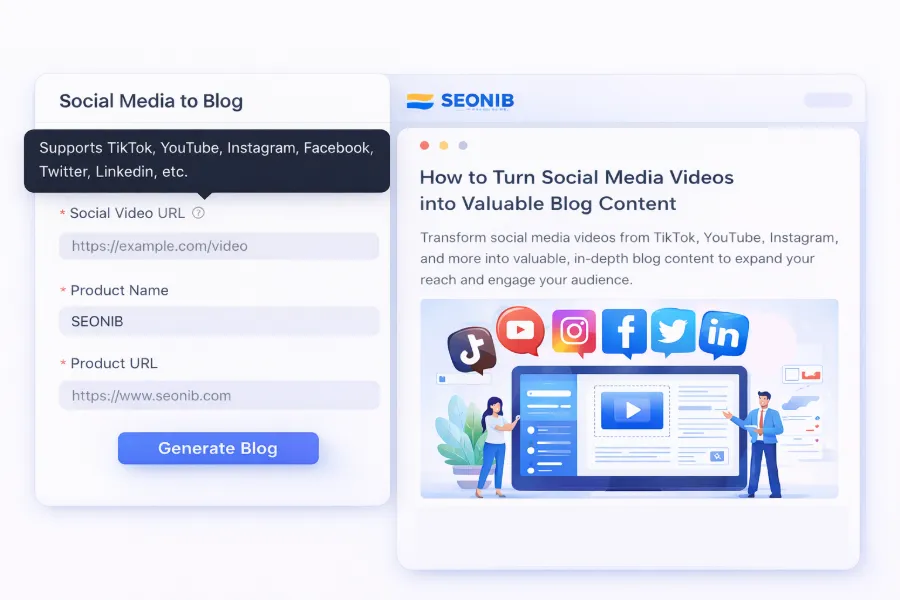
One‑time generation, multi‑platform sync dramatically reduces repetitive maintenance across channels. No need to log into each platform daily to upload; the content is generated once and automatically synced to WordPress, Shopify, SHOPLINE, etc. Merchants in the Shopify ecosystem should be familiar with this logic—there are already many automation tools in the Shopify App Store. See the “Multi‑Platform Distribution Practices in the Shopify Ecosystem” (https://shopify.com) for reference.
How product content captures the purchase‑decision scenarios on different platforms is the most overlooked point in multi‑platform distribution. TikTok users may watch a video and then search the product name; Instagram users click the profile for a purchase link; YouTube viewers look for links in the comments. Each platform’s decision path differs, so a single piece of content isn’t enough. The social‑to‑blog pipeline solves part of the problem, but a more complete approach is to unify multimodal content into a single traffic engine, as described in the “Concrete Build Process for a Multimodal Traffic Engine” (https://seonib.com/c/landing-pages/growth/multimodal-traffic-engine-dominate-google-ai-search-amp-social-feeds-on-autopilot). Treat Google, AI search, and social feeds as one integrated ecosystem rather than isolated silos.
Automation Workflows to Sustain Update Frequency and Scale
The most practical pitfall of content marketing isn’t the inability to write; it’s the inability to keep updating. Most teams can maintain weekly posts for the first two months, then start missing weeks, and traffic curves follow suit. This isn’t a lack of execution; it’s a mechanism problem—self‑discipline‑driven updates are inherently unsustainable.
Scheduled tasks and batch production are the real solutions. Keywords, product links, and hot topics feed directly into the generation pipeline, which automatically creates and publishes content without daily manual triggers. The publishing cadence shifts from “self‑discipline” to “mechanism,” ensuring continuity of content accumulation.
API integration and multi‑platform connectors are the most critical implementation steps in this workflow. SEONIB acts as the middle layer for content production and distribution—input a product link or keyword, generate structured content, then push it via API to various platforms. Manual steps are minimized; the remaining work is periodic calendar checks and direction adjustments. The WordPress integration guide is detailed in the “Connecting WordPress Sites to Automated Publishing” (https://seonib.com/help/6/How%20to%20Connect%20Your%20WordPress%20Website%20with%20SEONIB). The process itself is simple; the challenge lies in initially configuring the brand knowledge base and content rules.
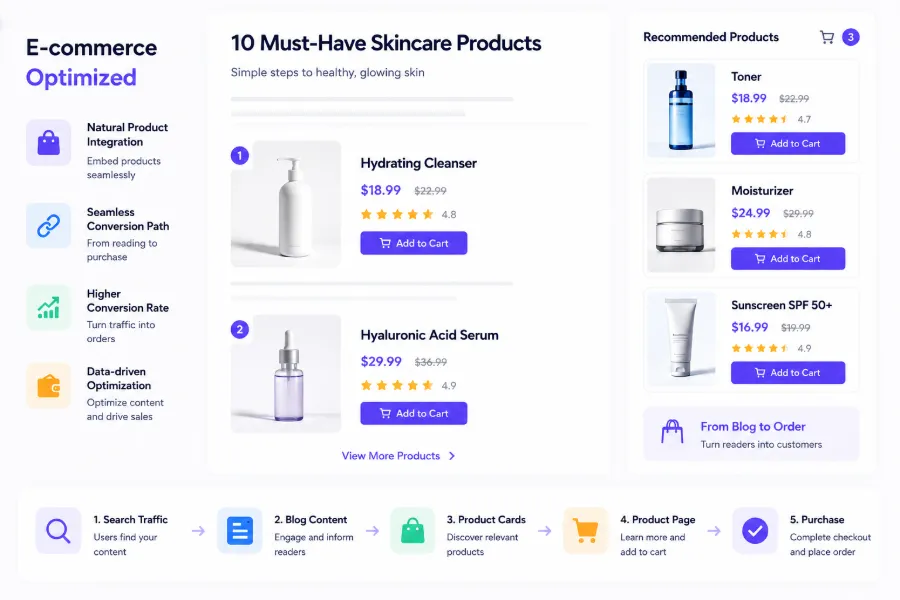
Whether automated content drives conversion hinges on the presence of purchase‑action entry points within the content. I’ve seen many content sites that attract traffic but fail to generate inquiries or orders because the content and the product are disconnected. Embedding purchasable product cards directly into blog posts shortens the path from “reading the content” to “making a purchase.” This often‑overlooked step is crucial in content automation. Detailed operational steps are available in the “Automation Content Publishing Help Documentation” (https://seonib.com/help).
Replacing human effort with mechanisms to continuously output content ultimately builds domain authority and search visibility. There’s no shortcut to this accumulation, but automation can lower the cost of “persistence” enough that content updates become a habit rather than a burden.
FAQ
Q1: After AI Overview, will an independent site’s organic traffic inevitably decline?
Not necessarily. Decline occurs when the content structure remains in the traditional long‑form style and traffic heavily depends on a single Google entry point. If the content is Q&A‑style, structured, and can be directly cited by AI, AI Overview may actually bring new exposure opportunities. The judgment standard is the trend in Google Search Console: stable rankings but falling CTR indicate click folding; adjusting the content structure can still help.
Q2: Are AEO and traditional SEO completely different content sets? Do we need to start from scratch?
No need to start from scratch. Structured Q&A content serves both systems—it satisfies AI search’s citation needs and also feeds traditional search’s featured snippets and rich results. The recommendation is to convert high‑frequency questions into a Q&A format and add structured data on top of existing content, rather than rewriting everything.
Q3: Our team is small; how can we maintain content update frequency without sacrificing quality?
Rely on mechanisms, not self‑discipline. Set up scheduled publishing tasks so the generation pipeline automatically creates and publishes content. The team only needs to configure the brand knowledge base and content rules initially, and then perform periodic direction reviews. Turning “write one article a day” into “review once a week” greatly improves sustainability.
Q4: Does multilingual content really help AI search indexing?
Yes, but only if the content is already structured. When answering cross‑language queries, AI search prefers pages with clear structure and comprehensive entity coverage. Multilingual content adds value by covering more regional search entry points, but rolling out languages too fast with low quality can dilute relevance. Start with 2‑3 markets that already generate inquiries, then expand.
Q5: How to tell if traffic decline is caused by AI Overview or by the content itself?
Compare average position and CTR in Google Search Console. Stable position with a clear CTR drop points to AI Overview compressing click space; a falling position points to content competitiveness issues. Additionally, monitor the proportion of zero‑click searches—this metric directly reflects the folding effect at the top of the results page.
Share Article