2026, The Silent Revolution in SaaS Independent Content Operations: From Tool Integration to AI Agent Full Managed
If you’re still manually writing every blog post in 2026, or relying on fragmented AI tools for content creation, you’re likely falling behind. This isn’t alarmist; it’s a “step-change” in operational efficiency our team has personally experienced over the past year managing a global SaaS tech blog. The core of this shift isn’t about a single AI writing model becoming incredibly smart, but rather a paradigm shift in the entire content production pipeline, moving from “humans operating tools” to “AI agents managing processes.”
What We Thought Was “Automation” Was Merely Semi-Automation
Three years ago, we built our first-generation content pipeline: using ChatGPT for first drafts, Midjourney for accompanying images, SEO tools for keyword optimization, and finally, manual publishing to WordPress. At the time, we felt this was already “advanced,” boosting efficiency by at least threefold compared to purely manual work. But problems quickly surfaced: too many process breakpoints.
Every Monday, content operations would spend half a day researching keywords and trending topics, inputting themes into ChatGPT, waiting for generation, and then spending more time revising articles that had a distinct AI tone and might deviate from the initial SEO intent. Image styles were inconsistent, publishing times relied on human memory, and multilingual versions were a nightmare – translating and then optimizing for SEO doubled the workload. This system heavily depended on a “skilled operator”; any personnel change or vacation would bring the entire process to a halt. We thought we had achieved automation, but in reality, we had merely packaged manual tasks with a series of tools, with core decision-making, scheduling, and quality management still firmly in human hands.
The real turning point came when we encountered a specific and painful bottleneck: a major product update required us to publish accompanying technical explanations, product update notes, and case studies for six major global markets (North America, Europe, Japan, Southeast Asia, etc.) within 48 hours, totaling over 30 articles, all adapted to different regional search habits. Our “semi-automatic” pipeline completely collapsed. Manual scheduling was simply impossible.
Seeking Not Writing Tools, But a “Content Brain”
That crisis forced us to rethink the definition of “automation.” We no longer needed a more powerful AI writer, but an intelligent hub that could understand the entire business chain from “hot topic discovery to multi-platform publishing.” This hub needed to acquire information, judge value, plan production, execute publishing, and continuously track performance on its own.
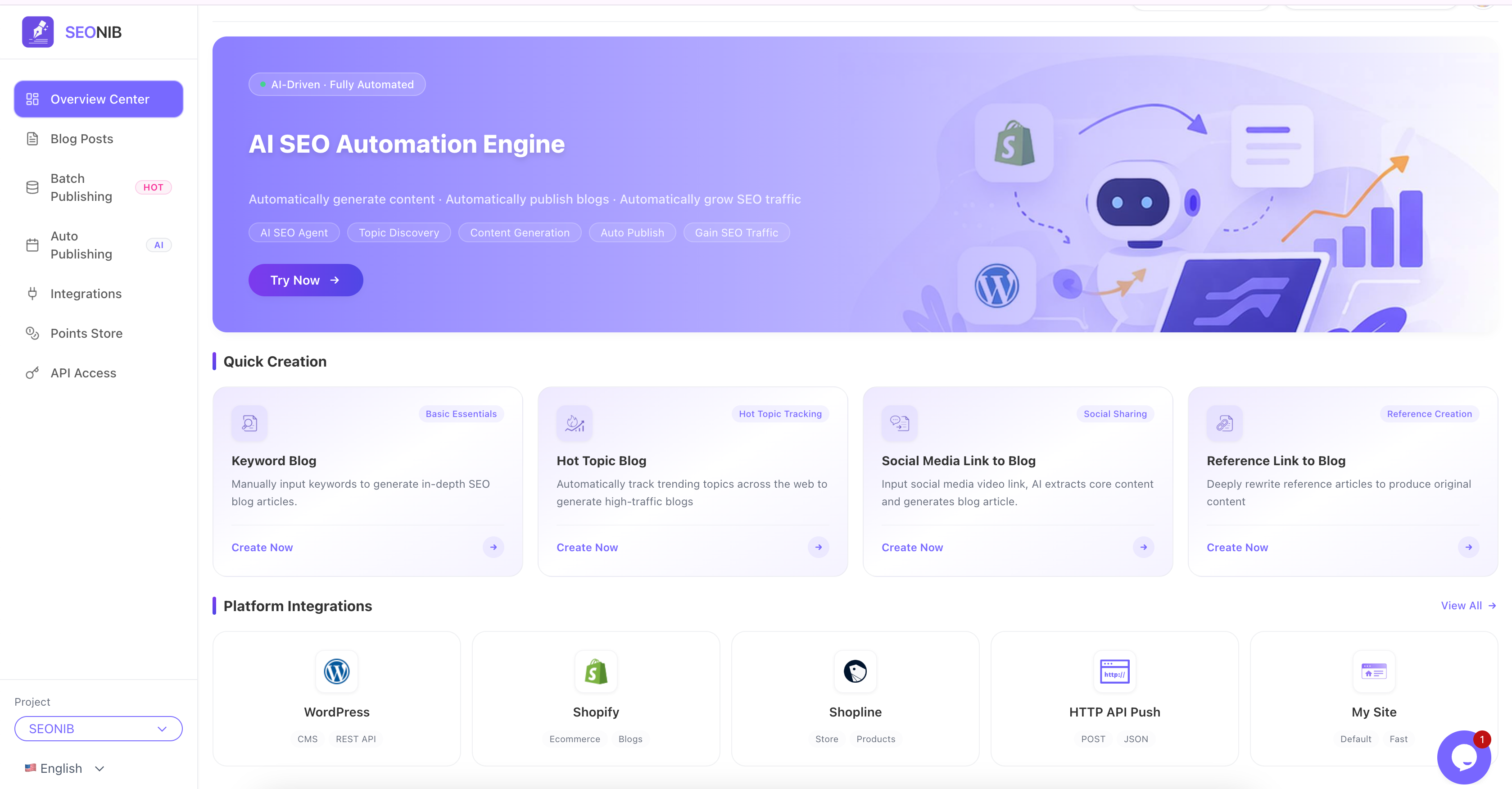
We began testing “automated” solutions on the market. Many tools remained at the “better writing interface” level. It wasn’t until we started systematically using SEONIB that some fundamental changes began to occur. What initially attracted us was its “multi-source generation” concept – not just keywords, but generating content directly from industry trends, YouTube videos, and even competitor pages. But this was just the surface. The truly critical aspect was that it provided a configurable, end-to-end pipeline framework.
We integrated SEONIB into our workflow, not to replace all steps, but to have it act as the “process manager.” We configured information sources (specific industry forums, news sites, competitor blog RSS feeds), set content topic boundaries and brand tone, and then connected our WordPress and Shopify CMS. The rest was observation.
From “Executing Commands” to “Managing Agents”: The Transformation of Work Nature
Within weeks, the job of our content operations team underwent a fundamental change. They no longer needed to search for topics daily, manually draft content, or publish frequently. Their work became:
- Strategy Calibration: Reviewing SEONIB’s automatically captured trending topic reports weekly, assessing their relevance to our product strategy, and fine-tuning the AI’s topic selection preferences.
- Quality Inspection: Randomly sampling published articles, monitoring user comments and engagement data, identifying systemic biases in the AI’s understanding of certain complex technical concepts, and correcting them through the “feedback training” feature.
- Exception Handling: Dealing with the rare instances of publishing failures (e.g., temporary CMS API outages) or intervening in AI-generated content that might contain inaccuracies (this proportion is less than 5%).
Their role shifted from a “content worker” to an “AI agent trainer and process supervisor.” Content output volume and publishing consistency saw exponential improvement. More importantly, we achieved true “24⁄7 content operations.” Even on holidays, the system continued to automatically capture trends, generate content, and publish on schedule, ensuring our blog remained consistently active.
Unexpected Benefits and Pitfalls to Remain Wary Of
This transformation brought some unforeseen advantages. First, improved content diversity. Because the AI sources information from multiple channels like videos and competitor pages, the angles of generated articles sometimes break out of our established thinking frameworks, bringing new inspiration. Second, drastically reduced startup costs for multilingual markets. Generating over 50 language versions with one click and publishing them automatically allowed us to test content reception in emerging markets at a very low marginal cost.
However, pitfalls still exist and are very real:
- Shift in “Homogenization Risk”: When all competitors might be using similar automation tools, how do you maintain content uniqueness and deep insights? Our solution is to use SEONIB-generated content as “high-quality first drafts” and “broad information supplements,” freeing up human experts to focus on creating “pillar content” with exclusive data, in-depth analysis, and distinct viewpoints.
- “Insensitivity” to Traffic Fluctuations: Automated systems consistently producing content can sometimes make us less sensitive to the performance of individual articles. We had to establish a separate dashboard specifically to monitor the aggregate performance of automated content (e.g., group keyword rankings, overall traffic trends), rather than focusing on single “hit” articles.
- Hidden Technical Debt: The entire process relies on stable connections between multiple APIs (SEONIB, CMS, data analytics tools). Any change in one part of the system (e.g., a WordPress core update causing API changes) could lead to the pipeline silently failing. Regular “pipeline health checks” have become a new mandatory practice.
The Reality of 2026: Full Management Has Become a Viable Option
Returning to the present, the market situation in 2026 is that for most SaaS companies, especially those requiring continuous content marketing to acquire global leads, building or adopting an AI agent fully managed pipeline like SEONIB is no longer a “cutting-edge” choice, but a “necessary infrastructure” for operational efficiency and market competitiveness.
It solves far more than just the problem of “writing articles faster”; it redefines the value chain of the “content operations” function. Human value is released from repetitive information processing and moves upwards to strategic planning, brand storytelling, in-depth creation, and relationship building – areas that AI cannot yet touch.
This revolution is “silent” because it lacks disruptive news headlines; it’s simply the quiet, unattended operation of content pipelines in countless backends. But for those involved, the change in work methods is profound and real. The future has arrived, it’s just not evenly distributed yet.
Frequently Asked Questions (FAQ)
Q1: Will using a fully automated content pipeline cause our blog to lose its “human touch” and brand personality? A1: This depends on how you configure and utilize it. If you let the AI generate content completely unchecked, there is indeed a risk. Our experience is to treat the AI as a tireless “research assistant” and “first draft writer.” Within SEONIB, you can “train” the AI’s output by setting detailed target audiences, tone of voice, and brand keywords. More importantly, human editors should focus on personalizing core articles, adding exclusive cases and insights, thus forming a collaborative model of “AI for volume, humans for quality.”
Q2: Will search engines (like Google) penalize automatically generated content? A2: Based on experience up to 2026, Google’s algorithms focus more on content value, relevance, and user experience, rather than whether it was generated by AI. The key is content quality. Low-quality, repetitive, or irrelevant content generated by automation tools will certainly be penalized. However, tools like SEONIB, when used appropriately, can generate well-structured, informative, and SEO-optimized content. By ensuring uniqueness and timeliness through multi-source input, they actually better meet search engines’ requirements for “quality content.” Our blog’s organic search traffic has seen stable growth after automation.
Q3: For small SaaS teams, is building such a system too costly and complex? A3: This is precisely where the market is changing. A few years ago, building such a pipeline required significant development and operational investment. Now, thanks to plug-and-play SaaS tools like SEONIB, the startup cost has been greatly reduced. You don’t need to develop AI models or integrate APIs yourself; you simply subscribe to the service and configure it. For small teams, you can start by automating parts of the process (e.g., only automatically generating industry news or product updates) and gradually expand the pipeline as content needs grow. This is a flexible and low-risk way to get started.