Why Brand Consistency Is Actually a Survival Issue in the Age of AI Search Discovery
Last year I did something foolish. I was testing an automated content production workflow—AI writes five articles a day and publishes them on three different platforms. The goal was to measure how much traffic “pure volume” could bring, without considering brand, style, or who was writing. Around day 17, I Googled my own company name and the first result was an AI summary that recommended my content to a competitor. The summary cited a source that was an aggregator site, which had taken my article, changed a few words, and republished it under a different by.
That moment made me realize a rough truth: the AI‑generated content you write isn’t liked by the AI itself.
It’s not because the content quality is poor, but because there’s no brand signal. AI search systems—whether Google’s SGE, Bing Copilot, or various AI agents—determine “trustworthy sources” very differently from traditional search engines. They don’t just look at backlinks and domain authority; they also look at one thing: whether your content comes from a name they recognize. If the content you spread across platforms lacks any consistent brand marker, the AI will see you as an anonymous information source and will pick someone else.
This article isn’t a deep framework. It’s just a few observations after months of tinkering. Some things I tried were wrong, some aren’t fully solved, but the direction is clear.
What Is “AI Search Discovery,” and How Is It Fundamentally Different From Traditional SEO?
First, a common‑sense difference that most people forget when they practice.
Traditional SEO works like this: crawl → index → rank. You write an article, Google’s crawler finds it, indexes it, and when a user searches a term, Google decides the rank based on hundreds of signals (backlinks, content quality, page speed, domain authority, etc.). It’s a relatively “slow” game—you spend time building content, wait for indexing, wait for ranking, wait for traffic, and the whole process is measured in weeks.
AI search discovery is a completely different beast.
When a user asks an AI assistant “recommend some e‑commerce SEO tools,” the AI doesn’t pull up ten blue links for the user to choose like Google does. It generates a direct answer that mentions three or four tools, each with a brief description. The logic behind that answer isn’t traditional ranking—it relies on dimensions such as “entity recognition,” “citation authority,” and “statement consistency.”
My way of understanding this was clumsy.
At the end of last year I ran a small project: the same article posted on three platforms (blog, Medium, LinkedIn), but I tweaked the phrasing for each—more formal on the blog, conversational on Medium, shorter on LinkedIn. My idea was “adapt to each platform’s reading habits,” which sounded reasonable. Later, when I used different AI tools to look up “authoritative sources on this topic,” none of them ever cited my own article. They either skipped it or cited a “cleaner” version that was taken verbatim from my blog’s RSS feed.
That version’s common traits were: unified author attribution, consistent style, clear brand marking. Those are exactly the things I failed to do.
So if a SaaS team asks me “how to do AI search discovery,” I’ll say: it’s not a ranking game; it’s an identity‑recognition game. You need to bind your name and your content together so tightly in the AI’s summary that the AI can’t work around it.
Brand Consistency Is an Amplifier for AI Search Signals—But Most People Do It Backwards
In the context of AI search discovery, brand consistency isn’t a design issue like “use the same color for our social media avatar.” It’s a deeper feature: can the AI extract a stable, predictable “entity signature” from all your public content?
What is an entity signature? Simply put, if the AI sees that your content A, B, and C all come from the same source, have similar style, overlapping topics, and repeated key terms, it can bind your name to certain concepts. For example, “Ahrefs,” “backlink analysis,” and “keyword research” always appear together in any AI model because Ahrefs’ content emphasizes those relationships. That’s the effect of consistency.
When I first tested the automated content workflow, the results were poor for months—until I noticed a strange issue: the same script generated content with “tone deviations” across platforms that exceeded what I could tolerate. The blog version said “we recommend,” the Medium version said “my personal approach,” the LinkedIn version said “data shows.” Those tone differences seemed minor, but when I bulk‑checked entity association, the AI struggled to link those versions to the same brand. It treated them as three independent content sources.
A key turning point was making myself a person the AI knows. I switched to a completely different strategy: abandon multi‑platform adaptation and force a unified brand expression across all outputs. Same case name, same numeric format, same pronoun (“I” everywhere), and each article mentions the brand at least once within the first three paragraphs. After about three weeks, on certain niche topics AI tools started quoting me. Not because I wrote something groundbreaking, but because the AI could confirm “this always writes about this topic, and its statements are consistent.”
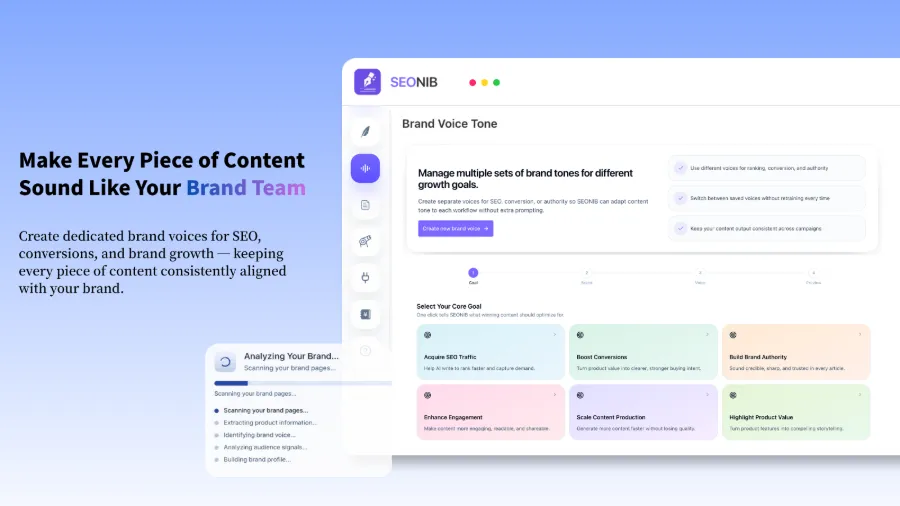
I used SEONIB to automate part of the work—mainly turning “brand term injection” into a content template component that automatically calculates keyword density and placement each time I generate. But honestly, the tool is only one piece. If you don’t know which signal you’re optimizing for, no tool helps. Many people who claim to do AI SEO don’t even understand the difference between AI search discovery and traditional search discovery.
A Counter‑Intuitive Observation: Over‑Pursuing Brand Consistency Can Turn You Into a “Parrot”
If the first two sections explained “why consistency matters,” this one explains “why consistency can hurt you.”
I ran into this confusion after four months of continuous output. By then I had taken “brand expression unification” to the extreme—tone, pronoun, case name, keyword phrases were all fixed. The upside: the AI started recognizing me. The downside: the content became extremely boring, and user engagement dropped.
Looking back at traffic sources, I saw a strange pattern: traffic from AI recommendations—those that appear in summaries and get clicked—was rising, while traffic from direct search and social shares was falling. In other words, AI liked me, but real humans were getting fed up.
How to resolve this paradox? I concluded that the “consistency” AI search discovery needs is brand recognizability, not template‑level uniformity. The AI wants a stable entity signature—your name, your key claims, your data format, your cases—not the same five‑sentence opening in every article.
My adjustment was to keep the entity signature unchanged while allowing the first three paragraphs of each article to deviate a bit—different entry angles, a discussion of a competing viewpoint, or even an intentional admission that a previous opinion was wrong. The signature stays consistent, but the path can wander.
After this tweak, AI recognition stability didn’t drop, and human interaction with the content recovered. I realized that SEONIB helped with this contradiction—its content template lets me set a “signature paragraph” that’s auto‑injected while preserving a flexible free‑input area—but the core solution remains human judgment: where to be strict, where to be deliberately inconsistent.
FAQ
Why does AI always skip my site and recommend competitors when it recommends content?
The most common reason is that the AI can’t confirm your content source is a stable, trustworthy entity. Check that your content maintains consistent name, brand, person references, and data format. If you have different publishing names, author bylines, or wildly varying tones across platforms, the AI will treat them as separate sources and won’t evaluate them as a single brand. This is a measurable signal—ask the AI about your brand topic and see if it mentions you; it’s more intuitive than any SEO tool.
How exactly should I achieve brand consistency so AI search can recognize me more easily?
Step one is to unify the entity information across all public platforms: brand name must be identical, author attribution cannot change, and the terminology you use (e.g., names for a feature) must stay the same across platforms. Step two is to explicitly establish the link between brand and core concepts in the first three paragraphs—e.g., “I’m X, and my main point is Y.” Finally, have your content automatically calculate the density of key brand terms to ensure stable coverage in every publishing cycle.
Does being cited by AI actually bring measurable traffic?
Yes, but don’t compare the volume directly with traditional search traffic. AI‑driven traffic usually appears as “a tool/service is mentioned here,” with click‑through rates in the single‑digit range, but conversion rates tend to be higher because users are already persuaded by the AI summary before they click. I’ve seen a small team on a niche topic triple their direct visits within three months after AI citations—not through search, but through users typing the domain directly.
Is this strategy useful for a one‑person operated small brand?
For a solo‑run brand, the effect is often even more pronounced than for large brands, because a personal brand can more easily build a stable, consistent entity signature. A large brand may have dozens of writers, making it hard to enforce a uniform style, whereas an individual’s output naturally yields a consistent voice and terminology. The only thing to watch out for is not to destroy that natural consistency by trying to “adapt to different platforms.”
分享本文