When AI Starts Writing Blogs: Real Observations from SaaS Professionals on SEO Content Automation in 2026
Several years have passed since the first wave of AI writing tools emerged, and the market has cooled down from its initial frenzy. Now, in 2026, an AI-driven blog automation pipeline is no longer a question of “whether to use it” but rather a daily routine of “how to master it” for a mature SaaS content operations team. Professionals are no longer debating whether AI can replace humans, but are pragmatically discussing how to ensure this system stably and sustainably generates business value amidst evolving content scale, language coverage, and search engine rules.
From “Content Generation” to “Operations Pipeline”: A Shift in Mindset
In the early days, teams often fell into a trap: viewing AI content generation tools as “writing replacements.” Input keywords, get a well-structured article, and publish. Initial traffic growth might have been exciting, but it quickly hit a bottleneck – content homogenization, topic repetition, insufficient long-tail keyword coverage, or worse, content that was “correct” but lacked any unique insights or value, leading to high bounce rates and low conversion rates.
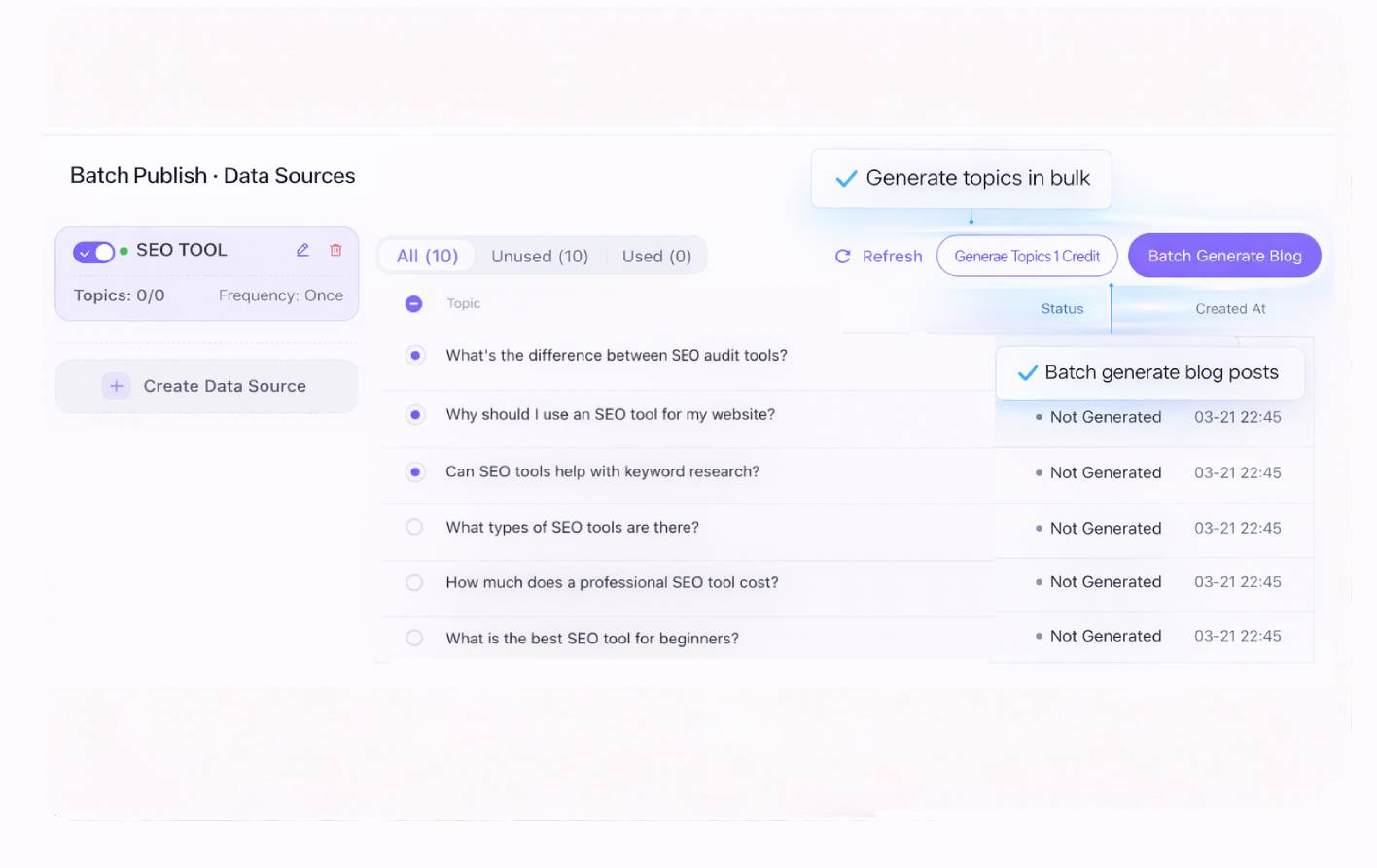
The real turning point occurred when teams began to see platforms like SEONIB not as writing tools, but as content operations pipelines that require careful design and tuning. The key difference lies in “input” and “feedback loops.” One end of the pipeline is diverse, high-quality information sources (not just keyword lists), and the other is post-publication data feedback (indexing status, ranking changes, user behavior). The system’s value isn’t in the “perfection” of a single article, but in the efficiency and sustainability of the entire pipeline in churning out “effective content.”
The Quality of Information Sources Determines the Pipeline’s Ceiling
This is the most easily underestimated aspect. Search engines in 2026 demand higher contextual understanding, topical authority, and information freshness. Simply inputting a bunch of highly competitive short-tail keywords and letting AI mass-produce them is far less effective than it used to be.
A more effective approach is to blend multiple information sources:
- Keywords and Questions (PAA): Used to cover basic search intent and long-tail questions.
- Trends and Hot Topics: Used to capture immediate traffic, but requires a rapid publishing mechanism and is highly time-sensitive.
- Reference Links: This is key to enhancing content depth. Providing AI with several high-quality reference articles (even competitor analyses or industry reports) and instructing it to synthesize, analyze, and generate original content with a new structure is far more reliable than letting it “fabricate” from scratch.
- Proprietary Data: For SaaS products, using customer case studies, usage data, and product update logs as information sources generates content with unparalleled uniqueness and persuasiveness.
Teams found that when SEONIB’s generation tasks were built upon filtered and combined information sources, the baseline quality of the output content significantly improved, making it easier to achieve initial rankings.
Hidden Challenges at Scale: Consistency and “Content Drift”
As content generation expands from a few articles per week to dozens per day, covering multiple languages, new operational challenges emerge. The foremost is brand voice consistency. Articles generated in different batches and for different topics may exhibit subtle inconsistencies in tone, professional depth, and terminology usage. Although the system supports preset styles, over months of operation, slow “content drift” can still occur, requiring regular manual review and style calibration.
Another challenge is internal competition. When batch-generating a large number of articles around similar topic clusters, it’s easy for two articles to inadvertently target overly similar keywords, leading to content “cannibalization” on the website, diverting authority that should be concentrated on a single high-quality piece. This requires operators to have a clear content architecture and keyword mapping mindset when planning information sources and setting generation rules.
The World After Publication: Indexing, Rankings, and the “AI Recommendation” Black Box
“One-click publishing” is just the beginning. In 2026, content success increasingly depends on a series of post-publication events: will it be indexed quickly? Will it be featured in search engines’ own “AI summaries” or “deep analysis” sections? Will it be picked up by other AI content recommendation systems?
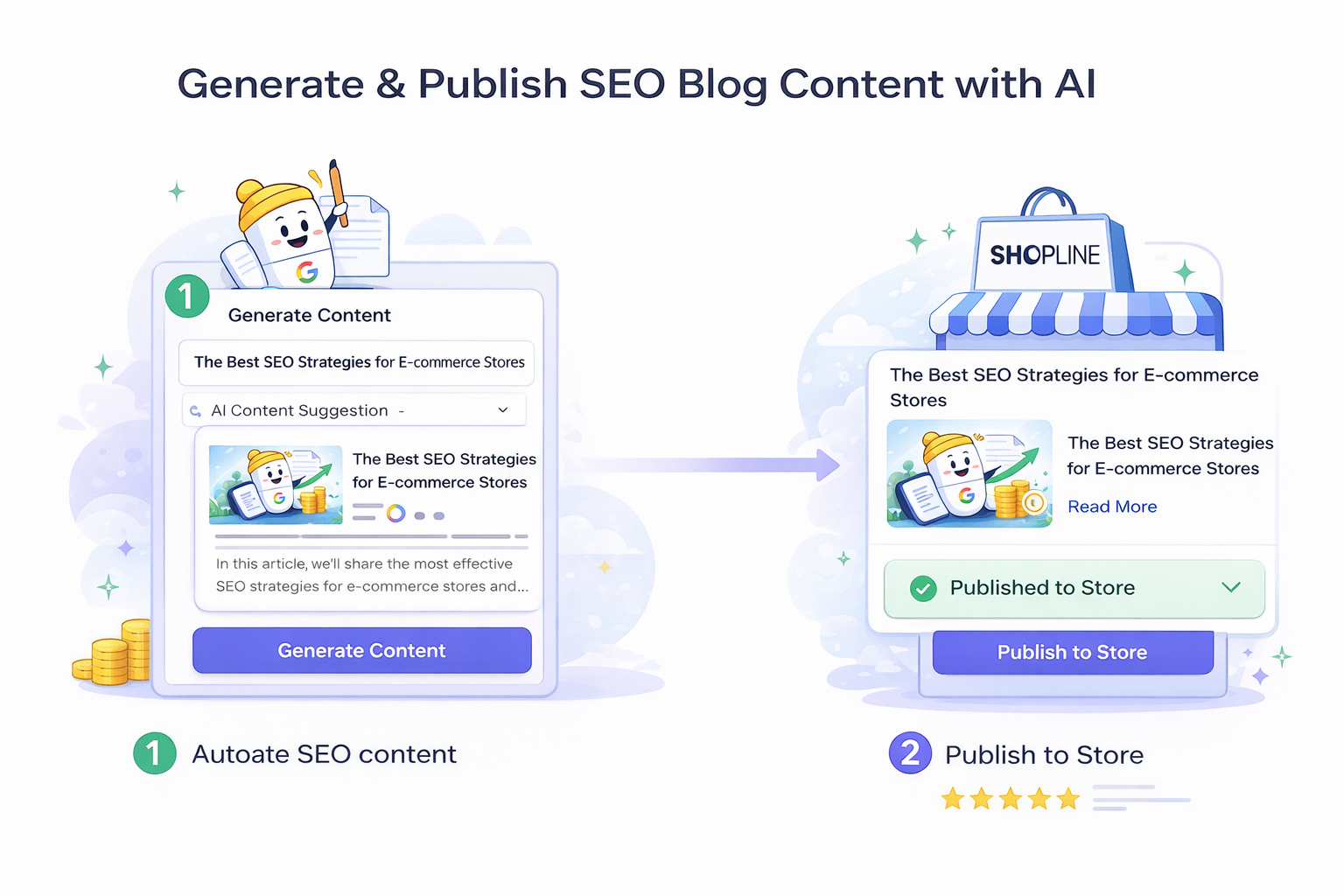
Features like SEONIB’s “publish to multiple platforms” and index monitoring are crucial at this stage. Teams need to establish a monitoring dashboard that tracks not just the number of inclusions, but also:
- Indexing Speed: Which platforms (e.g., Webflow, Shopify, own blog) are crawled and indexed fastest by search engines? This directly impacts the timeliness of hot content.
- Ranking Trajectory: How do the rankings of newly published content for target keywords change over time? Do some articles suddenly gain ranking boosts after a few weeks (potentially indicating entry into a recommendation loop)?
- Traffic Sources: Beyond traditional search traffic, is there traffic from “AI answers” or knowledge panels? This portion of traffic is steadily increasing in 2026.
Integration with Business Systems: The Last Mile from Traffic to Conversion
For SaaS companies, the ultimate goal of blogging is lead generation. Pure AI-generated content performs well in establishing initial trust and answering questions, but often falls short in driving high-intent conversions (like trial sign-ups or demo requests). The solution here is not to abandon automation, but to implement a tiered content strategy.
- Traffic Tier: Utilize the automation pipeline extensively to generate introductory content covering a wide range of questions and attracting top-of-funnel traffic.
- Consideration Tier: Strategically insert targeted product use cases, data comparisons, or success story modules (which can be semi-automated) within the automatically generated articles.
- Conversion Tier: Integrate intelligent, contextually relevant Call-to-Action (CTA) components at the end or sidebar of key articles, dynamically recommending the most relevant product feature pages or resources based on the article’s topic.
Connecting the content automation pipeline with CRM and marketing automation platforms creates a closed loop: content attracts visitors -> behavioral data feeds back into the system -> subsequent content topics and product mentions are optimized -> leads are nurtured. This is the complete picture of SaaS content operations in 2026.
The Future is Here, Roles are Evolving
Today’s SaaS content operators have seen their core responsibilities shift from “writing” to “pipeline architect” and “data tuner.” They need to understand the search ecosystem, AI generation logic, multilingual content strategies, and the core value proposition of their own products. Tools like SEONIB provide powerful automation engines, but the steering wheel and navigation map remain in human hands. The most successful teams are those that seamlessly combine human strengths in strategy, creativity, and quality management with machine strengths in scale, speed, and consistency.
The theme of this game is no longer “reducing labor costs,” but “how to leverage limited human resources to manage and optimize a continuously running, learning content production system to gain sustainable organic growth advantages in the overall competitive landscape.” This may sound complex, but it’s the daily reality in 2026.
FAQ
Q: Will search engines really give good rankings to AI-generated blog content? A: In 2026, search engines judge based on content quality and value, not the creation method. If AI-generated content accurately, comprehensively, and uniquely satisfies search intent and provides a good user experience, it can absolutely achieve good rankings. The key lies in the instructions provided by human operators, the quality of information sources, and post-publication optimization, rather than the tool itself.
Q: In a multilingual content strategy, is it better to directly translate English articles or generate content separately for each language? A: Direct translation usually yields poor results, leading to unnatural expressions and overlooking localized search habits. A better practice is to use core themes and keyword frameworks as guidance, and use AI to independently generate content for each target language based on localized information sources (such as local trends, Q&A, and reference websites). This better captures the real search intent of local users.
Q: How can we avoid batch-generated content from sounding monotonous and lacking uniqueness? A: The key is to enrich the diversity of information sources. Avoid relying solely on keyword lists. Mix in in-depth reference articles, the latest industry data reports, and real user discussions from social media as generation material. Additionally, in system settings, emphasize instructions like “analyze,” “compare,” and “summarize” rather than simple “describe.” Regularly incorporating “seed articles” edited by humans as benchmarks for style and depth is also effective.
Q: With fully automated content operations, are content editors or marketers still needed? A: Not only are they needed, but their roles are even more critical. Their work shifts from “assembly line workers” to “system designers and quality control officers.” They need to formulate content strategies, curate information sources, monitor data performance, adjust generation parameters, handle content for complex or high-value topics, and connect content traffic with business conversion paths. Human strategic thinking and creative judgment are currently irreplaceable by AI.
Q: For early-stage SaaS companies, should they build such an automated system from the beginning? A: It is not recommended. In the early stages, it’s more important to focus on defining the brand voice, establishing core topical authority, and validating product-market fit through in-depth, manual content creation. Once the core content framework and conversion paths are validated, introducing an automated system for scaled peripheral content expansion and long-tail traffic capture would be a more robust approach. Going all-in on automation from the start can lead to hollow content and prevent the establishment of genuine market recognition.