When Automated SEO Writing Becomes the Norm, How Do We Redefine Content Value?
In the past two years, we’ve witnessed a significant industry shift: SEO content creation, once taking days, can now be generated in minutes using AI tools. Our SaaS team was initially skeptical, fearing that automation would compromise content quality. However, when we saw competitors rapidly climbing the long-tail keyword rankings through bulk content strategies, we had to re-evaluate our stance.
From Manual to Automated: A Forced Revolution in Efficiency
In early 2024, we were still struggling to produce 20 high-quality technical blog posts per week. Each article required a tedious process of keyword research, outline planning, content writing, SEO optimization, and publication scheduling. The content team was under constant high pressure, while traffic growth had plateaued.
The turning point came after we analyzed a suddenly rising competitor’s website. Their content volume increased by 300% in three months, covering a vast array of long-tail queries we had never considered. Further investigation revealed they almost entirely adopted AI-assisted content generation, coupled with an automated publishing system. This wasn’t the “low-quality junk content” of our traditional understanding, but rather articles with clear structures, complete information, and optimized for specific search intents.
We faced a difficult choice: continue with our purely manual workshop-style content production, or embrace automation tools to improve output efficiency?
Unexpected Discoveries in Implementing Automated SEO
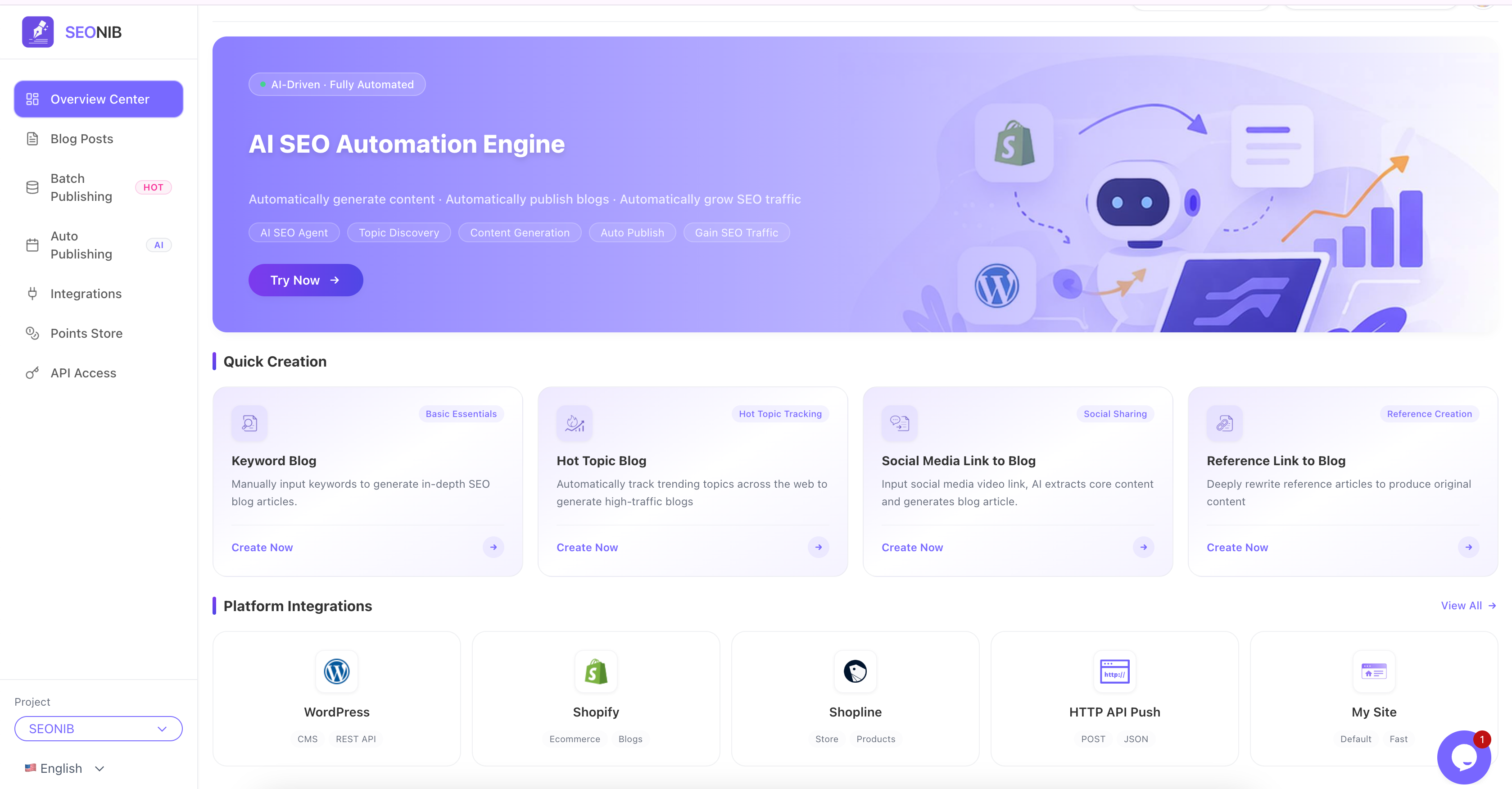
We decided to adopt a phased strategy, starting with non-core topics for testing. Initially, we chose SEONIB as our experimental tool, primarily because it supports multilingual generation and integrates directly with our WordPress site. The setup process was simpler than expected: we imported a batch of long-tail keywords, set the publication frequency, and the system began automatically generating and publishing content.
The results of the first month’s testing were surprising:
- Content quality did not decline linearly: AI-generated articles even surpassed some junior writers’ work in terms of information completeness and structural consistency.
- Long-tail keyword coverage significantly improved: The number of keywords we covered increased fivefold, with 30% of them driving considerable traffic.
- The editor’s role transformed: The content team shifted from creators to curators and optimizers, focusing on strategy development and quality assurance.
However, problems also emerged. Automated content lacked depth in analysis and unique insights, leading to shorter page dwell times. More critically, as multiple websites used similar tools to generate content on the same topics, homogenization began to appear.
Exploring the Balance Point Between Automation and Human Input
After six months of practice, we found that the most effective strategy was not to completely replace human effort, but to establish a collaborative workflow between humans and machines:
Phase 1: Automated Generation of Foundational Content The system generates initial drafts based on keyword and trend analysis, covering basic information and standard structures. This portion accounts for 60% of our total content volume, primarily targeting informational queries.
Phase 2: Human-Driven Deep Enhancement Editors and domain experts add case studies, practical experiences, industry insights, and unique data to the initial drafts. Although this content constitutes only 40%, it contributes 80% of our conversions and link acquisition.
Phase 3: Continuous Optimization Loop We utilize SEONIB’s bulk update feature to regularly refresh old content and add new information, ensuring its timeliness. This process is fully automated, but the optimization direction is guided by human strategy.
This hybrid model allows us to expand content scale without sacrificing depth and uniqueness. Our monthly organic traffic grew by 220% within six months, while the content team’s focus shifted from repetitive writing to strategic thinking.
When All Websites Use Automation Tools
With the widespread adoption of AI content tools, we’ve observed an interesting phenomenon: search engine evaluation criteria seem to be subtly changing. Algorithm updates in 2025 clearly favor:
- User experience signals (page dwell time, interaction depth)
- Content update frequency and timeliness
- Topical authority and breadth of coverage
- Quality of multimedia element integration
This means that relying solely on automated text generation is no longer sufficient. We began combining AI-generated text with manually created charts, video summaries, and interactive elements. This “enhanced automated content” performed significantly better than purely text-based content.
Another key finding is that in the age of automation, content strategy differentiation and the uniqueness of editorial perspective become even more valuable. When technological tools level the playing field for basic content production, what truly distinguishes a brand is its unique viewpoints, industry insights, and the depth of its solutions to real-world problems.
Future Outlook: Automation as a Starting Point, Not an End Goal
From our practical experience, automated SEO writing tools will not replace content creators, but they will fundamentally change the content creation workflow. The most successful teams will be those that can:
- Leverage automation tools to efficiently meet basic information needs.
- Invest human intelligence to create in-depth content that cannot be automated.
- Establish mechanisms for continuous content optimization and updates.
- Seamlessly integrate content with other marketing channels and product experiences.
Our team’s current state is: automation tools handle 70% of basic content production and publishing processes, while the team focuses on 30% of strategic content planning, in-depth analysis, and cross-channel integration. This balance allows us to remain competitive without losing the core value of content – connection, inspiration, and conversion.
FAQ
Will automatically generated content be penalized by search engines? From our experience, as long as the content provides real value, meets search intent, and maintains a good user experience, search engines will not penalize it solely based on its generation method. The key lies in content quality, not the creation method. We’ve observed that well-structured, informationally complete AI-generated content often ranks well.
How can the problem of homogenized automated content be avoided? We adopt a “basic automation + human enhancement” strategy. After the system generates the standard content framework, editors add unique case studies, industry data, practical experiences, and personal insights. Simultaneously, we focus on diversifying content formats, combining charts, videos, and interactive elements to create a differentiated experience.
Are automated SEO tools suitable for all types of websites? Not necessarily. For highly specialized websites requiring deep domain knowledge or a strong brand voice, relying entirely on automation may not be appropriate. However, for informational, educational, or product support content, automation tools can significantly improve efficiency. The best practice is to develop a hybrid strategy based on content type and business objectives.
How can the ROI of automated SEO content be measured? We track multiple metrics: growth in keyword coverage, changes in organic traffic, page engagement (dwell time, scroll depth), and ultimately, conversion impact. It’s important to analyze the performance of automated and human content separately to understand their respective contributions and areas for optimization.
Will automation tools reduce the skill requirements of content teams? Quite the opposite; it changes the required skill set. While basic writing tasks decrease, the demand for strategic planning, quality control, data analysis, and cross-channel integration increases. Content teams need to transition from executors to curators and optimization experts, which is actually a positive change for team development.