In the AI Search Era, How SEO Shifts from Competing for Rankings to Competing for Citations
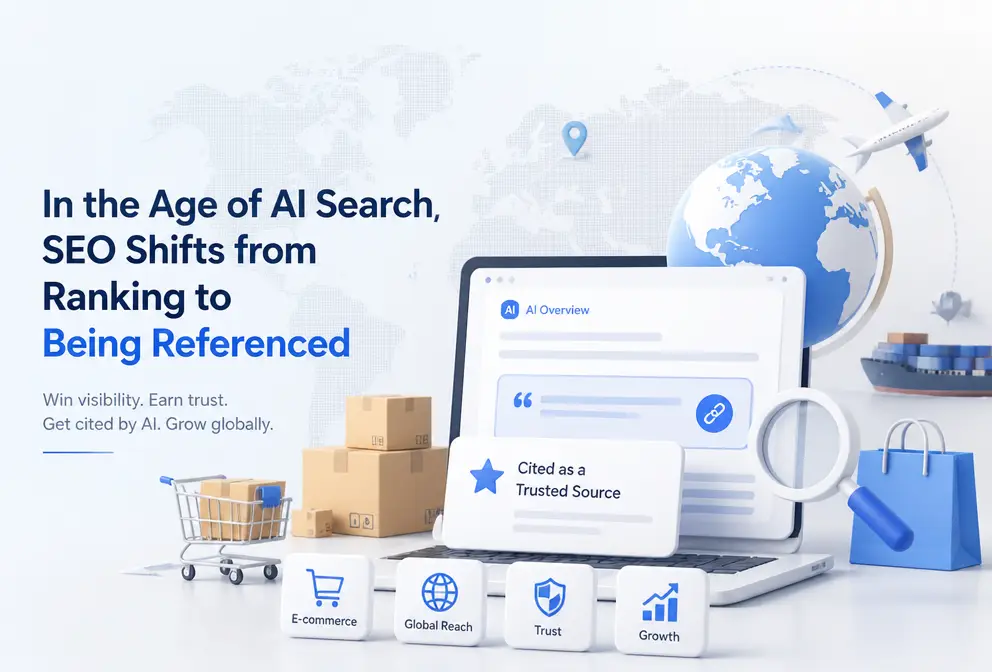
Cross‑border e‑commerce teams often encounter a very specific mismatch: product pages already rank in Google Search and even receive stable organic traffic, but when users ask the same question to AI search, the answer contains no brand or product link. Teams repeatedly refresh Google Search Console, compare impressions and clicks, yet find it hard to explain this “ranked but not shown” situation.
SEO now faces two goals simultaneously: competing for traditional search rankings and competing to be cited as a source in AI‑generated answers. Ranking still determines whether a page can enter the search infrastructure, but AI search also evaluates whether the page can directly answer the question, provide verifiable facts, and stay consistent with brand and product entities.
This isn’t just swapping keywords for a few new terms. Pages need to shift from “writing an article around a single word” to covering the questions that arise during a user’s decision‑making process, allowing brand, specifications, applicable scenarios, and constraints to be extracted, understood, verified, and cited.
Ranking vs. AI Citation: Solving Two Different Visibility Problems
Visibility in traditional search usually revolves around ranking, impressions, clicks, and organic traffic. After a user enters a keyword, Google Search returns a set of results, and pages compete for clicks through titles, snippets, and position. AI search may directly mention a brand, explain a product fact, or provide a source link within the answer; users may not visit the top‑ranked page but may remember the brand entity that appears in the answer.
Thus, teams are not simply swapping one metric for another; they have two co‑existing objectives. One is to have the page visible on the results page; the other is to become a source that AI answers can cite. The former leans toward results‑page competition, the latter depends more on whether the content can be compressed, restructured, and verified.
| Visibility Goal | Visible Position | User Action | Content Requirements | Primary Measurement Signals |
|---|---|---|---|---|
| Traditional Search Ranking | Search results page | Click the page and continue browsing | Relevance, page quality, technical accessibility | Ranking, impressions, clicks, organic traffic |
| AI Answer Citation | Generated answer and source area | Read the answer first, then decide whether to visit | Direct answer, complete evidence, entity consistency | Brand appearance, citation frequency, source link, brand search |
AI more easily handles pages that give clear answers. A page should first present a conclusion, then explain applicable conditions, data sources, usage steps, and exceptions, so the model doesn’t have to guess the answer from five paragraphs of marketing copy. Focus is also crucial: a page that discusses dozens of products, multiple market regulations, and completely different user groups may appear dense but actually creates ambiguity.
This is the dividing line between traditional page checks and AI‑readability checks. Titles, meta descriptions, structured data, and Core Web Vitals still need to be verified, but you also must confirm that the body text truly answers the user’s question and that product specs are consistent across modules. Teams can first use the Page SEO Checklist Framework to catch basic issues, then review the answer structure and fact sources separately.
Cross‑border e‑commerce pages cannot focus solely on “what to buy” for ranking. Buyers also ask: Which specification fits a small apartment? What’s the difference between two models? Can it be used with local voltage? How are cleaning and warranty handled? What are the return restrictions? If category pages, product pages, and blog posts collectively answer these questions, a brand’s Search Visibility becomes more than just keyword count, and Topical Authority is more than total article count—it’s the recognizability of the brand entity across multiple purchase scenarios.
Structuring Content for Citation, Not Just Keyword Stacking
Pages that are AI‑friendly usually organize information into four categories: Conclusion, Evidence, Use Cases, Constraints. These four pieces don’t have to be long essays each time, but you can’t rely on unverifiable adjectives like “lightweight, durable, suitable for everyone.” A product page can first state who it’s for, then give specs and test bases, followed by environments where it’s not suitable.
Product name, specs, target audience, usage limits, and after‑sales info must stay consistent across product pages, category pages, and blog posts. One page says “water‑resistant,” another says “splash‑proof only,” a third language version says “submersible”; AI may capture any one of those. The issue isn’t just copy quality; it’s a conflict in Entity SEO where brand and product attributes clash.
Titles, snippets, image alt text, body copy, and structured data also form a single information chain. For example, a product card labels 500 ml, the body copy says 450 ml, and the image alt text reads 0.5 L; a human reader may treat these as approximations, but a machine could interpret them as three distinct facts. Knowledge bases, FAQs, and internal links must not be maintained separately from the product data.
The purpose of topic clusters isn’t to create more pages, but to give each page a clear question to answer. One buying guide explains selection methods, a comparison page handles model differences, a tutorial shows usage steps, and an FAQ covers shipping, installation, and returns. Internal links establish semantic relationships among pages, allowing search engines and AI to see a relatively complete decision path rather than a heap of competing articles.
The AI SEO Implementation Guide is suitable for calibrating the boundaries of this work: AEO isn’t an independent skill detached from SEO; structured content, crawlable pages, clear titles, and reliable sources remain foundational. “Optimizing for AI” is more about reducing inference distance when generating answers, not about repeating a keyword dozens of times.
Original test data, after‑sales team‑accumulated real questions, spec sheets, and clear sources support citations far better than generic AI‑generated paragraphs. AI can help organize data, but it cannot replace the team’s confirmation that a product truly holds a certification, nor can it fabricate a market’s delivery rules. When a page is updated, the timestamp should reflect factual changes, not merely to appear fresh.
Embedding Citation Goals into the Cross‑Border E‑Commerce Content Publishing Workflow
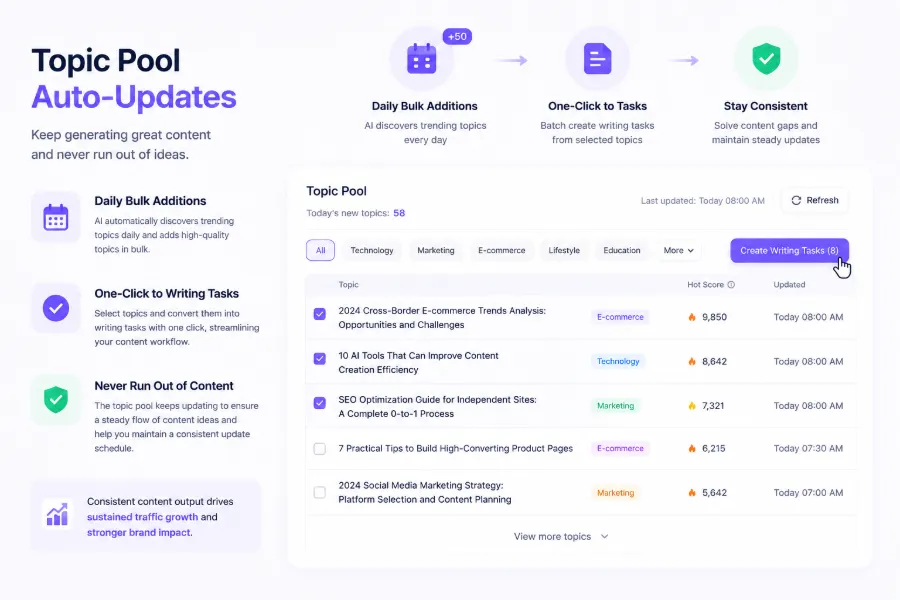
Cross‑border teams usually generate topics from trends, product links, keywords, and customer questions. A more reliable approach is to first filter for questions that connect to actual purchase decisions, rather than jumping on short‑term hype. Whether a topic can be linked to a specific product, applicable market, and verifiable data often determines its future value as a citable asset more than raw search volume.
When turning product data into buying guides, comparison content, tutorials, and FAQs, manual verification cannot be omitted. Prices, specs, inventory, delivery times, and promotion status change quickly; automatically generated copy may be fluent but can become outdated on the day of publication. Teams should make fact verification a publishing gate, especially for numbers and constraints that directly affect purchase decisions.
On Shopify, WordPress, or SHOPLINE, product links, content calendars, product cards, and blog bodies are usually managed by different modules. The publishing environment of the Shopify official platform is just the platform background; the real error source is unsynchronized modules: an article mentions a new model while the product card still points to the old link; the title is localized, but the meta description remains in the original language.
When teams need continuous topic generation, scheduled publishing, and multi‑platform synchronization, four automated steps are usually split: discover topics, generate content, schedule publishing, sync across platforms. SEONIB appears in these pipelines to tie together product links, content tasks, and publishing status; it supports 40 languages, but language count cannot replace manual checks of units, regulations, and after‑sales statements.
Multilingual SEO also cannot stop at sentence‑by‑sentence translation. US pages may use inches and dollars, German pages must handle metric units, return policies, and local delivery promises, while Japanese pages have different user expressions and usage scenarios. After translation, each market must confirm that brand names, model numbers, specs, and constraints have not been rendered into multiple versions.
Pre‑publish previews, field configurations, and sync status need to be recorded, especially when using webhooks to connect proprietary systems. Teams can use the Content Publishing and Sync Help Document as the entry point for configuration checks, confirming canonical links, language versions, image alt text, and product links before running the scheduled task. Automation saves repetitive work, not factual judgment.
Using Citation Signals and Operational Data to Debug Content, Not Just Ranking Changes
The post‑publish observation sequence can be fixed to three layers: first check whether the page is crawlable and indexed, then whether the content directly answers the target question, and finally whether entities and sources are consistent. This order sounds obvious but is often skipped during troubleshooting. When traffic doesn’t rise, the first reaction is usually to add more articles, which only inflates the number of unindexed, duplicated, or fact‑conflicting pages.
Layer 1: Examine crawl and index status, index coverage, canonical links, and language‑version relationships in Google Search Console.
Layer 2: Feed the target question repeatedly to different AI search engines and observe whether the answer covers the page’s conclusion, not just whether the brand appears.
Layer 3: Verify that brand name, product model, specs, source page, and update time are consistent across pages.
One content team published for six weeks, adding about 30 buying guides. Most pages were indexed, and a few achieved search rankings, but AI answers never cited the brand pages. The team kept adding articles until week 7, when they discovered that articles didn’t answer the question up front, specs differed between category and blog pages, and the cited test data lacked a clear source. Maintenance costs rose while thematic coverage remained incomplete.
In this failure case, rankings didn’t disappear; they actually masked the problem. Google Search Console’s impressions and clicks misled the team into thinking the content direction was correct, but AI answers require shorter conclusions, fuller context, and more stable entity relationships. The team later paused new articles, rewrote high‑intent pages, added constraints, and unified specs. Citations still lagged, but the investigation scope shifted from “what to write next” to “where the page fails verification.”
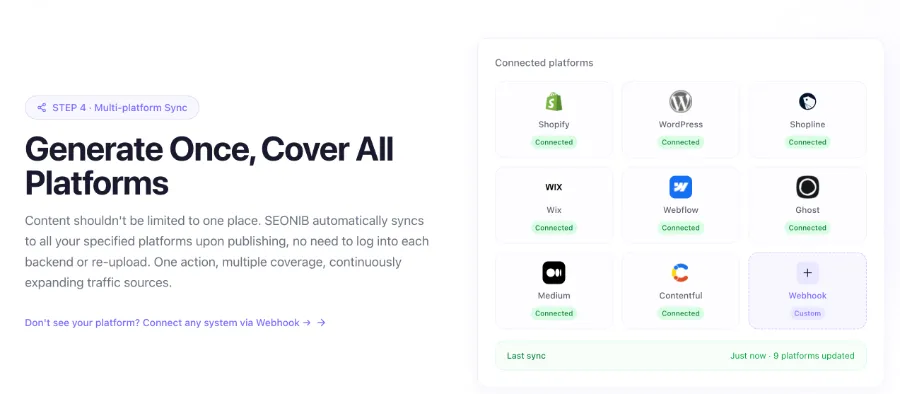
Multi‑platform sync amplifies another issue: the same content may appear on multiple domains or subdirectories; missing canonical, hreflang, or old‑page deprecation handling can create duplicate content or lagging versions. When using SEONIB to manage content calendars and sync status, the focus of troubleshooting isn’t whether a task shows “published successfully,” but whether each platform’s URL, canonical tag, and final update timestamp have truly landed.
A counter‑intuitive situation is that expanding sync channels may broaden content coverage but not increase AI citations. The more source pages there are, the higher the chance of factual divergence; an old page in one market retaining outdated specs can undermine the brand entity’s credibility. After scaling up publishing, index monitoring and version management usually take priority over simply increasing scheduling frequency.
Citation signals should not be treated as a single ranking replacement. Teams can simultaneously monitor impressions, clicks, organic traffic, brand searches, citation frequency, and the types of pages being cited, then distinguish whether the issue is insufficient topical demand, unindexed pages, answers that aren’t direct enough, entity conflicts, or delayed content updates. For deeper insight into answer structure and citation relationships, see the Content Supporting AEO Method.
Establishing a Continuously Iterative AI Search SEO Standard
The pre‑publish checklist order should not follow the output sequence of the authoring tool; it should start with search intent, then verify entity information, direct answer, evidence source, page technical status, language version, and responsible updater. This makes publishing slower but prevents discovering broken product links or missing spec sources after the page is already in the queue.
Content assets should be managed by topic, not just by article. Each topic should record at least four long‑term data points: coverage, page status, citation performance, and next update date. Linking products, source pages, target markets, and responsible personnel to the topic record is essential; otherwise, after three months the team will struggle to decide whether an article should be expanded, merged, or retired.
When converting external material into blog posts, you cannot simply rewrite reference links into a seemingly complete article. Source, publication date, applicable market, and verifiable facts must be retained, while editors add product scenarios, constraints, and their own test results. The Method for Converting Reference Links into Blog Posts helps teams turn this step into a reviewable content workflow rather than a one‑off text edit.
Different markets need to retain localized facts while maintaining a stable description of the same brand entity. Content review, index monitoring, citation observation, and old‑article updates can be scheduled weekly or monthly; for price, inventory, regulation, and delivery information, updates should be triggered by changes, not waited until organic traffic visibly drops.
Ranking remains part of the search infrastructure. For cross‑border e‑commerce, the long‑term maintenance goal is no longer isolated keyword pages but a comprehensible, verifiable, continuously updatable content entity; it can attract clicks on the results page and also serve as a clear source when users read AI answers directly.
FAQ
Does being cited by AI search guarantee a traditional search ranking?
Not necessarily. The visibility signals used for AI citation and traditional ranking are not identical. A page may be cited because it answers directly and has a clear source, but it still needs to be crawled, indexed, and evaluated for relevance; traditional ranking may lag by days to weeks.
What kind of content on cross‑border e‑commerce product pages makes them easier for AI to understand?
Product pages should first state the target audience and a direct conclusion, then add specifications, use cases, evidence, and constraints. Teams must also verify that model numbers and units are consistent across product pages, category pages, and multilingual versions, avoiding multiple versions of the same fact.
Will AI‑generated content automatically receive AI‑search citations?
No. Automatic generation only solves part of the production workflow; it does not automatically provide factual evidence or entity consistency. After publishing, you still need to check indexing status, whether the answer is direct, whether the source is clear, and update promptly when price or spec changes occur.
How should SEO teams measure “being cited by AI”?
Record brand appearances, citation frequency, source links, and the types of pages being cited, alongside impressions, clicks, organic traffic, and brand searches. It’s recommended to log answer changes for the target question weekly for at least several weeks before deciding whether a topic has a stable citation trend.
How can multilingual sites avoid entity conflicts across market pages?
Create a unified fact source for model numbers, specifications, brand names, after‑sales rules, and constraints, then let each market maintain its own units, regulations, and delivery details. After each version update, check hreflang, canonical tags, and page update timestamps to prevent old language versions from continuing to be crawled.
Share Article