
Content Decay: How to Automatically Detect, Diagnose, and Fix Persistent Ranking Decline

Content decay is a slow process, so slow that most teams never notice it. I’ve maintained the content libraries of several sites, and the most typical scenario is: one day you open Google Search Console and see that an article that was on the homepage last year has dropped three or four positions, and organic traffic is 20 % lower than the previous month. You look at the history and see that the last update was two quarters ago. No one on the team remembers who wrote it, and no one has time to audit each page individually.
The real bottleneck in fixing content decay has never been “how to change the content,” but “how to discover low‑cost which pages are worth saving.” Manually refreshing an old article takes 6–10 hours, and it must be done each quarter. If a site has dozens of such articles, the workload snowballs until you finally give up maintenance.
What Is Content Decay? Why More Than 60 % of Pages Keep Losing Traffic
Content decay refers to a page that once ranked well and consistently generated traffic gradually losing both ranking and organic traffic. This process rarely happens suddenly; it usually spans months—competitors publish more comprehensive content, data become outdated, search intent shifts, or algorithm updates change Google’s evaluation criteria.
Ahrefs’ 2019 study showed that 66 % of pages published two years ago experience a drop in organic traffic. This isn’t an isolated phenomenon; it’s a universal pattern across content libraries. HubSpot’s data confirm this: updating old blog posts can increase organic search views by an average of 106 %.
To determine whether a page is truly decaying, you must separate it from seasonal fluctuations or changes in industry demand. A practical operational rule of thumb: if organic clicks decline 20–40 % over an 8–12‑week period with no corresponding demand‑side signal, you can safely conclude decay. If a seasonal query’s overall volume drops, an entire class of pages will be affected, not just one or two.
Five Common Causes of Content Decay: Diagnose Before You Treat
Content decay has no single cause. I’ve categorized the vast majority of ranking drops into five groups, each requiring a different remedy. Misdiagnosing the cause makes all subsequent work futile.
| Decay Cause | Typical Signals | Applicable Fixes | Monitoring Difficulty |
|---|---|---|---|
| Competitor Content Upgrade | Competitor pages are more comprehensive, updated more frequently | Add entity coverage and depth, rewrite core paragraphs | Medium |
| Timeliness Decline | Statistics are outdated, tool screenshots are stale | Update data and case studies, add “last updated” timestamp | Low |
| Algorithm Update | Site‑wide traffic fluctuations after a core update | Adjust content structure according to E‑E‑A‑T signals | Medium |
| Search Intent Shift | SERP changes from informational to product‑comparison | Revise page format and content type | High |
| AI Citation Loss | Google ranking unchanged but AI citations drop | Maintain quarterly update cadence, optimize citable sections | Very High |
The fifth category deserves a separate note. AI citation loss is a blind spot that traditional SEO monitoring can’t see—your content may be disappearing from ChatGPT, Perplexity, Claude, and Google AI Overviews while Google rankings stay static. Qwairy’s research found that half of AI‑cited content is younger than 13 weeks, meaning there’s roughly a three‑month window of AI visibility. Updated content is 3.2 times more likely to receive AI citations within 30 days than old content.
Most teams monitor quarterly, and AI citation decay also occurs over about 13 weeks. This means that when you notice an anomaly, you’re usually looking at data that’s three months old. Quarterly monitoring will always show you stale data if AI citations decay within the 13‑week window.
Building a Three‑Tier Monitoring Framework: From Manual Audits to Automated Fixes
When dealing with content decay, I like to split monitoring tools into three capability tiers: detection, diagnosis, and automated remediation. Each higher tier reduces workload and latency.
The first tier is detection. Tools like Google Search Console and Ahrefs rank tracking tell you which pages are dropping. Detection only answers “what happened,” not “why.” The second tier is diagnosis, which requires manually reviewing SERP changes, comparing competitor content, and checking for intent shifts. This tier is the most time‑consuming and often skipped. The third tier is automated remediation, where tools generate updated versions and publish them, shrinking the entire loop to minutes.
Manually refreshing an old article averages 6–10 hours, and it must be repeated each quarter. I ran the numbers: if a site has 10 pages that need maintenance, that’s 60–100 hours per quarter. That workload is enough to make any small team abandon regular upkeep and only intervene when traffic visibly drops.
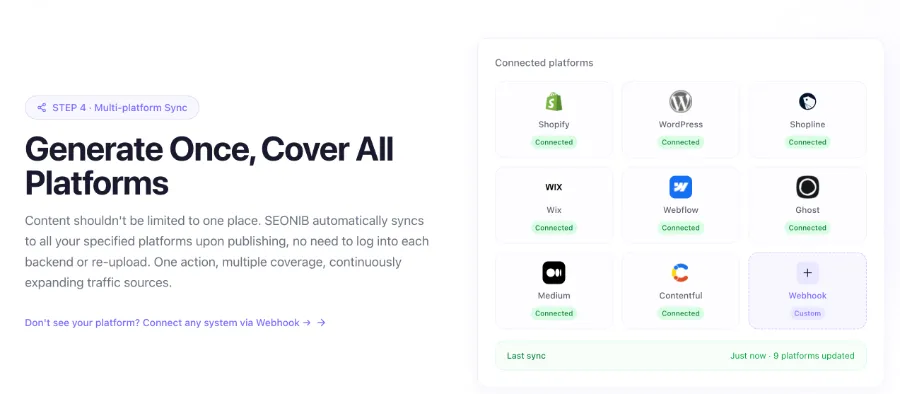
The toolchain also includes automated options that can handle the full loop, such as platforms like SEONIB. They ingest detected decaying pages and feed them into an automatic generation and publishing workflow, eliminating the need to copy‑paste into a backend. The difference from ordinary AI writing tools is that SEONIB takes over the entire publishing pipeline, not just text generation.
Closing the Detection‑Diagnosis‑Remediation Loop in Daily Operations
My approach is to set up dual‑track monitoring for Google and AI search results. For Google, I use Search Console’s page‑level reports and export click‑through changes weekly. For AI, there’s no ready‑made dashboard, so I periodically query major AI tools for brand and core keywords and record which pages are cited. Comparing the two data sets lets you tell whether the issue is a Google ranking problem or an AI citation loss.
Google’s core update in May 2026 caused a sudden, significant traffic drop for some sites. Such external shocks can’t be prevented; you can only detect and respond early through monitoring. Schedule content refreshes in your editorial calendar instead of waiting for traffic to fall—I’ve learned the hard way that a tutorial article that wasn’t updated for two months fell behind competitors, wasting that period’s traffic.

Dual‑track monitoring means you must continuously produce new content to maintain AI visibility, which dovetails nicely with content automation. I often turn well‑performing social media posts directly into blog articles, saving the time of brainstorming from scratch. This workflow can be executed directly in SEONIB—generate an updated version from social content or reference links, then schedule publication. See the guide “SEO Tools Recommended for Beginners” and the article “Turning Product Links into Sustainable SEO Blog Posts” for detailed steps.
Audit work should ultimately become automated rather than labor‑intensive. I’ve seen many teams treat content decay fixes as a one‑off cleanup—refresh once and think it’s done. Without a loop, the same pages will decay again next quarter. That’s why I moved to an automated pipeline, turning detection, diagnosis, and remediation into a continuously running process instead of a manual trigger each time. SEONIB’s Skill feature can integrate an AI Agent into the content workflow; the Skill page provides configuration details. A more complete guide is available in the SEONIB Help Center.
FAQ
How can I tell whether a traffic drop is due to content decay or seasonal factors?
Look at the scope of the decline. If only a few pages drop while other similar pages stay stable, it’s likely content decay. If an entire class of query terms drops together, it’s more likely seasonal or industry demand changes. Another dimension is time: decay usually lasts longer than eight weeks with no rebound, whereas seasonal fluctuations tend to recover after one cycle.
What magnitude of traffic decline warrants immediate action?
If organic clicks fall more than 20 % within an 8–12‑week window without a corresponding demand‑side change, intervene. A drop over 40 % indicates that competitors or algorithm changes have caused a substantive substitution, requiring rapid updates. For declines under 20 %, you can monitor first and decide based on SERP changes.
Why can’t traditional SEO tools detect AI citation loss?
Traditional SEO tools monitor Google rankings and organic traffic, while AI citations happen in the answer generation processes of platforms like ChatGPT and Perplexity, which don’t use Google’s index or ranking system. Your page may rank well on Google but be omitted by AI models that have already switched to newer sources. There are currently no off‑the‑shelf tools that directly track AI citations; you must query manually on a regular basis.
How often should I check for content decay?
AI citation decay has a roughly 13‑week cycle, so at least quarterly checks are needed. If your site updates frequently or operates in a fast‑changing industry, consider monthly checks. After a Google core update, run a special audit within one to two weeks, as external shocks can accelerate decay.
What parts of an old article need updating during a manual refresh?
First, update data and statistics—outdated numbers affect both Google and AI trust. Second, verify whether search intent has shifted—if the SERP has moved from informational to product‑comparison, a simple refresh isn’t enough; you may need to adjust the page format. Finally, add new entity coverage and internal links—these are often overlooked but crucial for maintaining rankings.
Share Article