Why AI Search Engines Only Love “Breathing” Websites
I spent three days writing a deep‑dive article—data, case studies, logic all in place—thinking it would comfortably sit at the top of AI citations. After a few rounds with Perplexity and ChatGPT, that article was never cited even once. Another short piece on the same topic that was updated just last week, however, was repeatedly referenced. This made me think for a long time: AI search engines don’t care who writes best; they only trust “breathing” websites.
“Freshness” Is More Harsh Than You Think—Look at the Data
I remember clearly looking at an analysis report on AI citation rates; the numbers chilled me. Articles updated within 30 days have an AI citation rate of about 82 %; those untouched for 1–3 months drop to 52 %; and articles not updated for over six months fall to 22 %—meaning a six‑month‑old “evergreen” post gets less than a quarter of the trust of a brand‑new article.
Different AI platforms have varying sensitivity to freshness. Perplexity is the most eager; as a real‑time Q&A engine, its citation rate for articles updated within 30 days is 82 %, with a monthly‑over‑quarterly increase of 31 %. ChatGPT is a bit milder, but its preference is still clear. Google AI Mode extracts paragraphs in parallel via a Query Fan‑Out mechanism, giving freshness an explicit weight—when two paragraphs on the same topic are compared, one from last week and one from two years ago, the AI almost always picks the former. Gemini relies more on E‑E‑A‑T signals, treating freshness as a secondary factor but still not irrelevant.
A practical tip: use the IndexNow protocol to notify Bing when you update content (Perplexity and ChatGPT also ingest Bing’s data). This can shrink the discovery time from days to hours, boosting visibility by 115 %. If you’re curious which sites get cited more often by AI, see this analysis on Why Some Websites Get Cited More Frequently by AI Engines.
These data show one thing: AI’s preference for freshness isn’t a vague “newer is better.” It’s a quantifiable gradient. A six‑month‑old deep article, even if still relevant, is cited less than half as often as a piece updated within the last 30 days.
Five Ways AI Trusts “Breathing” Sites—Mechanism Breakdown
I gradually realized that AI’s judgment of whether a site is worth citing follows a logic similar to human editors, but it’s more mechanical. Here are roughly five layers.
Active Maintenance Signals – AI looks at the
Last‑Modifiedheader, sitemap update frequency, and new‑content publishing cadence. A site with no updates for six months gets its trust level lowered—because lack of maintenance suggests the content may be outdated, even if it looks fine on the surface. It’s like a restaurant whose menu prices haven’t changed in three years; would you trust its ingredient recommendations?Information Timeliness Assurance – The core goal of an AI engine is to give accurate answers. If it cites outdated data (e.g., a 2023 market size that has since tripled), user trust is immediately damaged. Hence AI systems embed a timeliness assessment, preferring content that tags a “last updated” date or timestamps data points. Perplexity’s RAG system uses timestamps as one of the ranking weights when extracting sources.
Google’s RAG Index Preference – Google has explicitly said that AI Mode’s indexing system works like traditional search: crawlers visit frequently updated sites more often. The more often a site updates, the faster new content gets indexed. This mechanism is corroborated indirectly in many Gemini docs.
Query Fan‑Out Paragraph Freshness Evaluation – Google AI Mode’s Query Fan‑Out splits a user query into 10–15 sub‑queries and pulls the best paragraphs in parallel from the index. At the paragraph level, freshness is an explicit weight. Ahrefs’ analysis of 860 k keywords found that 62 % of AI citations fall outside the traditional top‑10 search results—showing that AI does independent paragraph‑level evaluation, with freshness as a key factor.
Triangulation Consistency – AI checks whether the same fact appears consistently across multiple sources. If a data point exists only in your old article while newer sources provide a different figure, the AI will choose the newer one. Ongoing updates keep your data aligned with the latest industry consensus, preventing you from being overtaken in triangulation.
Your “Updates” Might Just Be Self‑Deception—Substantive vs. Surface Updates
Knowing updates matter, many people start mass‑changing timestamps. That trick doesn’t work on AI—systems distinguish substantive updates from superficial ones, and the latter are just self‑consolation.
The most typical ineffective actions I’ve seen: only changing the publish date without altering content, fixing a few typos, swapping the title but leaving the substance untouched, bulk‑updating timestamps with a script, or adding a “This article is continuously updated” note at the end without any real change. These actions do not improve citation rates and can even trigger Google penalties.
What AI actually looks for: replacing outdated data and citing the latest source and year, adding new content sections, removing invalid viewpoints, supplementing recent industry events and case studies, and marking the final update at the article’s end. These actions directly raise citation probability.
Lily Ray’s tracking data is worth repeating: she monitored client sites across more than 220 AI content platforms and found that 54 % of sites saw traffic drops of over 30 %, and 39 % dropped more than 50 %. The collapse pattern is highly consistent—rapid growth in 6–12 months, then a fall below baseline within a year. The issue isn’t insufficient update frequency but a flood of low‑quality content.
Google’s official guide stresses that “non‑generic content” is the primary pillar. AI can piece together publicly available information; it needs material based on direct experience, original research, and independent viewpoints. Each update should inject new informational gain—not just tweak wording, but add something that wasn’t on the web before.
Princeton ran an interesting academic experiment: each update added three specific numbers and one authoritative citation, boosting AI citation probability by 41 %. This is a low‑cost, high‑return strategy. If you need concrete ideas, see the guide on How to Turn Social Posts into Blog Articles; the concept of informational gain is analogous.
How to Keep “Breathing” at Minimal Cost—Practical Strategies and Tools
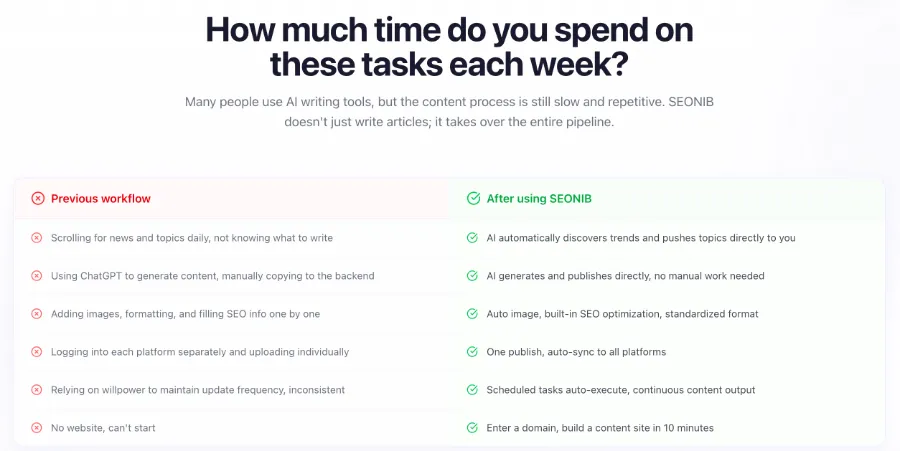
Understanding what to update and why is one thing; executing it is another. After several trials, I’ve distilled a relatively low‑effort workflow.
Create a quarterly update calendar. Core articles—those that drive the most traffic and citations (the top 20 %)—are refreshed monthly; the rest quarterly. Record what changed each time, add a “last updated” note at the end, and send a freshness signal to AI.
Leverage the IndexNow protocol. Notify Bing immediately after updating content; Perplexity and ChatGPT will follow suit, shrinking discovery time from days to hours. If you’re using automation tools, refer to this article on How to Connect Third‑Party Sites with SEONIB for a ready‑made guide.
Add a timestamp anchor to each core article. Place “Last updated: YYYY‑MM” at the beginning or end. AI’s NLP system extracts this as a timeliness cue. Perplexity explicitly treats timestamps as a ranking factor when evaluating sources.
Use SEONIB. The biggest obstacle to updating is not knowing what to change but lacking time. Orbit Media shows that writing a blog post takes on average four hours; updating ten core articles a month is a 40‑hour effort—equivalent to one person’s full‑time week. SEONIB handles the structural layer of updates: when you need to refresh an old post, it quickly rebuilds an AEO‑ready format—question‑style headings, direct answer paragraphs, Article FAQPage schema. This compresses update time from 2–3 hours to 20–30 minutes, freeing you to focus on informational gain.
A useful figure to remember: updating an old article costs 60‑70 % less than writing a new one because the skeleton and structure already exist; you only need to replace outdated parts, add new data, and perhaps insert one or two new paragraphs. The ROI can be higher than a brand‑new post—old articles already hold search authority and backlinks, and updating them layers that historic weight with freshness signals. Ahrefs shows that pages ranking #1 on Google typically rank in the top 10 for about 1 000 keywords; updating those pages yields far higher ROI than starting from scratch.
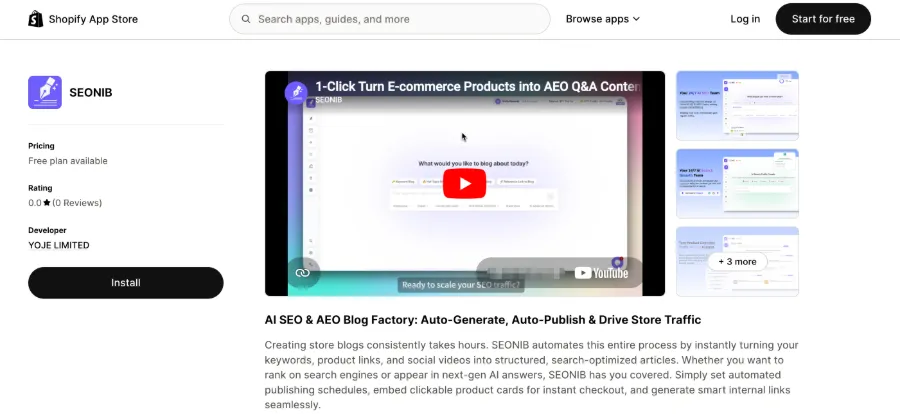
If you need a full step‑by‑step configuration, see SEONIB’s automation update guide in the help documentation.
FAQ
Why does AI trust continuously updated sites more?
AI’s core goal is to provide accurate answers; outdated information is equivalent to misinformation. Continuous updates send two signals: someone maintains the site (high credibility) and the information remains accurate. Citation rates are 82 % for updates within 30 days and drop to 22 % after six months—an inherent risk‑avoidance mechanism baked into AI.
What counts as an effective update?
AI distinguishes substantive from superficial updates. Effective updates include replacing outdated data with cited sources, adding new content sections, correcting invalid viewpoints, and adding timestamps. Ineffective updates are merely changing timestamps, fixing typos, or swapping titles without substantive change. Google emphasizes “non‑generic content” as the primary pillar—each update should add informational gain.
How often should I update?
Monthly updates are optimal, yielding a 31 % higher citation rate than quarterly updates. Core articles (top 20 %) should be refreshed monthly; the rest quarterly. Use IndexNow to notify Bing and Perplexity at update time; discovery time shrinks from days to hours, boosting AI visibility by 115 %.
Which matters more: update frequency or content quality?
Quality comes first. Lily Ray’s monitoring of 220 sites found that 54 % of bulk‑content sites lost over 30 % of traffic after 6–12 months. AI can assemble generic content on its own; it needs original data and exclusive insights. Four high‑quality monthly updates outperform seven low‑quality weekly updates.
What if a new site has no update history?
62 % of AI citations fall outside traditional top‑10 search results—AI leaves a side door for new sites. Perplexity selects sources based on answer relevance rather than domain authority. For new sites, start a monthly update habit from day one, build trust through timeliness, and focus on non‑generic, exclusive information that other sites don’t have.
Share Article