2026 Shopify AI Agent In‑Depth Review: Seonib Skill vs Codex / Claude Code vs n8n – Which Is Better for Cross‑Border E‑Commerce SEO?
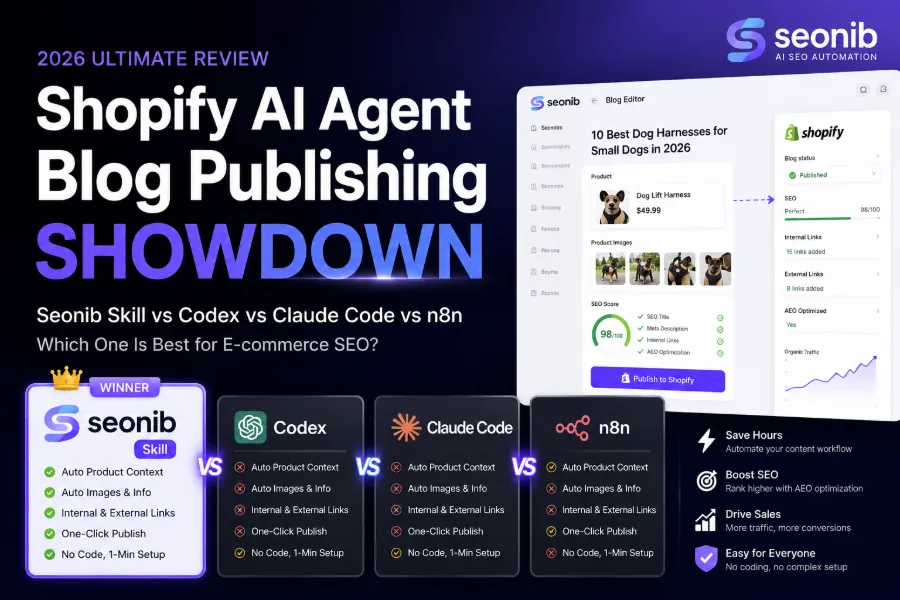
Evaluation Targets: Seonib Skill, Codex / Claude Code, n8n Automation
Core Scenario: Generating SEO/AEO blog posts from Shopify products and publishing them
Intended Users: Shopify cross‑border e‑commerce merchants, DTC brands, independent‑site teams, and solo entrepreneurs
Conclusion First: If you just need “write an article,” a general‑purpose AI Agent is enough; if you need “read store context, generate content, and publish to Shopify,” Seonib Skill’s value is more focused; if you need to build a highly customized cross‑system workflow, n8n offers the most freedom, but its learning and maintenance costs are also the highest.
Why Not Just Compare “Who Writes Better”?
In the past, AI content tool evaluations usually focused on prose, logic, and keywords. For Shopify merchants, finishing a draft is only half the job.
A truly live e‑commerce blog often also requires:
- Reading the product title, description, price, and URL;
- Selecting and inserting product images;
- Matching brand positioning and tone;
- Generating SEO Title and Meta Description;
- Adding internal links, external links, and product CTAs;
- Converting to a Shopify‑compatible format;
- Logging into the backend, uploading assets, and publishing;
- Ongoing updates rather than just publishing a single post.
Therefore, this evaluation does not compare the underlying large models’ intelligence, but rather compares three solutions’ ability to complete the Shopify SEO content workflow.
What Are the Three Solutions?
1. Seonib Skill – Dedicated Capability for E‑Commerce Content Publishing
Seonib is not just a pure AI writer; it is a content automation tool that covers topic selection, generation, scheduling, and multi‑platform publishing. Its website showcases publishing capabilities for Shopify, WordPress, Shopline, etc., as well as workflows for generating content from product links, SEO optimization, and multi‑platform sync.
Seonib Skill further brings these capabilities into AI Agents that support Skills, such as Codex and Claude Code: after merchants register with Seonib, install the Skill, and grant authorization, they can launch tasks directly with natural language.
Typical commands can be very simple:
Generate an SEO/AEO blog post for this Shopify product, insert product info, images, and CTA, and publish it to Shopify.
It solves not “Can AI write?” but “Does AI know the store information, and can it continue to execute after writing?”
2. Codex / Claude Code – Powerful General‑Purpose AI Agents
Codex and Claude Code excel at understanding instructions, researching material, generating Markdown, handling files, and executing development tasks. With sufficient context, they can also produce structurally complete SEO blog posts.
However, without a dedicated Skill, MCP, API, or custom script, a general Agent usually does not know:
- Which products you have in your Shopify store;
- Which product fits the current topic;
- The real‑time price and image URLs;
- Brand tone, prohibited words, and CTA guidelines;
- Internal linking opportunities in already published articles;
- Which blog category the final content should be published to.
In other words, Codex / Claude Code are excellent “brains,” but the Shopify store connection, product context, and publishing actions still need to be supplied by a tooling layer.
3. n8n – Highly Flexible Automation‑Building Platform
n8n is more like a box of automation building blocks. You can connect triggers, LLMs, Shopify, databases, image services, and notification systems to construct a custom workflow.
Its advantage is flexibility: as long as you’re willing to configure nodes, call APIs, design data structures, and handle exception branches, even complex processes can be realized. The downside is equally clear: the builder must understand credentials, field mappings, APIs, prompts, retry logic, and ongoing maintenance.
Thus, n8n is best suited for teams with technical ability, highly customized processes, or the need to connect multiple business systems simultaneously.
Feature Comparison: Who Can Actually Complete the Shopify Blog Workflow?
The table below compares the default positioning and out‑of‑the‑box experience of the three solutions. Codex, Claude Code, and n8n can all be extended through development and integration, so “requires development” does not mean “cannot be done.”
| Capability | Seonib Skill | Codex / Claude Code (without dedicated tools) | n8n (built from scratch) |
|---|---|---|---|
| Generate long‑form blog | ✅ | ✅ | ✅ (needs LLM integration) |
| Read Shopify product context | ✅ Dedicated flow | ⚠️ Requires API / Skill | ⚠️ Requires node or API configuration |
| Inject brand knowledge & tone | ✅ Reusable config | ⚠️ Needs context supplied | ⚠️ Needs custom data source |
| Insert product title, price, link | ✅ | ⚠️ Must be implemented manually | ⚠️ Needs field mapping |
| Insert product images | ✅ | ⚠️ Needs media source integration | ⚠️ Needs configuration |
| Generate SEO Title / Meta | ✅ | ✅ Can generate text | ✅ (needs workflow design) |
| AEO / FAQ structure | ✅ | ✅ Can be generated via prompts | ✅ (needs workflow design) |
| Auto‑recommend internal links | ✅ Based on content resources | ⚠️ Needs site data provided | ⚠️ Needs crawling or DB |
| Auto‑add external links | ✅ | ⚠️ Needs retrieval & validation | ⚠️ Needs extra node |
| Directly publish Shopify blog | ✅ | ⚠️ Needs publishing capability integration | ⚠️ Needs Shopify API configuration |
| Need to orchestrate workflow | ❌ | ❌ (but integration requires development) | ✅ |
| First‑time onboarding cost | Low | Low for content generation, high for publishing integration | High |
| Customization freedom | Medium | High | Very high |
| Best suited for | Shopify content operators | Developers, research & writing teams | Automation engineers, technical teams |
Real‑World Workflow Comparisons
Ordinary AI Agent Workflow
Input Prompt
    │
    ▼
Supplement brand & product info
    │
    ▼
Generate Markdown
    │
    ▼
Human review & copy
    │
    ▼
Upload images, insert product & CTA
    │
    ▼
Fill SEO info
    │
    ▼
Publish to Shopify
n8n Custom Workflow
Design triggers & nodes
    │
    ▼
Configure LLM, Shopify, and credentials
    │
    ▼
Map product, image, and article fields
    │
    ▼
Set up conditionals, retries, and error notifications
    │
    ▼
Test and maintain continuously
    │
    ▼
Auto‑publish to Shopify
Seonib Skill Workflow
Input Prompt
    │
    ▼
Read brand & product context
    │
    ▼
Generate SEO/AEO content
    │
    ▼
Insert images, product, CTA, and links
    │
    ▼
Publish to Shopify
The differences are clear: an ordinary AI Agent automates “writing,” n8n can engineer the entire process, while Seonib Skill attempts to productize the whole e‑commerce content pipeline.
Core Advantages of Seonib Skill
Advantage 1: No More Manual Copy‑Paste of Product Context
General AI does not inherently know your products. Manually providing product titles, selling points, prices, images, and links each time is time‑consuming and prone to version mismatches.
A dedicated Skill’s purpose is to connect content generation with store data. The article is no longer generic; it can revolve around actual products, offering buying guides, comparisons, FAQs, and CTAs.
Advantage 2: Brand Knowledge Can Be Reused Continuously
For cross‑border e‑commerce brands, “fluent writing” is just the baseline. What truly impacts content quality is:
- Alignment with brand positioning;
- Use of consistent terminology;
- Maintaining a stable tone;
- Knowing the core audience and usage scenarios;
- Adhering to product claims and compliance boundaries.
If you start from a fresh prompt each time, brand consistency is hard to guarantee. Reusable brand context reduces repetitive input and better supports ongoing content production.
Advantage 3: From Markdown to Real Publication
“AI can write an article” and “AI can operate Shopify content” are two different things.
The former delivers Markdown; the latter must also handle products, images, links, Meta, formatting, and CMS publishing. The most noteworthy part of Seonib Skill is precisely the bridge that connects the AI Agent’s natural‑language interaction with Shopify’s publishing pipeline.
Advantage 4: More Suitable for Non‑Technical Merchants
According to the current scenario, Seonib Skill’s installation path is: register on Seonib, install the Skill, and authorize usage. The goal is to let beginners start operating within about a minute. Actual time may still depend on account, store authorization, and network conditions, but it avoids the need to orchestrate nodes, debug APIs, and maintain scripts from scratch.
Why Codex / Claude Code Are Still Worth Using
This isn’t a “dedicated tool replaces general agents” competition. On the contrary, Seonib Skill relies on agents like Codex or Claude Code to provide a flexible natural‑language entry point.
Codex / Claude Code are better suited for tasks such as:
- Deep industry and competitor research;
- Designing content clusters and keyword maps;
- Generating multiple article angles;
- Modifying theme code and structured data;
- Developing custom Shopify integrations;
- Bulk reviewing and rewriting existing content.
Their limitation isn’t a lack of ability, but the default absence of your business context and publishing channel. Once a dedicated Skill is added, the combination resembles a “brain + execution system.”
When n8n Might Be the Better Choice
If your workflow contains many custom conditions, n8n may be more appropriate. Examples include:
- Reading topics from Airtable and routing through multi‑person approvals;
- Deciding recommended products based on inventory and margin;
- Calling multiple models simultaneously and scoring quality;
- Syncing post‑publish notifications to Slack, Notion, and CRM;
- Auto‑retrying on failure and alerting technical staff;
- Distributing language versions to multiple stores.
These scenarios demand an “automation platform,” not just a “blog publishing tool.” However, the more freedom you have, the higher the design, testing, and maintenance costs. Small teams without technical members should factor long‑term maintenance into total cost, not just subscription fees.
SEO vs. AEO: Auto‑Publishing Does Not Equal Auto‑Ranking
Regardless of the tool you choose, avoid the common misconception that publishing more articles guarantees more organic traffic.
High‑quality Shopify content still needs to:
- Match real search intent, not just mechanically stack keywords;
- Offer unique experiences, product data, or usage advice;
- Accurately describe products, avoiding fabricated specs or effects;
- Build clear topic clusters and internal linking;
- Use concise answers, FAQs, and clear headings for search engines and AI to extract;
- Manually verify prices, links, image rights, and facts before publishing;
- Continuously update based on Search Console and conversion data.
Seonib Skill can lower execution costs, but content strategy, factual quality, and brand judgment still require human responsibility. The safest approach is to start in draft mode, confirm stable output, then gradually increase the proportion of automated publishing.
Which Shopify Merchants Is It Suitable For?
Seonib Skill is best for:
- Shopify independent sites that need regular blog updates;
- DTC brands and solo entrepreneurs with limited manpower;
- Teams managing multiple sites or multilingual markets;
- Merchants already using Codex, Claude Code, or other AI Agents;
- Operators who don’t want to configure APIs, scripts, or n8n workflows themselves.
It may not be necessary for:
- Stores that publish only one or two articles per quarter;
- Content that is entirely produced by professional editors through deep interviews and manual creation;
- Enterprises with mature CMS back‑ends and automation teams;
- Publishing processes that involve complex approvals, compliance, and custom systems.
Overall Scores
Scores are based on the “Shopify SEO blog generation and publishing” scenario defined in this article, not an absolute evaluation of all product capabilities.
| Dimension | Seonib Skill | Codex / Claude Code (default) | n8n (built from scratch) |
|---|---|---|---|
| Content generation ability | 4.5 / 5 | 5 / 5 | 4 / 5 |
| Shopify scenario fit | 5 / 5 | 2.5 / 5 | 4 / 5 |
| Product & brand context | 5 / 5 | 2.5 / 5 | 4 / 5 |
| Publishing automation | 5 / 5 | 2 / 5 | 4.5 / 5 |
| Beginner onboarding difficulty | 5 / 5 | 4 / 5 | 2 / 5 |
| Customization freedom | 3.5 / 5 | 4.5 / 5 | 5 / 5 |
| Ongoing maintenance cost | 4.5 / 5 | 3 / 5 | 2.5 / 5 |
| Recommendation for Shopify merchants | 5 / 5 | 3.5 / 5 | 3.5 / 5 |
Final Verdict: Choose the Tool Based on Whether You Want an “Article” or a “Result”
If your goal is simply to generate a high‑quality Markdown file, Codex or Claude Code can already do the job well.
If you need highly customized, cross‑system automation and have a technical team, n8n offers the greatest freedom.
But if you are a Shopify merchant who wants to complete the entire chain—“read product → generate content → add SEO/AEO → insert images & links → publish to Shopify”—Seonib Skill aligns most closely with business outcomes and is the easiest for non‑technical users to adopt quickly.
Its biggest selling point isn’t that AI writes more like AI; it’s that AI doesn’t stop at Markdown but moves a few steps further, actually getting the article into Shopify.
Frequently Asked Questions
How does Seonib Skill differ from ordinary AI writing tools?
Ordinary AI writing tools usually deliver plain text; Seonib Skill’s focus is connecting store context and the publishing pipeline so that the article uses real product and brand information and completes the Shopify publishing step.
If I already have Codex or Claude Code, do I still need Seonib Skill?
If you only need research and writing, not necessarily. If you want the Agent to read Shopify data and execute a dedicated publishing workflow, the Skill can reduce the amount of custom integration work you have to do.
Can n8n achieve the same functionality?
In principle, yes, but you’ll typically need to configure the model, Shopify API, field mappings, image handling, prompts, error handling, and publishing logic yourself. It’s more flexible but also more dependent on building and maintaining the workflow.
Is Seonib Skill suitable for beginners?
Its product positioning is to lower the configuration barrier. Beginners are still advised to start with test products and draft mode to verify fields, links, images, and content quality before enabling full publishing.
Will AI‑automated publishing affect SEO?
Search performance depends on whether the content is useful, accurate, original, and meets search intent—not on whether AI generated it. Bulk publishing low‑value content carries risk; automation should serve quality and consistency, not unlimited volume.
Reference Links
Official Site: https://seonib.com
If you’re already using Codex, Claude Code, or other AI Agents while running a Shopify store, Seonib Skill is worth testing as the “writing‑to‑publishing” connector. Start with a single draft, validate content, links, images, and Meta fields with real products, then decide whether to expand the automation scope.
Share Article