
Cross‑border E‑commerce SEO Content Factory: After Three Months I Finally Stopped Chasing Blogs

I’ve been doing this for three years. In the first year I wrote every blog by hand; in the second year I outsourced to writers but the quality fell apart; by the third year I finally accepted that the essence of content marketing isn’t that you can’t write, but that you can’t finish.
Have you ever calculated it? A cross‑border e‑commerce site that wants steady orders needs at least 30‑50 SEO blogs per month. A single person, working at a normal pace, can produce three high‑quality articles a week and that’s already considered prolific. The gap in capacity is obvious and can’t be solved by effort alone.
I tried many approaches. I hired part‑time writers, but each article required two hours of feedback and revision; I bought AI writing tools, but the generated content still had to be manually pasted into the backend, then paired with images, SEO metadata, and published across platforms—the workflow was both smelly and long.
What really broke me was that even after generating 50 articles with a tool, there was another problem waiting: the content wasn’t being indexed.
H2: 50 Articles Finished, Google Indexed None
This was the deepest pitfall I hit at the end of 2024.
I spent a month using AI tools plus manual review to force‑create 48 product‑related blogs. After publishing them on my Shopify site, I opened Google Search Console waiting for results. Two weeks later the index status showed: submitted but not indexed—47 of them.
Only one article got indexed, and it had no ranking at all.
I checked the logs and found Googlebot had only crawled my homepage and two product pages; the blog directory was completely ignored. I later realized that a brand‑new site’s crawl budget is already tight; dropping 50 new pages on it at once leaves Google’s crawler unable to digest them. The faster you upload, the more Google suspects you’re a spammy site.
Many people have the misconception that more content automatically brings traffic. In reality, crawl budget is limited; a new site may only get a few dozen crawls per day. If your content quality is uneven, internal linking is messy, or there’s a lot of duplicate content, Googlebot will pick a few “valuable” pages from your new 50 and leave the rest queued.
I later adjusted my strategy: publish only 10 articles per week, ensuring each has independent value and a solid internal‑link loop. After two months, the index rate rose from 10 % to 65 %. It doesn’t sound high, but the actual traffic quadrupled.
H2: Lots of Content Is Useless If No One Pushes the Trend
I discovered another counter‑intuitive fact: writing product‑feature posts blindly won’t attract users because they don’t search for those terms.
In 2023 I spent a whole year on “product‑feature” blogs, such as “How to Choose the Right XXX Model” and “XXX Material Comparison.” The SEO traffic was stable but never took off. Later I used Semrush to pull competitors’ traffic keywords and found that the top‑ranking terms weren’t feature‑related at all—they were trend and scenario keywords, e.g., “Impact of 2025 Amazon Logistics New Rules on Independent Sites” and “How to Set Discounts During Big Promotions Without Losing Money.”
I realized that traffic keywords aren’t invented; they must be tracked in real time. At first I manually checked Google Trends and industry news, spending half an hour each day filtering information and picking topics with search volume. The method works, but after two months I gave up—seeing the same pages and similar topics daily is exhausting.
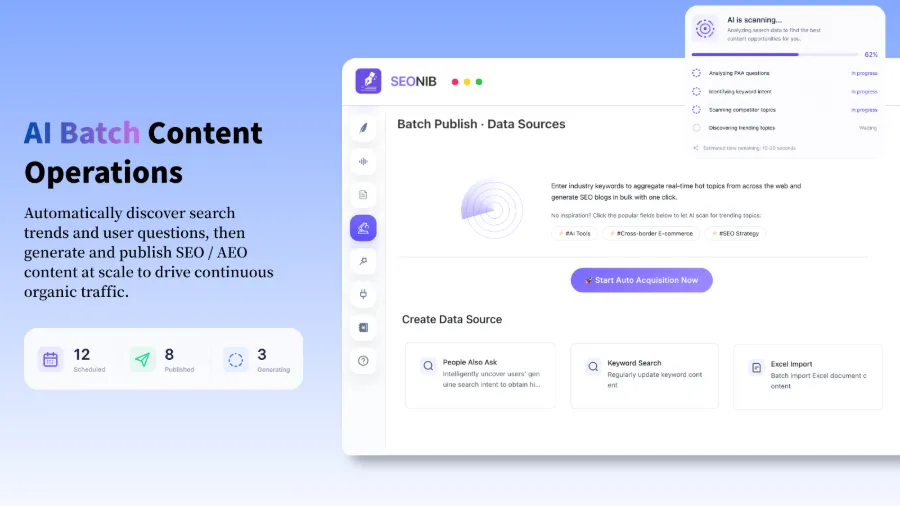
Then I started using SEONIB to automate the job. Its trend‑discovery module automatically pushes today’s hot topics and related keywords, preparing the topics for me. I no longer need to spend half an hour browsing forums and news sites each day; I spend ten minutes each week picking a few interesting topics, and the rest is handled by the system.
Even more surprisingly, it can identify content gaps between my existing articles and competitors. Once it suggested a long‑tail keyword “Shopify Multilingual SEO Settings 2025.” I thought it was niche, but Ahrefs showed a monthly search volume of 1,200, and competitors’ articles were two years old. I spent 40 minutes writing a post, and three months later it generated steady organic traffic.
H2: Scheduled Publishing Beats Burst Publishing by Far
Another point many don’t understand: Google prefers a steady publishing rhythm.
I ran a test. In the first half of the year I went all‑out, publishing 90 articles in two months. In the second half I published only 15 articles per month. The articles from the first half actually ranked less stably than those from the second half. The reason: a continuous output rhythm tells Google the site is alive and regularly updated. After a burst of publishing, the site goes silent, and Google assumes the content operation has stopped, reducing crawl frequency.
My current rhythm is: three to four articles each on Tuesdays and Thursdays, totaling just over 50 articles per month. This rate doesn’t overwhelm the crawl budget and keeps Googlebot coming back.
Before publishing, I glance at each title’s CTR potential. Over‑templated titles get no clicks; click‑bait titles get demoted. I usually check the average CTR for similar content in Google Search Console; if it’s below 2 %, I rewrite the title.
FAQ
Will publishing 50 AI‑generated articles a month cause Google to de‑rank me?
No, as long as each article has independent value. My mistake was batch‑generating 50 similar articles using the same keyword template, which Google flagged as low‑quality. My rule of thumb: each article should have at least one unique angle or data point—don’t just swap keywords and republish.
For cross‑border e‑commerce SEO content, which type of blog should I write first?
Prioritize scenario‑based and trend‑based topics. For example, “How to Deal With 2025 Tariff Adjustments” is far more likely to attract search traffic than “Our Product Comes in Five Colors.” Before writing, verify search volume with Google Keyword Planner; skip topics with less than 200 monthly searches.
How long after publishing can I see ranking results?
New sites typically need 2–4 months. In my experience, the first 30 days focus on getting Google to index and building internal‑link loops; by day 60 you start seeing impression changes; around day 90 you get stable rankings and CTR. Don’t obsess over rankings in the first two weeks—it only creates anxiety.
Do small sellers need to produce 50 articles a month?
It depends on the niche. In highly competitive categories (e.g., fashion, home décor), low content volume struggles to break into search results. In niche B2B or long‑tail product categories, 20 articles a month may be sufficient. I monitor impressions and CTR; if there’s no upward trend after three months, I adjust the content strategy or increase output.
What about multilingual sites? Does each language need 50 articles?
Start by validating the content strategy in a single language. Once the business model is proven, expand to other languages and gradually increase publishing frequency. I’ve seen a five‑year multilingual foreign‑trade operation where only one or two languages actually drove traffic and customers; the rest were a waste of resources.
Share Article