How One Person Can Sustain SaaS Operations: My Daily Workflow and Toolchain

Running a SaaS solo for three years, the hardest thing isn’t writing code or acquiring customers; it’s knowing what to do when you sit down each morning. Content production stalls, SEO rankings fluctuate, and repetitive multi‑platform publishing—these consume the bulk of daily energy. I’ve tried many approaches and hit a lot of pitfalls; below is my currently relatively stable workflow and toolchain. It may not suit everyone, but it can at least serve as a reference.
The Real Enemy of Content Consistency Is Not Creative Burnout
‘I have nothing to write’ is a false premise I only realized after more than half a year. The deeper cause isn’t an empty mind but a lack of a systematic topic discovery mechanism. You can’t rely on inspiration each day to decide what to write—insspiration is too unstable, and manually finding a topic, from browsing industry news to validating search volume, takes on average 15–20 minutes. Finding three topics a day takes an hour, before you even start writing.
Later I changed the process to automated monitoring. Using tools to track industry trends, keyword data, and competitor content changes, I automatically generate topics and push them to a topic library. The time gap between manual browsing and automated discovery is orders of magnitude: after automation, discovering and confirming a topic takes only a few seconds. No need to scroll through dozens of pages daily; the backend pushes a batch of candidate topics with search volume assessments each day, and I just pick the high‑priority ones.
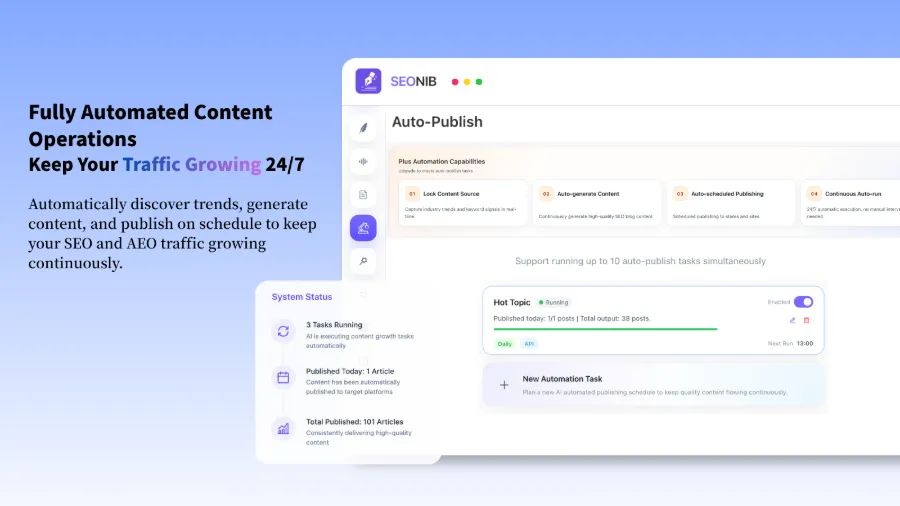
Building a topic library has a hidden benefit: it shifts decision fatigue to the system. Previously I hesitated before each topic; now there’s a fixed topic queue, allocated by date, so opening it tells me what to write today. Ongoing updates no longer depend on willpower but on whether the topics for the next two weeks have been pre‑batch‑prepared. Someone documented a real experience of gaining search traffic by writing a blog, noting that the hardest part in the first three months was maintaining rhythm rather than content quality—once the rhythm stops, traffic stops.
SEO Rules Have Changed — From Rankings to Decision‑Making Nodes
In 2024 I suffered a pretty harsh lesson. A product entered its peak season, and thanks to Google keyword optimization I achieved a good ranking, yet that month’s sales were 40% lower than the same period last year. After a long investigation I discovered the issue: before making a purchase decision, users increasingly search first in AI search tools like Perplexity and ChatGPT, and my content never appears there. Google ranking stayed intact, but the user decision path changed, and my content didn’t enter the new path.
After that I started adjusting strategy. Traditional SEO’s core is to get a high ranking in Google’s search results, but AI search works completely differently—it extracts content to answer user questions rather than showing a list of links. This means you need “AI citations” rather than “Google rankings.” The logical difference is huge: rankings can be fought for with backlinks and on‑page optimization, but citation rate depends on whether your content fits a Q&A structure and entity coverage.
At that time I began researching AEO (AI Engine Optimization); the core idea is to present content in a human‑question‑answer format favored by AI search engines, rather than traditional paragraph‑style blogs. Essentially it’s not mystical—just structured content, clearer entities, and question‑driven information organization. The diagram below shows a common format I use after adjustments.
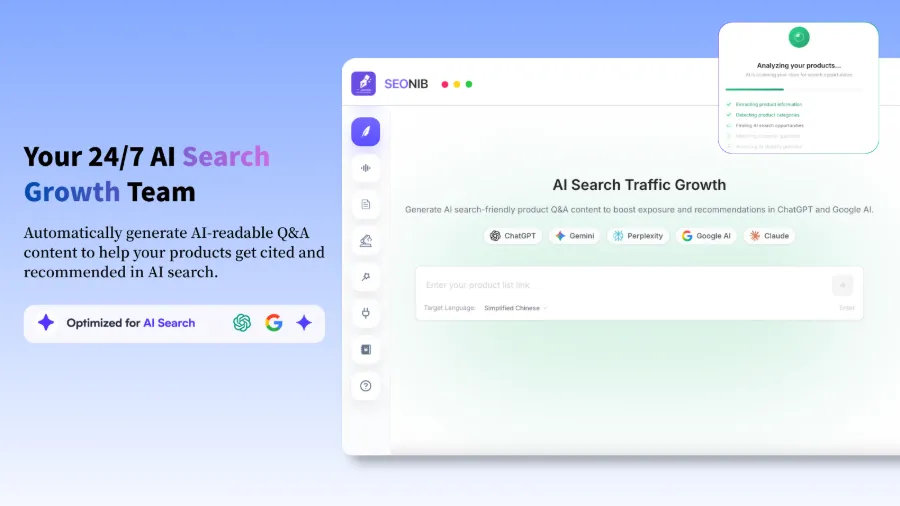
Industry data now corroborates this—73% of modern “search” behavior occurs outside traditional search engines. Your content might still get traffic ranking at the tenth position on Google, but if it can’t be found in ChatGPT, Perplexity, or even Amazon’s AI search, that portion of traffic will never belong to you. Multi‑platform coverage also became a requirement; I later synced content to Shopify and, along the way, noticed that SEONIB has joined Shopify’s App Store, so I integrated it, with good results.
One more point about AEO: the hidden impact of brand consistency on AI search. Many underestimate it—AI search pulls the same brand’s information from multiple sources; if the brand name, description, or product categories differ across platforms, the AI engine lowers its confidence in that information, causing citation priority to drop.
Automated Workflow — Zero Human Intervention from Generation to Publication
Running a SaaS solo, time is the scarcest resource. I once measured that the full manual process for a single piece of content—topic selection, generation, formatting, SEO optimization, image upload, and multi‑platform publishing—takes an average of 45 minutes. Publishing two pieces a day consumes an hour and a half. And you have other tasks: responding to users, fixing bugs, iterating features.
The core benefit of automation isn’t “not writing,” but eliminating the cost of context switching. Every time you jump between tasks, your brain needs 15–25 minutes to re‑enter a focused state. Manually publishing a piece may require switching to social media, then to the backend, then to the image library—each switch drains attention.
The current process is: a scheduled task automatically pulls a topic from the library each day, generates the full text, performs SEO optimization and image matching, then publishes automatically according to a preset schedule and platform list. All I need to do is periodically check the topic library and preview the quality of a few generated pieces. A single piece goes through the same full pipeline in under 5 minutes of automation, and I don’t even need to be online for those 5 minutes.
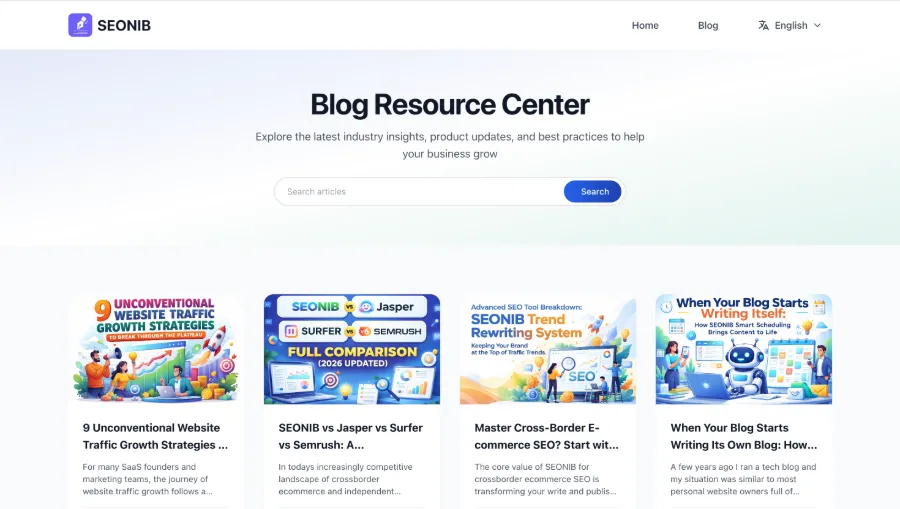
The key is a standardized output format. I created a fixed blog template—title structure, paragraph distribution, punctuation conventions, image placement are all pre‑configured. This ensures that regardless of how much content is generated, the output style remains consistent, and readers won’t feel a jarring shift between articles.
The core engine of this automation I chose is SEONIB, which bundles topic selection, generation, formatting, and publishing into a closed loop. I no longer need to manually log into four backends each day to paste content; once the scheduled tasks are set, the content syncs automatically to all platforms. If you want to learn the specific configuration, see the complete guide from inspiration to global distribution for detailed steps.
Here is a relatively complete demonstration of the automated workflow, showing the entire process from product link to blog publication:
Technical SEO and Index Maintenance — Unseen Quality Content Equals Non‑Existence
Content is written and automatically published, but no one reads it—this scenario is all too common. Solo operators often overlook technical SEO issues: is the sitemap updated, are internal links reasonable, is the index status normal? Over 60% of independent sites have at least one technical issue affecting indexing; common problems include robots.txt blocking, sitemap not containing new pages, and duplicate content lacking canonical tags.
I perform a technical SEO check monthly, focusing on three items. First, confirm that newly published pages are indexed by Google and Bing within 24 hours; a quick run of Google Search Console’s ‘URL Inspection’ shows this. If indexing is significantly delayed, crawling efficiency is the issue—perhaps adjust sitemap submission frequency or check for many low‑quality pages consuming crawl budget. Second, verify internal link structure, ensuring each important page has at least 2–3 inbound links from other pages. Third, check for duplicate content caused by multi‑platform syncing and assign correct canonical tags to each page.
Internal linking strategy is vastly underestimated for independent sites. Internal links help search engines understand site structure and pass authority from high‑traffic pages to new ones. I did a comparison: after adding three core internal links from the homepage to a new article, its index status changed from ‘discovered but not indexed’ to ‘indexed’ on the third day after being crawled. If you’re interested in this area, see a more systematic Technical SEO Checklist covering the checks most solo operators need.
The automation tool itself also requires maintenance. SEONIB, which I use, has a nuance—it supports scheduled tasks and multi‑platform sync, but each platform’s API occasionally updates, so after the initial authorization you must regularly check the connection; otherwise content may be sent but not synced to the target site. After connecting WordPress to the automation system, I set a bi‑weekly schedule to check connection status, preventing a situation where a site’s content has been out of sync for two weeks.
From Content Operator to System Architect — The I Evolution
The ultimate goal of running a SaaS solo isn’t to do more tasks, but to have the system run itself. It took me a year and a half to truly grasp this. Initially I poured all my energy into “writing more content,” only later realizing that if the system can’t sustain output, you’ll eventually burn out. And if you stop updating, the SEO traffic advantage you built will gradually erode.
The core of the role shift is moving from a “manual executor” to a “rule designer.” You need to design automation rules: under what conditions content is auto‑generated, what quality level can be published without review, and how to alert when exceptions occur (e.g., API failures). You also need to establish performance metrics: not just raw page views, but contributions to index coverage, AI citation rate, and natural traffic conversion.
It took me about seven months to get the automation system’s output stable—producing two pieces of content daily, with quality within a controllable range, without daily human intervention. Most solo operators who achieve a similar state typically reach this point around months six to nine. The first half‑year is mostly spent debugging rules, fixing exceptions, and adjusting topic sources.
But the biggest enemy of automation isn’t technology; it’s “setting it up and never looking back.” The search environment constantly changes—Google algorithm updates, AI search model iterations, platform rule adjustments—if you don’t check your automation rules every six months, they may become obsolete. I schedule a two‑hour monthly full‑process review: whether new topic sources are needed, if content templates are outdated, and whether any platform APIs have changed.
Which steps must remain under human control? Content strategy direction, crisis‑communication wording, deep customization of high‑value pages—these can’t be handed off. Which can be fully handed off? Routine knowledge‑aggregation articles, product announcements, industry news round‑ups—these have stable rhythm and low risk, yielding the highest automation ROI.
If you’re also building this path, you can always consult the SEONIB help documentation for specific rule configuration.
The biggest hidden cost for solo operators is actually “context switching.” Automation truly saves not writing time but the 15–25 minutes of mental warm‑up needed for dozens of task switches each day. The saved time isn’t half an hour, it’s half a day of work state. From this perspective, automation isn’t slacking off—it’s survival.
FAQ
Q1: What should a solo SaaS operator give up the most?
Give up the notion that every piece of content must be perfect. Solo operators have limited resources and can’t compete with large teams on the depth and polish of each piece. A more pragmatic approach is to ensure 80% of content meets a satisfactory threshold, and devote the remaining effort to strategic content and system optimization. Perfect content per piece isn’t sustainable; a system that delivers continuous output is the moat.
Q2: After automation, how to avoid a decline in generated content quality?
Regularly reviewing the topic library’s accuracy and the content template’s effectiveness is key. Every two weeks I audit 5% of auto‑generated content, comparing it to the original topic source to see if it deviates. Additionally, setting clear quality filter rules for the automation—e.g., titles must contain core keywords, the opening paragraph must directly answer the question, paragraphs no longer than seven sentences—significantly reduces the probability of low‑quality content generation.
Q3: Does full automation mean no longer needing human checks?
No. Fully human‑free automation isn’t realistic under current technology. At minimum, you need to check the publishing log weekly to confirm that content sync across all platforms is normal, index status has no anomalies, and traffic received isn’t experiencing unusual fluctuations. Automation amplifies your efficiency, it doesn’t replace your judgment.
Q4: From manual to automation, which step is most recommended to prioritize?
Prioritize automating the “multi‑platform publishing” step. It’s the most time‑consuming, mechanical, and error‑prone, and its benefits are immediately visible after automation. A solo operator publishing on three platforms can make formatting errors each time they paste; after automation, a single configuration works permanently, offering the best ROI. Next, automate topic discovery, and finally content generation—since generation demands the highest quality, automating it too early can pollute the site.
Q5: How to determine if your operational workflow is ‘sufficiently automated’?
When you can go a full week without logging into any content backend to perform any manual steps, and the quantity, quality, and indexing progress of content production remain stable, you can essentially consider the automation workflow functional. Another metric: monthly technical checks shift from ‘discovering a pile of issues to fix’ to ‘most items normal, only minor tweaks.’ Reaching this state typically requires 2–3 months of continuous iteration.
Share Article