Daily Routine of Writing Blogs with Claude Code: From Dilemma to One‑Click Publishing

Every morning I turn on my computer, not to drink coffee first, but to scroll the news—checking if there’s a hot topic to ride on, what competitors have just posted, which keywords are suddenly trending. Then I open ChatGPT, toss my ideas in, wait for it to spit out an article, copy each paragraph into the WordPress backend, add images, adjust formatting, fill in the SEO title and meta description, and finally log into Shopify, Medium, and the other platforms.
I ran this workflow for a full two years. One day I did the math: writing a blog actually takes 40 minutes for topic selection + 15 minutes for generation + 8 minutes for publishing, and only about 10 minutes of that—“thinking of a topic”—creates real value. The rest of the time I’m just a human copy‑and‑paste worker. This isn’t blogging; it’s assembly‑line work.
Today I want to discuss how much boring manual labor can be eliminated if AI handles everything from topic selection to publishing.
Topic Selection Is the Most Labor‑Intensive Part
Many people think the hardest part of blogging is writing. It isn’t. Writing is deterministic—give me a theme and I roughly know how to write it. Topic selection is uncertain—what should I write today? Does this direction have traffic? Have competitors already covered it? Deciding these questions each day consumes more willpower than writing a 2,000‑word post.
I spend an average of 40 minutes a day hunting for topics. I check Google Trends for rising keywords, skim competitor blogs to see what they’re writing about, then glance at Ahrefs for search volume. After one round I have only a few viable topics, and my mental energy is already drained. Moreover, the mere thought of “doing this again tomorrow” creates psychological resistance—content marketing’s biggest enemy isn’t quality, it’s the friction cost of “having to think of something to publish every day.”
Later I tried an automated approach: let AI track industry trends in real time, automatically identify topics whose search volume is rising but competition isn’t fierce, and push them straight into my topic queue. All I have to do is glance at the list, pick the most appealing one, and click “Start Writing.”
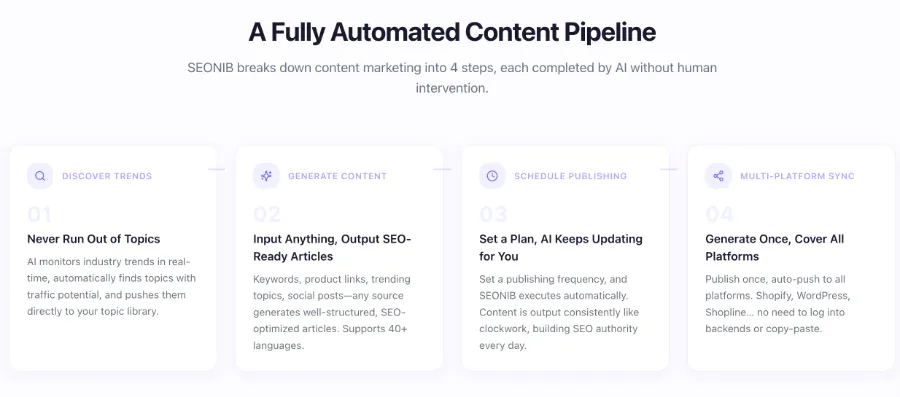
This turns “What should I write?” into “AI suggested five topics today, which one should I pick?” The mental load shifts from decision‑making to simple selection, a huge difference. Moreover, AI’s recommendation logic isn’t just “this term has a lot of searches”; it also considers what content my site currently lacks and how to fill more semantically related topics. Each new article actively expands my site’s topical breadth instead of being a random guess.
From Keyword to Article, There Should Be No Copy‑Paste
Traditional AI writing tools follow this workflow: generate article in ChatGPT → manually select → Ctrl + C → open backend → Ctrl + V → adjust title/format → manually insert internal links → manually add alt tags → manually set canonical → publish. For one article, you switch windows 8–10 times on average.
The problem isn’t just slowness; each switch is an opportunity for error. Missed a paragraph when pasting, formatting went off, forgot an image alt, internal link broken—these low‑level mistakes happened to me dozens of times. Plus, every time I have to re‑enter brand info, product links, internal‑link rules, even though I set them up just last week.
I grew impatient with this workflow, so I looked for something that could go straight from input to publishing, and I eventually discovered SEONIB. Its core function is to eliminate the “copy‑paste” step entirely. You feed it a keyword, a social‑media post link, or even a product URL, and it outputs a fully formatted article with SEO data pre‑filled, then automatically pushes it to the connected platforms.
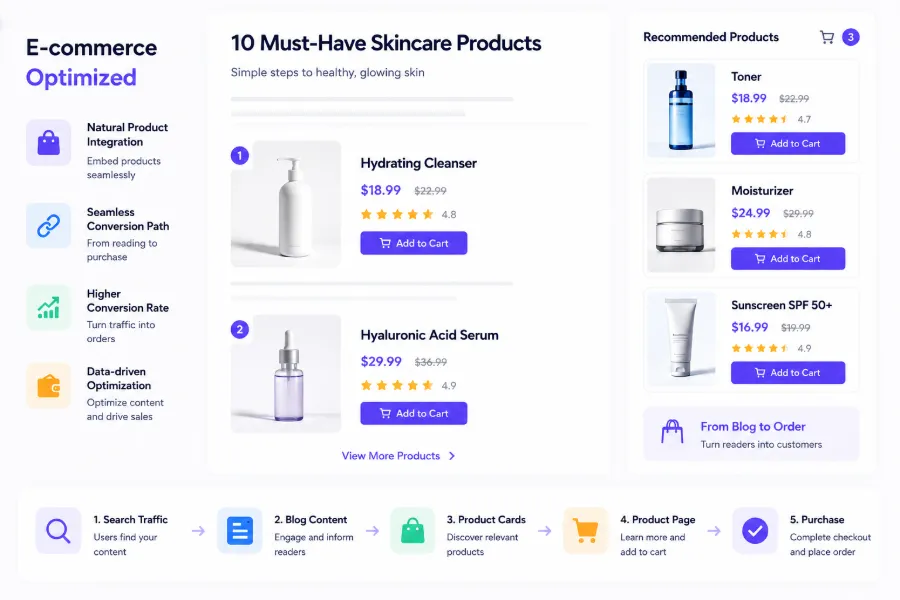
What really makes it worth it is the brand‑context configuration. You fill in brand description, default keyword internal‑link rules, product info, and asset library once during initial setup; thereafter every generated article follows that template automatically. Internal links, external links, brand information are inserted without any manual configuration.
For example, if a tweet goes viral and I want to turn it into a blog post, I just drop it into SEONIB and it generates a complete post in my brand’s style. I previously wrote a complete guide on converting social‑media posts into blog articles that’s quite practical. It also supports 40 languages, which is valuable for cross‑border scenarios—publish a Chinese version on domestic platforms and an English version on a Shopify blog without a separate translation step.
Manual operations from generation to publishing dropped from 15 minutes to almost zero. It’s not just ten‑fold faster; the step is eliminated entirely.
Publishing Is the Most Overlooked Pitfall
Many think the hardest part of content marketing is writing. I’ve seen too many people—including myself—stop after a few posts, not because they can’t write, but because “publishing one post is easy, but staying consistent for three months is hard.”
How tedious is manual publishing? Log in → upload image → set publish time → choose category → save → then log into a second platform → re‑upload image → re‑choose category… If you publish to three platforms, each post takes at least 8 minutes. Once you’re busy, blogging is often the first thing to get cut.
I started by manually using ChatGPT to write a post a day, kept it up for six weeks, then stopped. Not because I ran out of topics, but because after writing I still had to log into three backends, upload images, adjust formatting, add ad copy—exhausting. After I stopped, traffic dropped and my previous effort felt wasted.
I only realized after a costly failure that content marketing is a systems problem, not a willpower problem. You need a scheduling system, not just determination.
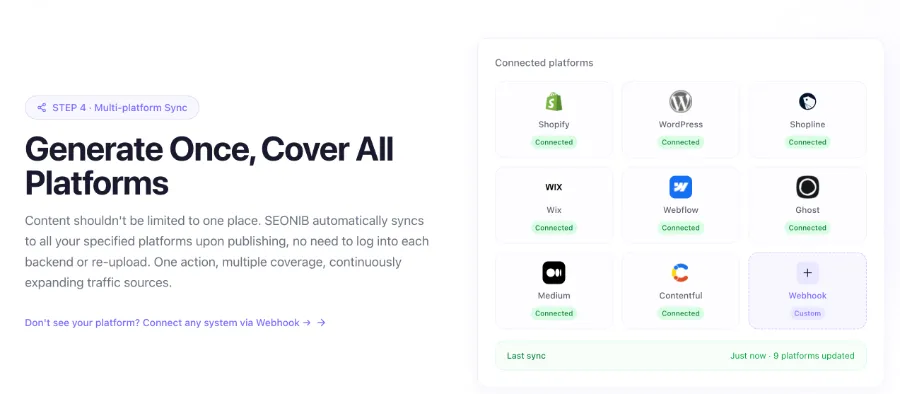
Now I use a scheduled‑publish + content‑calendar approach. Set a cadence of three posts per week, let AI generate and publish automatically, no daily monitoring. The system pushes each post to Shopify, WordPress, SHOPLINE, and all other connected platforms in one go—login once, no repeated actions. This multi‑platform sync saves a ton of time, especially when you manage both an independent site and an e‑commerce store.
Even though I run my own site, I know many new sites can gain traffic without backlinks. I wrote an article titled How a Zero‑Backlink New Site Can Win from the Starting Line that explains how consistent content builds authority—not through viral posts, but through steady output that signals to search engines that your site is “alive and has substance.” Most people overestimate the value of a single viral post and underestimate the cumulative effect of regular publishing; I’m increasingly convinced of this view.
After Connecting the Whole Workflow, I Realized How Foolish I Was
Once I linked topic selection, generation, and publishing, my daily content‑ops routine transformed completely. I used to spend 1–2 hours on repetitive tasks every day; now I spend about 10 minutes a week checking the content calendar, confirming that AI’s chosen topics are appropriate, and occasionally tweaking an article’s wording. The rest of the time goes to truly meaningful work—analyzing data, responding to comments, improving products.
The traffic impact is tangible. After running this workflow on a test site for 60 days, average search impressions grew 3–4 times. It’s not a sudden spike but a steady upward curve—Google Search Console’s impression graph went from flat to gradually rising. That “set‑and‑forget” feeling of growth is more reassuring than any viral hit.
Of course, I must be honest: it’s not a magic bullet. The initial setup of brand info, internal‑link rules, topic preferences, and asset library took about two hours. You need to clearly define your product terminology, common keyword chains, and content style in SEONIB so the AI knows what to produce. This upfront investment is fixed; once configured, you can reuse it indefinitely.
Regarding cost, you can pick a plan that fits your situation—SEONIB’s pricing plans range from personal to team tiers, and are not a burden for early testers. If you use a Shopify store, SEONIB already has an official integration in the Shopify App Store, allowing you to install and use it directly from the backend.
A practical piece of advice: don’t rush to automate the entire workflow. Start by “picking three topics you write most often,” let AI generate and publish for those, run it for two weeks, evaluate the results, then expand to more topics.
Also check out a more systematic guide: Complete Solution for Independent Sites to Auto‑Publish Daily SEO Content, which walks through building an automated content pipeline from scratch.
Now the first thing I do when I turn on my computer is no longer scroll the news; I check SEONIB’s content calendar—AI has already generated two posts for today, scheduled them, and I just need to glance at them. Removing the friction of “what should I write every day” turns content marketing into a system that can run continuously, not a grind sustained by willpower.
FAQ
Will automatically publishing content with AI get penalized by search engines?
No, as long as the content you generate is original and valuable. Search engines penalize low‑quality, plagiarized, or meaningless content—not content created by AI. The key is to have AI write according to your brand context and industry knowledge rather than using generic templates. Consistently publishing original, topic‑deep content actually improves rankings.
What if the content quality is low?
The quality ceiling of AI‑generated text depends on the quality of the input information. If you fill in brand data, industry terminology, product info, and internal‑link rules thoroughly during setup, the generated articles will be consistently good. My usual workflow is to let AI draft a rough version, skim it quickly, and if a paragraph isn’t precise enough, tweak a few keywords and regenerate. Overall it’s much faster than writing from scratch and the quality is sufficient.
Can I use my own brand style in the prompts?
Yes, and it’s recommended. SEONIB has a brand‑context module where you can configure tone, terminology preferences, common phrasing, etc. The more detailed you are, the more the output will sound like you wrote it. My style is conversational with a hint of self‑deprecation; after configuring that, every generated article reads as if I wrote it myself.
Is this workflow applicable to non‑e‑commerce sites?
Absolutely. Although SEONIB was initially designed for cross‑border e‑commerce, its underlying logic is content automation + SEO optimization, which is industry‑agnostic. Content blogs, corporate websites, personal knowledge bases can all use it. In non‑e‑commerce scenarios you simply don’t need the product‑card feature; the topic‑generation‑publish pipeline stays the same.
Do I need to know code to use it?
No coding required. The entire workflow is handled through the web interface—configuring brand info, setting internal‑link rules, binding platforms. The only potentially technical part is installing the Shopify or WordPress integration, but the official docs and tutorials cover every step. I came from a zero‑technical background and spent about two hours on the initial setup.
Share Article