Page-Level GEO in Practice: Getting AI Search Engines to Actively Cite Your Content

Last week I used Perplexity to look up an industry term and found that none of the three cited pieces were any of the articles I had on hand. This isn’t a ranking issue—my page is on Google’s first page, but the AI didn’t pick it. I began to realize that traditional SEO optimizes for clicks, while GEO optimizes for citations. This article breaks down page‑level GEO from a hands‑on perspective, explaining what’s changing and how to act.
AI search engine citations are not random. For the same query, the brand rotation rate among cited sites reaches 52%. This means AI won’t rely on a single source long‑term—if your content isn’t selected today, it doesn’t mean there’s no chance tomorrow, but you must organize your content in a way AI can understand.
What Is Generative Engine Optimization (GEO)? How Is It Fundamentally Different From Traditional SEO?
Generative Engine Optimization (GEO) is the strategy that makes AI search engines—ChatGPT, Perplexity, Google AI Overviews, Microsoft Copilot, Claude, etc.—understand and cite your content. Traditional SEO tells search engines that your page exists; GEO tells AI engines that your content is worth citing.
The core differences are obvious:
| Dimension | Traditional SEO | GEO |
|---|---|---|
| Optimization Goal | Ranking position | AI citation adoption |
| Success Metric | Clicks and traffic | Cited as a source by AI |
| Key Signals | Title and keyword density | Clear, precise declarative statements |
| Competitive Landscape | Compete for 10 blue links | Compete to be among 3‑5 selected sources |
| User Behavior | Users click links to visit | AI cites and synthesizes answers |
GEO does not replace SEO; it stacks on top of it. The same page can serve both types of engines—my tests show that pages optimized for GEO usually do not perform worse in traditional search results.
A point many overlook: AI’s “authority” comes not from the number of external links but from internal consistency and definiteness. A brand‑new site with no backlinks can still be cited by ChatGPT if its content structure is clear and its statements are assertive. To explore this phenomenon further, see Why Some Sites Get Cited More by AI Engines.
Three Core Strategies for Page‑Level GEO—Structure, Statements, Semantics
Clear Content Structure
Heading hierarchy (H1 → H2 → H3) must progress logically. AI parses a page by relying on heading structure to determine sections and main ideas. Each paragraph should convey a single point so AI can accurately extract the paragraph’s gist. In my 2024 GEO experiments I fell into a trap: I focused only on structured data and ignored the density of authoritative statements. The AI could recognize the page structure, but because there were no clear, citable conclusion sentences, it never adopted the content. Only after I forced each paragraph to provide a direct viewpoint did the citation rate start to climb.
Authoritative Direct Statements
Use affirmative sentences instead of vague language. Saying “recommendation volume increased by 30%” rather than “might help increase” makes the AI more likely to cite a sentence with a clear conclusion. Many content teams habitually use cautious phrasing to avoid risk, but that is precisely GEO’s nemesis. You can refer to How a Zero‑Backlink New Site Can Start from Scratch with the Right Idea for a content strategy that works equally well under the GEO framework—the key is not how many backlinks you have, but what you say and how you say it.
Structured Data & Entity Markup
FAQ Schema, HowTo Schema, and entity tags (Entity SEO) help AI confirm context and authority. Pages that use structured data are about 35% more likely to be cited by AI than those that don’t. Schema.org offers a rich set of markup types; choosing the right type matters more than piling on many—generally I add only 1‑2 the most relevant schemas to a page; adding more can actually cause AI to ignore them.
Integrating GEO Into Your Content Workflow—A Four‑Step Closed Loop From Ideation to Publication
Content marketing production can be fully standardized. The four‑step loop I use turns GEO from concept into daily operation.
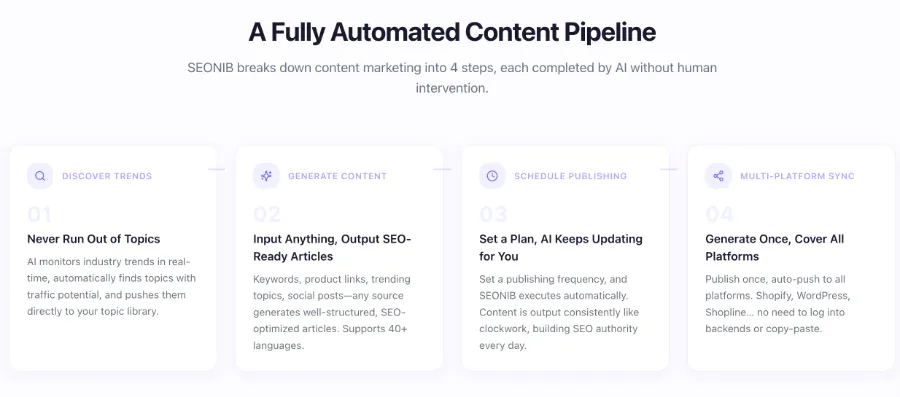
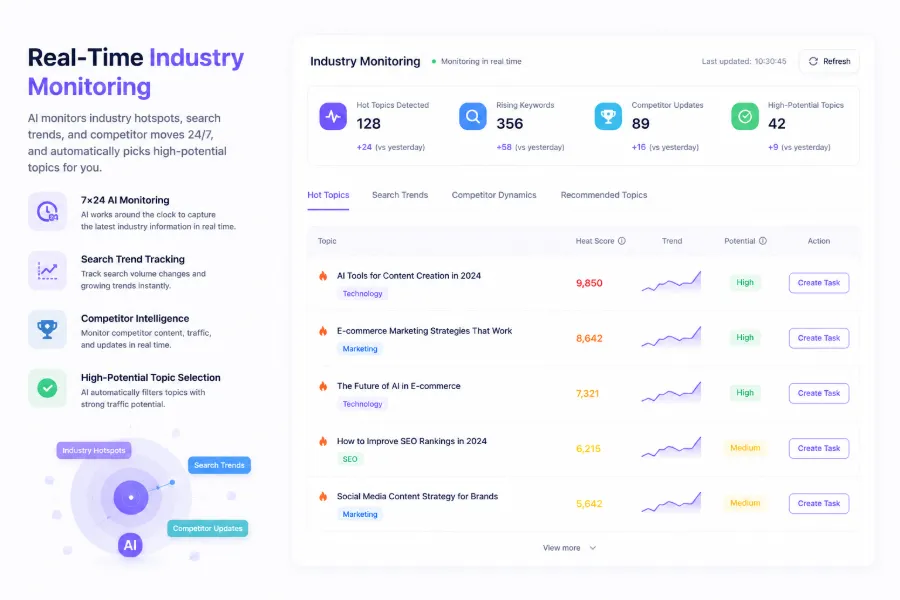
Trend Discovery
Use AI to monitor industry hot topics, search trends, and competitor content, automatically identifying topics with traffic potential. This step solves the “what to write” problem—relying on intuition for topic selection is the primary cause of low content operation efficiency.
Content Creation
Generate articles that are structurally clear and dense with authoritative statements based on keywords, product links, or reference sources. In this step I began using SEONIB—enter a keyword or product link and it directly produces an article with structured data and internal links, eliminating the manual structuring phase. You can see the full demonstration in the product‑to‑blog workflow:
For the specific mechanics of SEONIB and how it differs from ordinary AI writing tools, see What Is SEONIB and How Does It Differ From Regular AI Writing Tools?.
Planning & Publishing
Set a frequency and automate execution to maintain consistency. Continuous output is more effective than occasional bursts—maintaining a steady rhythm of 3‑4 posts per week usually shows increased AI citations after 3‑6 months. I initially tried publishing 10 posts per week; the content quality plummeted and AI citation feedback worsened. Scaling back to three posts per week and spending more time polishing core statements produced results. For tool selection, the comparison in 2026’s Best SEO Tools for Beginners can help you balance automation and manual work.
Multi‑Platform Synchronization
One generation automatically pushes to Shopify, WordPress, SHOPLINE, etc., reducing duplicate effort. Many content teams invest heavily in creation but waste more energy on distribution. After automating synchronization, SEONIB’s cross‑platform push capability closes the loop.
If you need a complete guide to each feature’s configuration, consult the SEONIB Help Documentation.
FAQ
Can GEO and traditional SEO be done simultaneously?
Yes, and they should be. GEO optimizes the citation value of content, while traditional SEO optimizes ranking signals. The goals don’t conflict; they reinforce each other—well‑structured pages also perform solidly in traditional search results.
Can a brand‑new site with no backlinks be cited by AI?
Yes. AI’s core judgment is whether the statements in the content are clear and the structure is logical, not the number of backlinks. I’ve seen several zero‑backlink sites get cited by Perplexity and Google AI Overviews within 6‑8 weeks of publishing.
How long does it usually take to see GEO results?
Typically, after continuously optimizing content structure and adding authoritative statements, you’ll see changes in AI citation sources within 2‑4 weeks. A brand‑new site from scratch usually needs 3‑6 months of steady content output to build a sufficient citation base.
What types of content are most likely to be cited by AI search engines?
Content with clear conclusions—comparative pieces, data‑backed how‑to guides, and well‑structured FAQ pages—has the highest citation rates. Vague industry overviews and macro analyses lacking concrete actions are significantly less likely to be cited.
Share Article