Content Closed Loop Is the New Standard: SEONIB, Veonib, and FlowNib Ecosystem Outlook

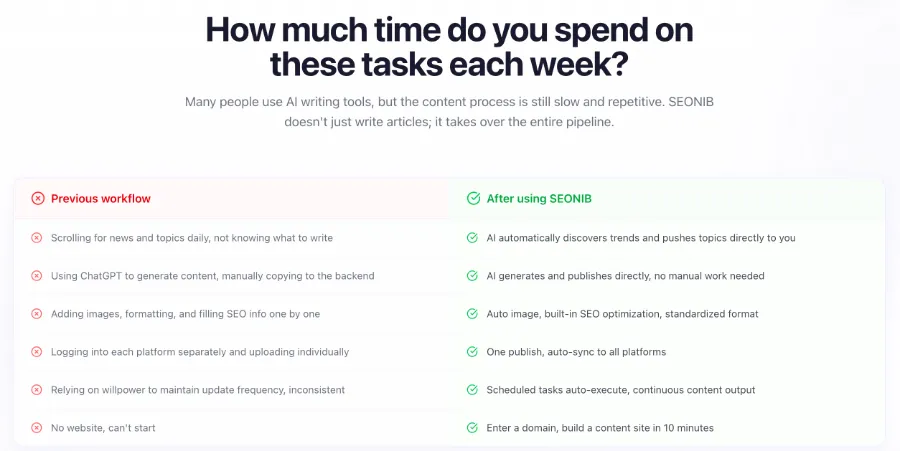
Last year I ran three independent sites by myself, spending nearly 20 hours a week on content. On Monday I selected topics, on Tuesday I used AI to draft a few articles, on Wednesday I manually added images, formatted, and filled SEO fields, on Thursday I logged into Shopify and WordPress back‑ends one by one to publish, on Friday I discovered that some platforms hadn’t synced at all, and I had to redo it over the weekend. After two months the publishing frequency dropped from five posts a week to zero, and search traffic was halved. That lesson made me realize that the biggest enemy of content operations is not that AI writes poorly, but that the whole process lacks a closed loop—each step consumes labor, yet no step automatically triggers the next.
Most independent‑site teams spend over 10 hours a week on manual tasks, time that could be used for data analysis and strategy optimization but is instead consumed by copy‑pasting and logging in and out. Trend discovery, content generation, scheduled publishing, and multi‑platform synchronization—if these four breakpoints aren’t connected, content assets can never be continuously accumulated.
Four Core Breakpoints in Independent‑Site Content Operations
First, trend discovery. I used to check Google Trends, Ahrefs keyword analysis, and competitor blog update lists every day, trying to find the next worthwhile topic. This approach is highly random—today a keyword may have traffic, tomorrow it may be obsolete. Even worse, when you get busy you simply can’t check the data, and topic selection grinds to a halt. I ran my site through Screaming Frog and found that pages not updated for three months saw a 60% drop in impressions in Google Search Console.
Then comes the manual step after AI generation. Many AI writing tools output only plain text; I need to add images, manually adjust heading levels, fill in meta descriptions, and insert internal links. A 1,500‑word article takes about 25 minutes from AI output to being ready for backend publishing. For sites that need to post 2–3 articles a day, this step directly determines whether you can keep up.
The publishing step is equally heavy. Managing multiple stores means logging into Shopify, WordPress, and SHOPLINE back‑ends one by one to paste the content. Sometimes the same article is posted on three platforms, and the formatting isn’t compatible. Updates are even more troublesome—changing a typo or swapping a product image requires repeating the operation on every platform.
The consequences of lacking automated scheduling are easily underestimated. The essence of content operation is frequency—Google’s crawl budget is preferentially allocated to sites that update continuously. If the update frequency fluctuates, the search engine’s trust in the site declines. The traffic halving I experienced was directly caused by two months of zero updates, leading to a comprehensive ranking drop. What’s needed isn’t just a writing tool, but a system that can automatically maintain the content rhythm. For more on this topic, you can read What is SEONIB and how does it differ from ordinary AI writing tools?
Content Closed Loop: Full Automation from Trend to Publication
A content closed loop, simply put, is: automatic trend discovery → AI generation → scheduled publishing → multi‑platform synchronization, with no human intervention required throughout. This isn’t a lofty vision; it’s an operational method I validated after three months.
SEONIB solves the trend discovery step. It monitors industry hotspots and competitor content gaps in real time, automatically pushing topics with traffic potential into the topic pool. I no longer need to check Ahrefs’ keyword explorer every day; the backend shows the newly generated topics for the day, each with search volume and competition data. These pushes aren’t random; they’re based on extensive content analysis—including the site’s existing content structure, under‑covered topics, and rising queries on search engines.
In terms of content generation, SEONIB supports multiple input sources. I pasted a product link and the AI automatically produced a complete blog containing a buying guide, product specification comparison, and FAQ. I also extracted the core idea from a Twitter post, and the AI expanded it into a 1,200‑word SEO article. The generated article already includes SEO fields, images, and internal links, so I don’t need to add anything manually. If you’re interested in this process, check out the AI SEO Guide (2026 Edition).
The multi‑platform synchronization feature is what I value most. With one click, the AI automatically pushes content to Shopify, WordPress, SHOPLINE, and other platforms. I’ve synced to four sites simultaneously, and each platform’s format was automatically adapted, eliminating the need for me to log into each backend and adjust manually. SEONIB supports 40 languages, so a single generated piece can cover multiple language versions across platforms.
The video below demonstrates how to sync blog content to Shopify, illustrating the actual multi‑platform synchronization workflow:
Ecosystem Perspective: Collaborative Value of SEONIB, Veonib, and FlowNib
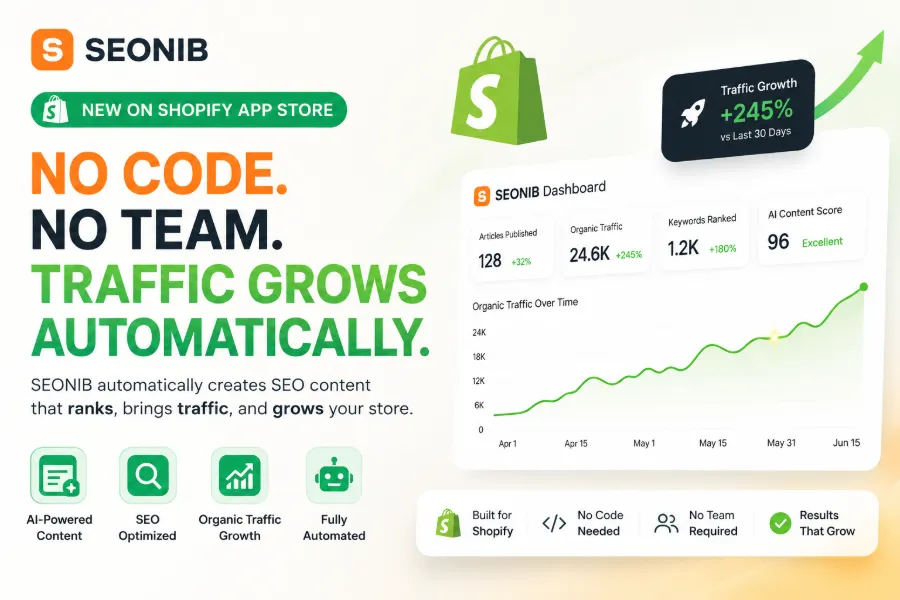
Once SEONIB supports an automation closed loop centered on textual content, I began wondering what could happen if visual content and workflow orchestration were also integrated into the same framework. This is the nascent ecosystem formed logically by SEONIB, Veonib, and FlowNib.
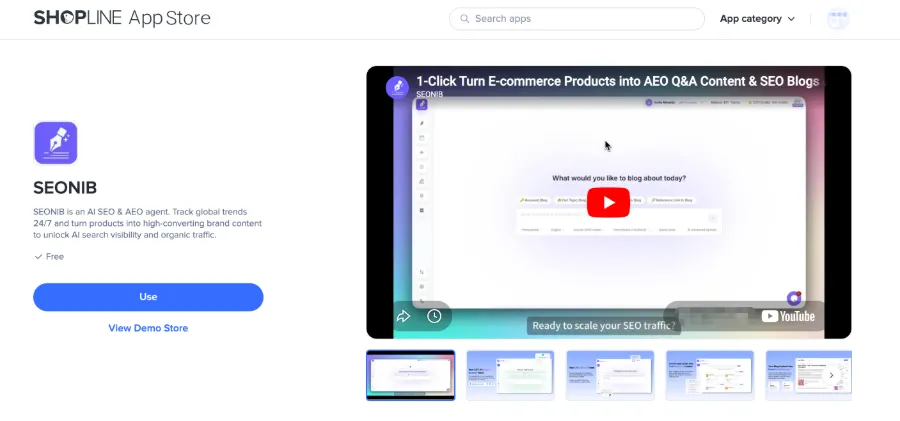
SEONIB handles search traffic acquisition, Veonib produces video content, and FlowNib manages social‑media distribution. Together they form a one‑stop AI cross‑border marketing automation workflow suitable for solo entrepreneurs, cross‑border e‑commerce, and independent developers, achieving end‑to‑end automation from content creation and video marketing to social‑media operation. Currently, SEONIB and Veonib are integrated, allowing AI videos to be synced to SEO blogs with a single click; FlowNib, as an independent AI social‑media distribution platform, provides content publishing capabilities. The chain formed by these three tools is “Discover → Create → Publish → Track.”
SEONIB discovers trends and generates text, Veonib adds visual assets, and FlowNib coordinates scheduling and cross‑platform pushes. When the tools collaborate within the ecosystem, the time from content publishing to indexing can be reduced to a few hours. Even using only one tool, such as SEONIB, can still form a closed loop—SEONIB already covers the main stages of the loop, while Veonib and FlowNib are complementary, further enhancing the ecosystem. For this multi‑mode collaboration, see SEONIB: One Platform, Three AI Growth Modes.
How to Start Building a Content Closed Loop: Practical Recommendations
Based on my one‑month experience, building a content closed loop doesn’t have to be done all at once. I recommend starting with configuring a brand knowledge base.
Step one is to get the AI to understand your business. In the SEONIB settings panel, fill in product information, industry terminology, and internal linking rules. For example, if your site mainly sells outdoor gear, enter product line names, common questions, and the brand’s core positioning. Also provide positive examples—your best‑written one or two articles—as style references. Prepare negative examples as well, indicating expressions you don’t want to appear in articles. This step determines the upper bound of AI‑generated content quality.
Step two: set up trend‑tracking keywords and competitor monitoring sources. Don’t overdo it; choose 5–10 core keywords and 2–3 main competitor blog URLs. The AI will continuously monitor updates from these sources and automatically push traffic‑potential topics to your topic pool.
Step three: define a publishing frequency. My recommendation is 1–2 articles per day, no more, no less. Set up a schedule from Monday to Friday in the content calendar, and let the AI execute automatically at that pace. Many people start with five posts a day, but after two weeks they can’t sustain it and stop altogether, which hurts site authority more than not publishing at all.
Step four: connect your store platforms. In the SEONIB backend, bind your Shopify or SHOPLINE account, then manually publish one or two articles to verify synchronization—check that titles, images, and internal links display correctly. Once confirmed, enable automatic scheduling. If you want to generate blogs directly from product pages, see Use SEONIB to Turn a Product Page into a Blog with One Click.
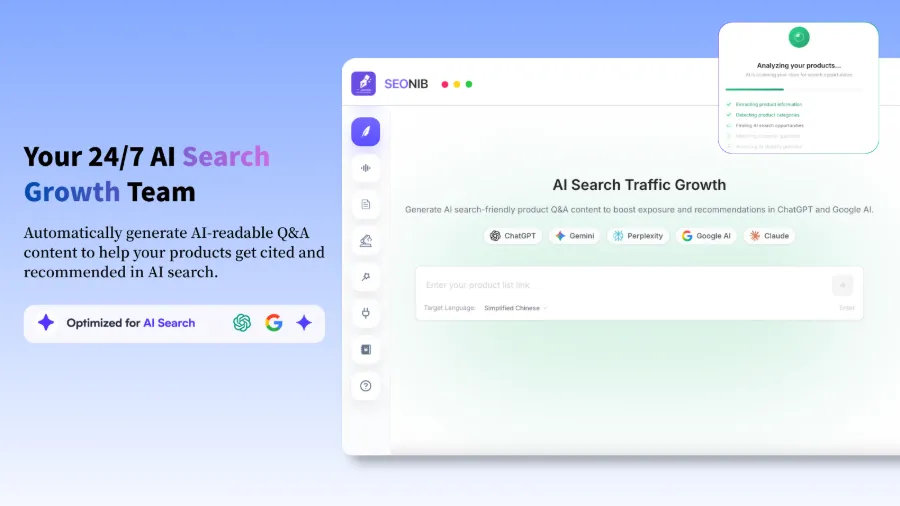
I suggest starting with the free tier for 1–2 weeks, monitoring page indexing and search impression changes in Google Search Console. At this stage, don’t chase rapid volume; focus on validating content quality and how search engines respond to automatically generated content. Once indexing looks normal, gradually increase the publishing frequency. If you want to check a page’s SEO performance later, see How to Check Page SEO Optimization: A Complete Step‑by‑Step Guide.
Once configured, the AI can run continuously without daily backend logins. After a month, you’ll notice content assets accumulating silently—each day a couple of articles rank on the first few pages of search results, bringing dozens to hundreds of clicks individually. These scattered small traffic gains combine into substantial natural search growth. For more detailed configuration methods, refer to the relevant Help Documentation.
FAQ
Does a content closed loop require human review?
It’s advisable to keep periodic spot checks, such as spending 20 minutes each week reviewing that week’s published content to ensure there are no factual errors or brand‑information deviations. However, routine execution is fully automated by AI, and you don’t need to manually check every publication.
How does the SEONIB ecosystem differ from ordinary AI writing tools?
The core difference lies in the closed loop. Ordinary AI tools only output text; you still have to select topics, format, fill SEO fields, and log into each platform to publish. The SEONIB ecosystem automates the entire workflow—from trend discovery and content generation to multi‑platform synchronization—so you only need to focus on settings and strategy.
If I only use one of the tools, can I still form a closed loop?
Yes. SEONIB alone already covers the main stages of the closed loop—trend monitoring, AI generation, scheduled publishing, and multi‑platform synchronization. Veonib and FlowNib are complementary additions to the ecosystem, not required.
How is content quality ensured after building the closed loop?
The key is pre‑configuration. Fill the system with your brand’s style guide, keyword strategy, asset library, internal linking rules, and positive and negative examples. Content generated by AI under these constraints has far greater quality stability than random output without such configuration.
Share Article