One-Person Marketing Team: How Small Teams Maintain Content Competitiveness with Automation
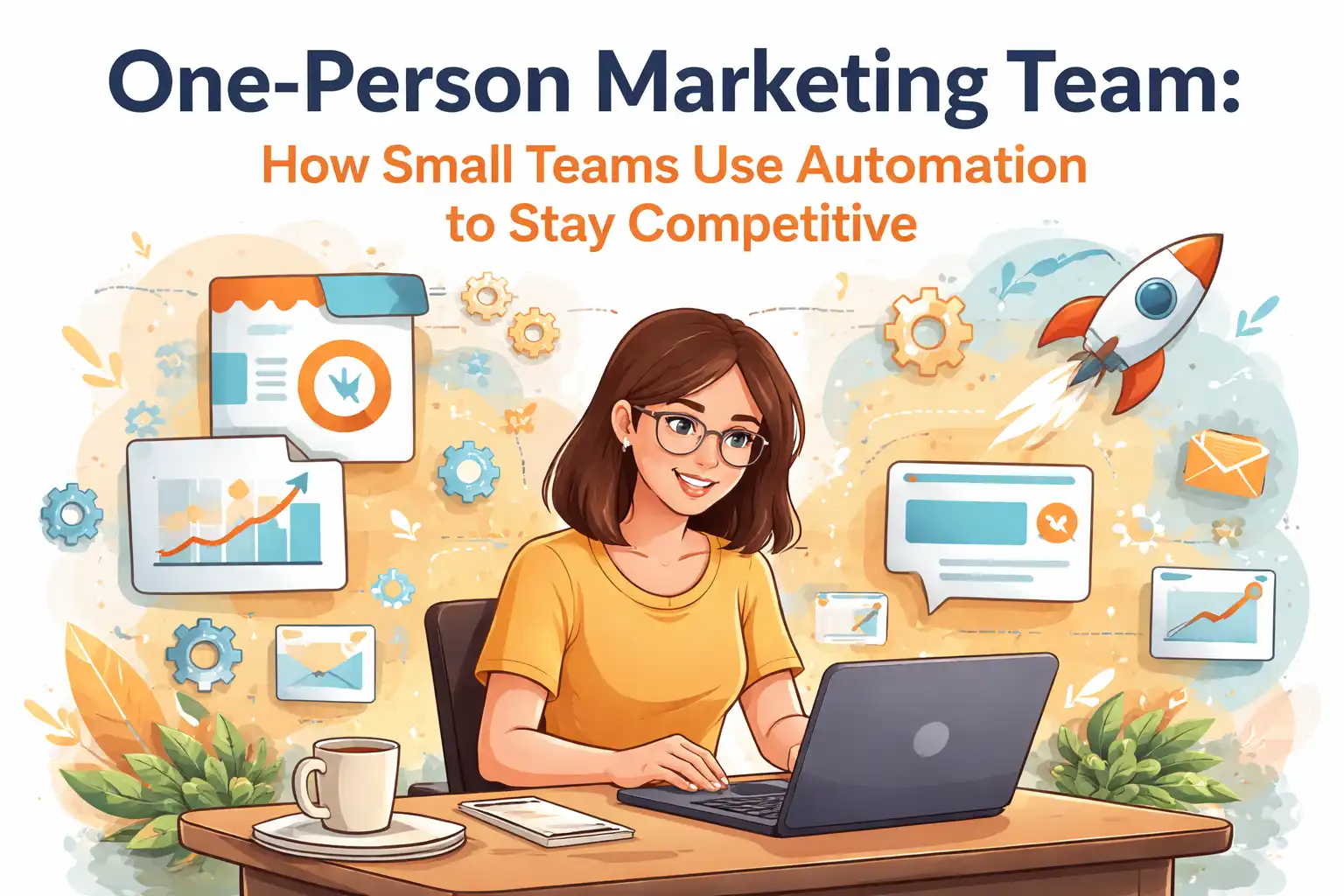
At the end of 2024, the team was reduced from five members to one. The weekly meeting agenda shifted from “publish three articles next week” to “synchronize five channels today” — this isn’t an exaggeration; it’s the daily reality for cross‑border marketers in 2025. This article does not discuss “whether to hire more people,” but instead breaks down how, when manpower is irreversibly reduced, workflow reorganization and toolchain upgrades enable a single person to complete the entire process from topic selection to publishing. Is paying for SEO and GEO services worth it
Downsizing Marketing Teams Is Not an Isolated Case, but a Structural Efficiency Shift
Data from the C.M.O. Survey 2024 shows that, for the first time, the share of spending on automation tools in marketing teams has exceeded that on personnel. This is not a simple budget cut, but a structural efficiency shift: tools are replacing repetitive tasks that previously required two to three people. How content supports AEO and AIO frameworks
In the cross‑border industry, this trend is especially pronounced. Industry observations from Gartner and HubSpot both point to the same conclusion — marketing team sizes continue to shrink, but output targets have not been proportionally reduced. A smaller team does not mean less output; it simply requires a redesign of the workflow.
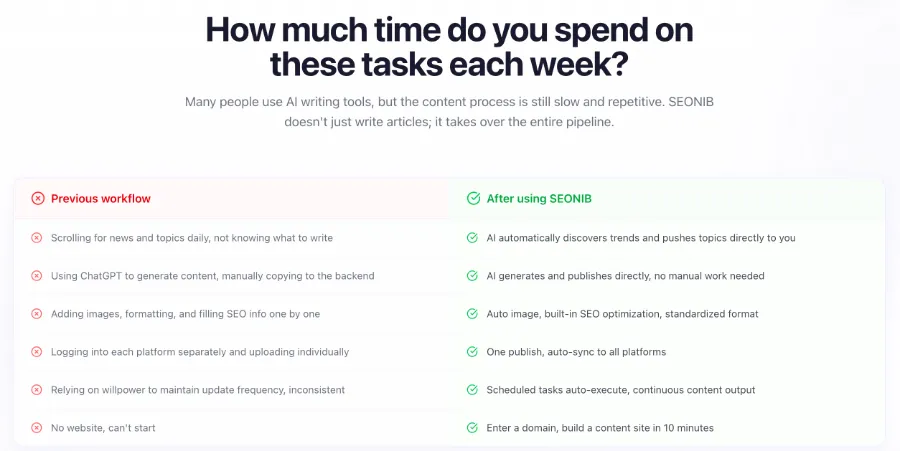
The previous division of labor among five people was: one person monitors trends and topics, two writers, one SEO optimizer, and one publication manager. Now these steps must be performed by a single person, and the only viable solution is to use tools to handle the repetitive parts.
 Which content performs well in ChatGPT search
From an industry perspective, this is not a problem unique to cross‑border sellers. Any content‑driven business faces the same efficiency bottleneck when the team size drops below three. The difference lies in who finds the alternative solution first.
Research shows that marketers in small teams spend an average of 12 hours per week on formatting and platform transfers. This time could be spent on topic strategy or content quality optimization. Make AI answer engines cite your content
These repetitive steps are precisely what automation tools excel at solving. For these repetitive steps, some platforms such as SEONIB integrate topic discovery, AI generation, SEO optimization, and automatic publishing into a single pipeline. However, tools are only means; the key is how the workflow itself is reorganized.
There is another often‑overlooked issue: content quality and its compatibility with AI search. If the generated content structure is incorrect, even if published, ChatGPT search or Google AI Overviews will not index it. Understanding in advance which types of content perform better in ChatGPT search is crucial for pre‑defining content structure. On the other hand, from a content‑structure optimization perspective, understanding how content supports AEO: the complete 2026 framework can help you plan Q&A structures, entity annotations, and brand context before generating content.
From Topic Selection to Publishing: An Automated Workflow That One Person Can Run
Operating a full content pipeline as a single person revolves around a four‑step framework: trend discovery, content generation, scheduled publishing, and multi‑platform synchronization.

Step 1: Trend Discovery. No need to manually browse forums and social media. Automation tools can monitor industry trends and competitor content in real time, automatically identifying topics with search demand and traffic potential, and push them to the topic pool daily. For a Shopify seller, the tool can automatically match high‑search‑volume keywords such as “Shopify SEO 2025” and “AI search optimization,” and generate corresponding writing tasks.
Step 2: Content Generation. Input a keyword, product link, or hot topic, and the tool automatically generates an SEO‑optimized article. It supports more than 40 languages, which is essential for multilingual cross‑border e‑commerce. Input a product link to generate a buyer’s guide, usage tutorial, or review article. Input a keyword to generate a complete article with pre‑set H2 structure, internal linking rules, and brand context.
Step 3: Scheduled Publishing. Set a publishing frequency (daily, weekly, or custom), and the tool executes the schedule automatically. No need to log into the backend daily to trigger manually. The content calendar can preview the upcoming week’s publishing queue, and you can manually adjust before publishing.
Step 4: Multi‑Platform Synchronization. One publish automatically pushes to all platforms. For example, SEONIB supports a single publish that automatically pushes to Shopify, WordPress, and others, eliminating the need to log into each backend or copy‑paste. For sellers building an independent site with the Shopify website, this synchronization capability saves over an hour of daily platform uploading.
If you want to configure this workflow from scratch, refer to SEONIB’s guide “Bulk Publishing to WordPress: Turn Your Blog into an Automated Content Factory,” which details how to integrate site‑building tools and set up automatic publishing rules. Bulk publish blog to WordPress
More advanced settings can be found in the official help documentation, which includes complete instructions from account configuration to multilingual content strategy.
After adopting this automated workflow, a single person can produce 15–20 pieces of content per day and sync them to more than four platforms. This number may sound exaggerated, but the premise is that you are willing to spend two days initially configuring the brand knowledge base, internal linking rules, and publishing templates. Once configured, daily maintenance only requires half an hour to check content quality and adjust topic direction.
Returns of Automation and the Trade‑offs You Must Accept
A Shopify seller who used an automation platform saw natural search traffic increase by 150% within three months. This was not due to increased investment, but to a stable frequency and breadth of content output.

The traffic growth is real, and indexing speed is also improving. Previously, a piece of content would wait two to three weeks for long‑tail keywords before being indexed. Now, with a stable frequency and broad topic coverage, Google’s crawler trusts the site more, and the proportion of new content indexed within 24 hours has risen from 60% to 90%.
However, in another case, an independent e‑commerce marketer tried full automation in 2024 and experienced a backlash. He set up three automatic publishing channels, outputting 30 articles per day, and traffic did rise. But after two months, the articles, though numerous, lacked unique viewpoints, and click‑through rates declined after AI search and Google indexing. The reason was that all content was template‑generated, appearing structurally complete but lacking differentiation when read. His lesson: full automation wins on coverage and consistency, but brand depth requires human calibration.
SEONIB offers a compromise: it allows users to pre‑populate a brand knowledge base to reduce homogenization risk. After configuring industry terminology, product information, and brand tone, the generated content style aligns more closely with the brand voice. Additionally, a recommended practice is to set aside one day each week for manual review of that week’s published content, selecting 3–5 high‑quality pieces for deep processing — adding real case studies, inserting internal data, and adjusting opening sentences. This operation takes only one or two hours but yields noticeable improvements in click‑through rates and user dwell time.
From the data, after adding a human quality‑check step, the same seller’s content click‑through rate recovered from 0.8% to 2.1%. Although total output dropped from 30 to 20 pieces per day, overall search traffic increased by 20%. This validates the conclusion: automation handles coverage, humans handle depth; both are indispensable.
Comparing paid SEO and GEO services: the real‑cost and ROI decision framework has discussed similar questions — tools are suitable for scaling, but brand tone calibration still requires humans. If you want to see a purely personal operation, a personal case study that gains search traffic through a blog demonstrates the output efficiency of fully manual work, while the “cheat” record of creators who let AI run first shows automation’s advantage in content volume. Looking at both together provides a clearer assessment of automation’s applicability at your current stage.
FAQ
Q: If the team has only one person, can automation tools really replace the work of two or three people?
What can be replaced are execution‑level tasks — topic discovery, drafting, formatting adjustments, and multi‑platform publishing. What cannot be replaced are strategic judgment and brand‑tone control. A single person using tools can achieve the output of three people, but must allocate 4–6 hours each week for content quality checks and direction adjustments. Data shows that a single person can produce 15–20 pieces of content per day, provided the brand knowledge base and internal linking rules are fully configured.
Q: Will automatically generated content be judged as low quality by search engines?
The key lies in content structure and degree of differentiation. If you generate only with templates and lack brand context configuration, it is indeed prone to being labeled as homogenized. However, with a brand knowledge base, internal linking rules, and entity annotations configured, the content’s entity density and topical relevance meet standards. The core issue is that automatically generated content appears to search engines as “structurally complete but with ordinary viewpoints.” The remedy is to incorporate brand‑unique cases and data points.
Q: In multilingual cross‑border e‑commerce scenarios, how does the tool handle content in different languages?
The tool supports over 40 languages, but not all languages achieve the same quality. English and Spanish have the highest output quality, while minor languages such as Arabic or Thai require human verification of grammar and localization. A recommended approach is to let the tool generate a draft, then have a native speaker polish it, rather than relying on machine translation. The cost is still about 80% lower than fully manual writing.
Q: After using automation tools, is an SEO specialist still needed?
Yes, but the role changes. Traditional SEO specialists mainly conduct keyword research and on‑page optimization; now they need to become “automation workflow managers” — responsible for building and maintaining the toolchain, configuring brand context, monitoring quality, and adjusting internal linking strategies. This role focuses more on technical configuration and data analysis rather than repetitive execution. Independent sellers can take on the role themselves, but will need one to two weeks to learn tool configuration and SEO metric interpretation.
Q: If I don’t have an independent site, can I still get traffic with automated content?
Yes. Automation tools support publishing to platforms such as Medium, LinkedIn, Facebook, etc., and also allow long‑tail SEO articles to be distributed on third‑party content platforms. Traffic sources expand from brand website search to platform search and AI search. However, in the long term, it is still recommended to pair this with an independent site to accumulate genuine brand assets and user data.
Share Article