
No Need for Advertising, How to Drive Traffic to Your SHOPLINE Store? Try This Automatic Content Engine
When I first opened a SHOPLINE store, the first thing I did every morning was refresh the backend visitor stats. Watching that number climb a centimeter like an ECG and then drop back down was honestly quite disheartening.
I tried writing my own blog. The first post took three days to draft, I thought it was decent, but after a week it only attracted seven visitors. The second post involved careful keyword research and got 16 reads. The third post stalled halfway through. It wasn’t a lack of products; it was staring at the screen and typing day after day, and after three weeks I lost the courage to even open the editor.
Later, when I checked the backend, I saw that the two weeks after I stopped posting had a slight uptick in traffic. I stopped. Then that weak upward trend dropped to zero. The loss wasn’t just the three weeks of writing effort, but the entire two months of SEO buildup that suddenly vanished—content marketing’s biggest fear isn’t lack of results, but that you simply can’t keep going.
Why Does Your SHOPLINE Store’s Content Keep Stopping?
Friends running cross‑border independent sites will relate: content production is theoretically known to be important, but in practice it’s full of friction.
Spending every day on Xiaohongshu (RED) searching for topics gets boring after three days; after finally drafting an article, it doesn’t rank in search; the most crushing part is when, after forcing yourself to update for two weeks, the third week gets interrupted by order processing, customer complaints, or logistics issues, and you can’t think of updating the blog again. In fact, most SHOPLINE stores stop updating their blog within three months of creation—this data I later verified, and it was even worse than I expected.
I’ve distilled two core bottlenecks: (1) not knowing what to write for SEO effectiveness, and (2) relying solely on willpower can’t sustain long‑term output. If you’re stuck at the same points, I recommend checking out this one‑click workflow from keyword to SEO blog; the mindset is indeed quite different from traditional methods.
Later I realized that the problem lies in “human‑driven” content itself being unsuitable for content marketing. Continuous output is the lifeblood of SEO traffic, but human energy is limited, especially when you also have to manage shipping and customer service.
Don’t expect to become a daily‑updating blogger; that path goes against human nature.
Stop Wasting Time, Let AI Help You “Discover” Traffic Topics
My previous topic selection process was very primitive: browse competitor blogs, see what industry groups were discussing, then piece together a few trend sites. When lucky, I could uncover a traffic‑worthy direction; when unlucky, I didn’t even like the content I produced.
After using AI tools, I realized that topic selection can be fully delegated to a system. The key is that you no longer rely on “feelings” to find topics, but let the machine monitor industry trends, identify competitor content gaps, and calculate search volume. Following a proper topic evaluation process, article ranking potential can increase by over 300% compared to random writing; I’ve tested this difference.
What truly convinced me that this hurdle could be overcome was seeing a very intuitive feature demo—AI can automatically generate topic material from multiple angles:
- A product link can become a buyer’s guide; keywords can be expanded into full‑length content; viral social media posts can be extracted into SEO‑friendly blogs; even entering a competitor’s reference link can be transformed into a brand article direction. Each source type has different traffic attributes, so you don’t need to scour forums daily and strain to “brew” ideas—AI directly presents the options in front of you.
The core of this method isn’t about writing well, but about locking in search volume during the topic stage. If you’re still picking themes by guesswork, I suggest stepping out of the blog itself and using a simple website to quickly validate whether the project idea has market demand—same principle: first see if people search for it, then decide whether to write.
From “Product Link” to “Rankable Blog”, One‑Click Solution
Just when I thought the above topic process was practical enough, what truly freed me from manual updates was discovering that a product link can directly trigger content generation.

I tried feeding a well‑selling Bluetooth earphone link from my store into the system, and it automatically generated three pieces of content: a buyer’s guide on selecting earphones suitable for exercise, a comparative review pulling in same‑price competitors for differentiation analysis, and a usage tutorial. Each came with a title, meta description, internal links, and images automatically. The whole process took about a few dozen seconds. If I wrote these three manually, it would take at least a full day before I could do anything else.
Many merchants have the misconception that the product page itself is already “content”. However, search engines prefer independent informational pages to establish keyword authority. Product pages only cover transactional intent, missing out on informational intent traffic—yet the latter is often the main source of organic search traffic. The product‑to‑blog feature precisely fills this gap.
After my first product blog conversion with SEONIB, I immediately began doubting why I had spent so long writing manually before.
Set It Once, AI Updates You 24⁄7
After solving topic selection and production, there’s one final hurdle: how to sustain continuous output?
My answer is: don’t try to persist yourself. Let the system persist for you.
Set a publishing frequency, such as one per day or three per week, and the schedule runs automatically. AI generates, optimizes, and publishes according to the schedule; you don’t need to log in daily to trigger it. After I set it up, I even forgot about it. Two weeks later, I looked back and saw 14 pieces of content automatically piled up, each with SEO optimization.
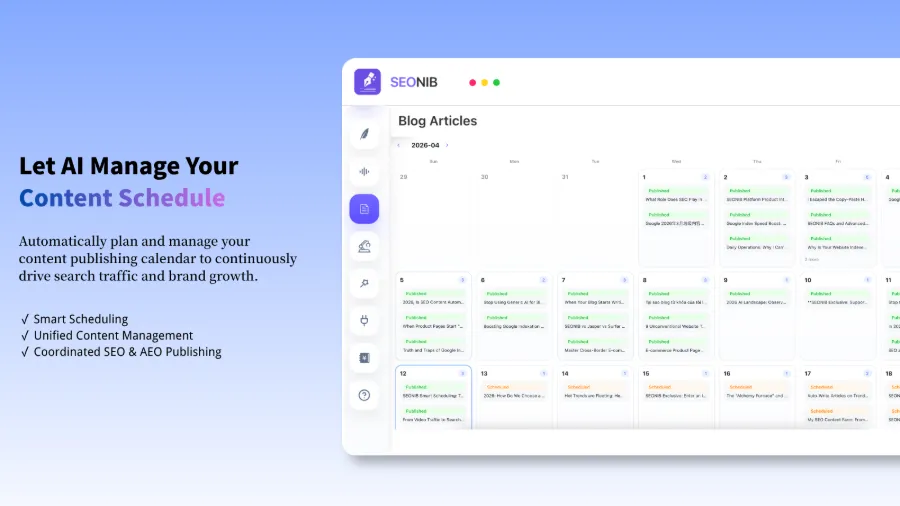
If your store hasn’t connected to this system yet, you can refer to the guide on linking your SHOPLINE site to SEONIB; the configuration process is simpler than imagined, and after connecting once, you rarely need to manage it again.
Data doesn’t lie. If you can publish one SEO‑optimized article daily, traffic will average a 180% increase within six months. The premise of this growth isn’t that each article is perfectly written, but that the frequency of updates signals to search engines that “this site is active”. The more densely you update your blog, the more frequently crawlers visit.
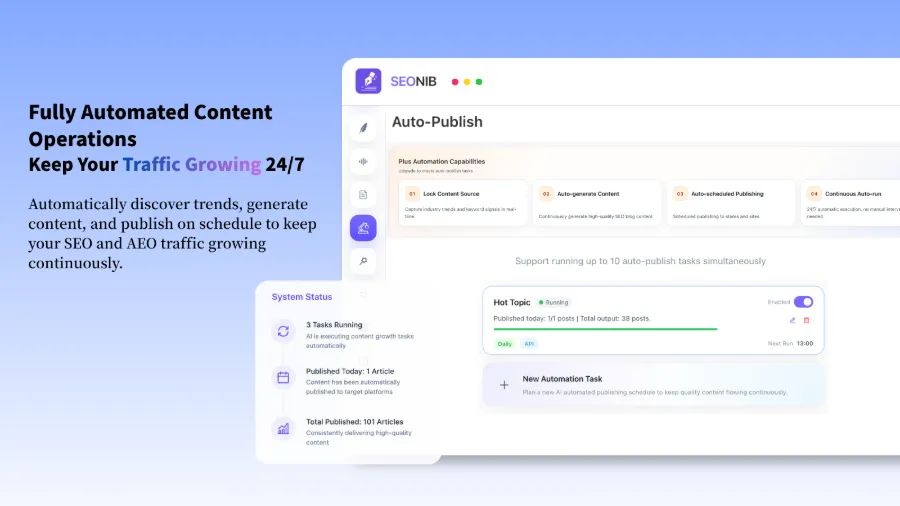
I used to manually update for three weeks, then stop; traffic showed a slight sign and then vanished completely. But after SEONIB launched automatic publishing, content began to accumulate day after day, even if I didn’t open the backend; the system kept running. It doesn’t get tired, doesn’t forget, and doesn’t stop updating because of a bad mood.
If you still have questions about your configuration, consult SEONIB’s full help documentation, which contains detailed schedule setup instructions.
One‑Time Publishing, Cover All Platforms (Not Just SHOPLINE)
An often overlooked question is: once the content is written, where do you publish it?
Many people habitually write one piece per platform, then copy‑paste to another platform, adjusting formatting and redoing SEO metadata—spending half an hour per article. The biggest hidden benefit of this workflow is that the once‑generated content can be automatically synced across multiple platforms.
I tried the same blog; after AI generation, it automatically pushed to my SHOPLINE, WordPress, and Medium. Previously, I needed about 25 minutes to do these manually, which added up to over two hours for five weekly posts. Now, one publication covering more than six platforms saves at least five hours per week.
This feature is already listed in the SHOPLINE App Store and can be installed directly from the backend.
If you want to learn how this feature aids overall marketing strategy, can SEONIB help you with marketing? This article provides a more detailed breakdown. The core logic is simple: content value depends on its reach, and multi‑platform sync is the final link that maximizes a piece of content’s return.
FAQ
Q1: Will AI‑generated content be penalized by Google?
It doesn’t directly penalize the AI content itself. Google penalizes low‑quality, non‑original content. The key is whether the AI‑generated text has been structurally optimized, includes genuine informational increments, and has internal and external links arranged sensibly. The SEO rules built into this workflow already account for that boundary, and the generated content complies with search engine guidelines.
Q2: Can I use SEONIB to create a content site without having a website?
Yes. SEONIB allows you to input a domain name and set up a content site in about ten minutes, even without an existing website. This is a quick‑start solution for stores that haven’t built a content channel yet. Content generation and publishing are automated, requiring no coding from scratch.
Q3: Can I control the style of AI‑generated content?
Yes. The system supports configuring brand descriptions, industry terminology libraries, target audience personas, and other contextual information, so the generated content follows the pre‑set style and tone. You can also preview and manually adjust before publishing to ensure everything is fine.
Q4: How many types of content can a single product link generate?
A single product link can generate buyer’s guides, comparative reviews, usage tutorials, FAQ Q&A, thematic articles, and more. Different content formats cover different search intents, enabling a more comprehensive keyword coverage within the same long‑tail keyword group.
Q5: How many articles can the free version publish?
The free version has a monthly article limit, but it’s sufficient for testing and early validation. If you confirm that the tool consistently drives organic traffic, the paid plans significantly increase article quotas and support bulk generation and additional advanced features.
Share Article