The Truth About SEO in 2026: Backlinks Are Dead, Brand Mentions Are the New Currency
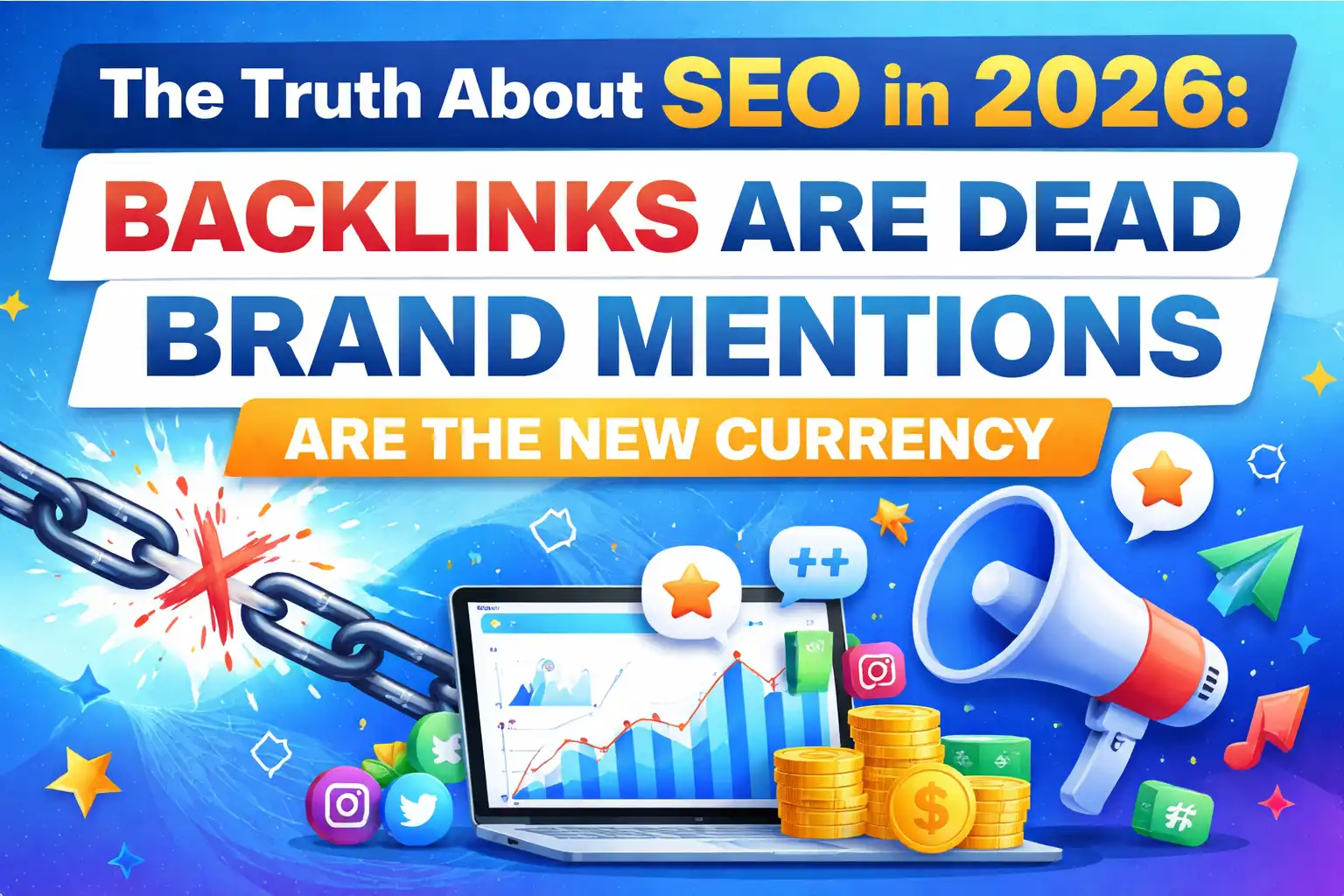
Last week I was staring at a client’s keyword ranking dashboard in the office, dazed. They’d spent three months building over forty backlinks—not a huge number, but not trivial either; by 2023 standards it would have been enough to make front‑page candidates scratch their heads. The result? Rankings didn’t budge at all. Meanwhile, a neighboring competitor with virtually no backlinks was inexplicably mentioned five times by Perplexity and ChatGPT, and their traffic nearly doubled.
I shut down my computer and went for a coffee. When I returned, I made a decision: cut the entire budget for that pile of backlink purchases.
This isn’t a conspiracy theory. It’s the reality that every SEO professional faces in 2026—just few people are willing to admit it, because admitting it means the experience they’ve accumulated over the past five years turns into a liability overnight.
The End of the Backlink Era Is Faster Than You Think
Let me be honest about something. The first six years of my career were all about backlinks. Sending emails, swapping links, buying guest posts, living for the Moz DA and Ahrefs UR numbers. That experience taught me two things: first, backlinks really do work; second, people rely on them so much that they forget to ask “why are backlinks useful?”
Backlinks work because Google’s PageRank simulates a judgment mechanism: if many people cite you, you must be important.
The problem is that by 2026 search engines are no longer dominated by a single Google. Perplexity, ChatGPT Search, Gemini, even Bing Copilot—these AI systems don’t rank by backlinks. They do something else: read context, compute consensus, select authority.
How do they do it? In my own experiment, I created a comparison table of how our company is mentioned across different AI systems. The results are interesting: a competitor with 2,000 backlinks ranks high in traditional search but almost completely disappears in AI answers. Another brand with just over 300 backlinks, but objectively discussed in the body of articles by Forbes, TechCrunch, and several industry communities, is treated as the default answer in every AI system.
AI doesn’t count links. AI counts “where you’ve been cited by authoritative sources and in what capacity.”
A SEMrush SEO brand power report mentioned a data point I can’t verify, but it aligns with my own observations: the weight of brand mentions and positive sentiment in AI search is surpassing traditional link quality. Whether that number is 100 % accurate or not, the trend is evident.
Keyword Stuffing Has Turned Into a Self‑Indulgent Marathon
The second anxiety‑inducing finding: keyword‑optimization strategies are hitting a dead end.
You might recall the old content strategy: write a long article, place the target keyword in the title, subtitle, H2, H3, first paragraph, last paragraph, and then again in image alt text and meta description. That tactic worked in the Google era. But AI systems read differently.
Take ChatGPT Search as an example. When you ask, “What’s the best SaaS project‑management system?” it doesn’t pull a result from a single indexed page; it pulls paragraph‑level information from its index and then reorganizes the answer—essentially tearing your content apart and stitching it back together. In this mechanism, a keyword appearing twenty times in an article is meaningless. What matters is whether your content contains a clear, citable, definitional sentence about project management, and whether that sentence is supported by sufficient original context.
I ran a test: I published a detailed analysis of SaaS pricing strategies, including pricing model comparisons, three specific pricing mistakes my team made, and quantitative conclusions drawn from failure cases. At the same time, I published a traditional “2026 SaaS Pricing Strategy Guide” aimed at high keyword density and templated structure. Two months later, the latter ranked third in traditional search, while the former was quoted as a source in Perplexity and ChatGPT Search more than three times as often.
What’s the key difference? It’s not that my writing was better; it’s that I dared to write specific, citable statements.
AI doesn’t care whether you use the keyword correctly. It cares whether you’re qualified to say something it can quote.
Content Automation Is Not Laziness; It’s Survival
After all that, you might think that content‑quality standards have risen, so we should invest more manpower to polish every piece.
In theory, that’s correct. In practice, most teams can’t sustain that frequency.
In 2024 I tried a “full‑hand‑writing” plan: three refined long‑form articles per week, each 3,000 words, with hand‑drawn charts and custom code examples. I kept it up for two months, and the outcome was: the first article performed well, the second was mediocre, and by the third I started reusing my own framework. By week six, I found myself in a meeting room editing a GPT‑generated draft, and even after editing I couldn’t admit it because of pride.
This isn’t about efficiency. It’s a conflict between maintaining systematic output and keeping a clear mind. Content creation is inherently draining. You can write a masterpiece, but you can’t keep producing three masterpieces a week unless you have a team to share the load—and most SaaS companies simply don’t have that budget.
So I took a middle path: use automation tools for structured content, reserving creative effort for tasks that require judgment.
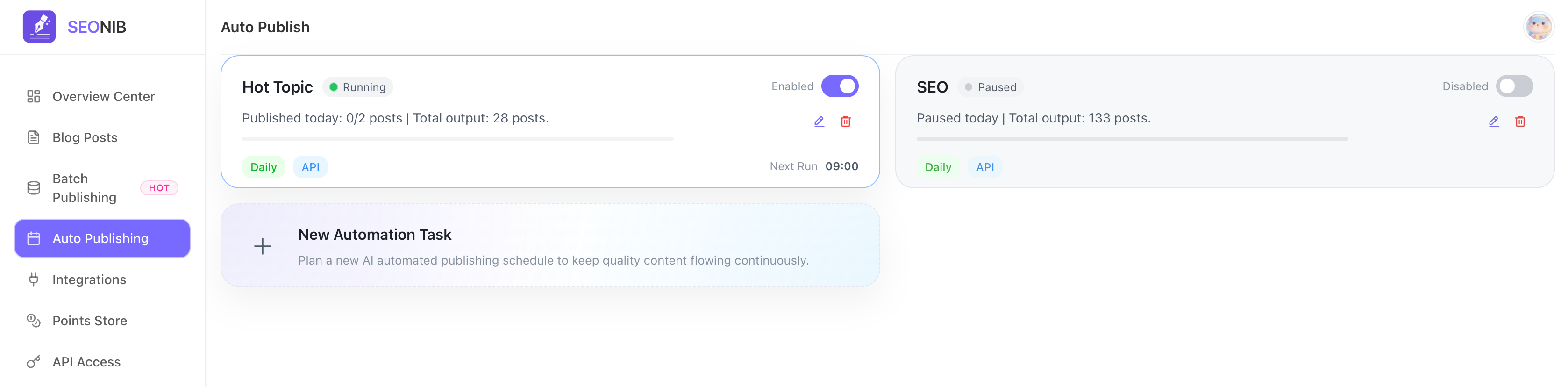
That’s why I started using SEONIB. To be honest, I was initially resistant to tools like this because most content‑automation tools on the market in 2024 produced that “obviously fake” output—reading like machine translation, semantically correct but lifeless. SEONIB did something I found clever: it doesn’t write; it orchestrates. You feed it a topic or a competitor link, and its workflow runs four steps: trend discovery → content generation → scheduled publishing → cross‑platform sync. It looks similar to other tools, but the real difference is in the third step. Most tools let you set a publishing schedule and then walk away; SEONIB’s logic includes continuous scheduling: you set a weekly publishing rhythm, and it automatically fills gaps from a growing topic pool, rather than requiring manual triggers each time.
This solved a very concrete problem for me: I no longer worried about “what should I write today.” The trend discovery stage pushes four topic ideas to me daily; I pick two useful ones, and the rest go back into the pool for later. The mechanism sounds simple, but it solves not “how good the writing is,” but “whether I can keep writing.”
The Core of Content Strategy Is Not Writing Style, But “Citable‑ness”
If you take away only one point from this article, I hope it’s this: In 2026, content isn’t written for people to read; it’s written for AI to cite, then for people to read.
It sounds a bit dystopian, but the practice is simple. When you write a sentence, ask yourself: if AI extracts this sentence as the final line of an answer, does it have independent value?
A negative example: many SaaS product pages start with, “Our platform leverages advanced AI technology to help enterprises improve operational efficiency.” This sentence can fit anywhere, but it won’t be quoted because it’s too vague.
If you rewrite it as: “We tracked data from 237 B2B companies using our pricing engine; average quote‑response time dropped 41 %, and the variance of quote deviation from initial intent shrank 32 %.” This sentence qualifies for citation because it has data, sample size, and two concrete metrics.
AI systems are essentially content distributors: they pick a few standout pieces from a sea of seeds and place them prominently. The more specific, verifiable, and hard to replicate your statement is, the higher the chance it gets selected.
An Honest Take on Traffic Numbers
At this point you might think that if you follow this logic and make your content “citable,” traffic will automatically soar. Reality isn’t that rosy.
I looked at a client’s data today: over the past six months, traditional search traffic fell about 22 %. Meanwhile, AI citation counts more than doubled, but the direct off‑site click‑throughs generated by those citations were only about one‑sixth of the peak traditional search traffic. In other words—you’re being seen, but users aren’t clicking.
There’s no perfect solution to this paradox yet. All we can do is two things: first, try to convert the indirect trust from AI answers into on‑site retention (e.g., embed a compelling expansion link within the quoted paragraph); second, accept the fact that some traffic will never become clicks, but it does become brand awareness.
Metrics have changed too. I no longer focus solely on rankings and organic traffic; now I run a monthly comparison of brand mention volume and sentiment in AI systems. Some tools can help with this—pairing SEONIB’s publishing dashboard with AI citation analysis tools like Ubersuggest can give you a relatively complete view. It may not be perfectly precise, but it’s more informative than just looking at a ranking dashboard.
FAQ
What’s the difference between brand mentions and backlinks?
Backlinks are other sites placing a link that points to your page. Brand mentions are references to your brand name and its standing in a field within the body of content, not necessarily with a link. AI systems value the latter more because it signals cross‑source brand consensus.
My content is high quality, but AI never cites me. Why?
Two common reasons: first, your content structure lacks clear, stand‑alone summary paragraphs that can be quoted; second, you haven’t been discussed by enough authoritative sources in their body text. Try self‑testing in Perplexity and ChatGPT Search with your keywords to see if your brand appears among the top candidate answers.
Has SEO become completely obsolete?
No. Traditional search traffic still has commercial value, especially for high‑intent long‑tail queries. SEO’s definition is expanding: it’s no longer just about ranking high on search results, but also about achieving high citation rates in AI systems. Both coexist; they’re not replacements.
How can a small brand improve AI citation rates?
Start with industry communities and vertical media. You don’t need to be on TechCrunch, but if 5–10 specialized blogs, forums, or podcasts in your niche objectively discuss your product, AI will have enough evidence to deem you a relevant player. The key is that the discussed content includes substantive business or technical details.
Will content‑automation tools lower quality?
It depends on how you use them. If you treat the tool as an excuse to stop thinking, quality will inevitably drop. If you see it as a way to free yourself from formatting and publishing logistics so you can focus on judgment and strategy, it can help you maintain steady output at lower cost over a longer period.
Share Article