Don't Talk to Me About AI Agent Platforms, I Just Want My Blog to Auto-Update — A Content Creator's Honest Rant

This week it’s been all over the place again. Axio Work just launched, Claude Desktop and Open Claw took turns, Alibaba’s new platform joined the hype, and the demo at the launch event left my eyes spinning. But honestly, after each big‑company grand narrative, I only have one thought: who’s going to write my blog?
I manage three sites, and need to publish a dozen or so blog posts each week. The big‑company Agent platforms are indeed flashy—smart agents, multimodal, workflow orchestration—sounds great, but the implementation barrier is absurdly high. I’m just a content creator, not a cloud‑computing architect. Finding topics, writing, adding images, publishing—each step is repetitive work. Is there a tool that, once I set the rules, runs automatically, so I don’t have to log into the backend and paste manually every day?
It’s estimated that content marketers spend an average of 15 hours per week on manual publishing and repetitive tasks. Fifteen hours is enough for me to read two books or spend a weekend with my kids. The big‑company PPTs look great, but my blog remains empty.
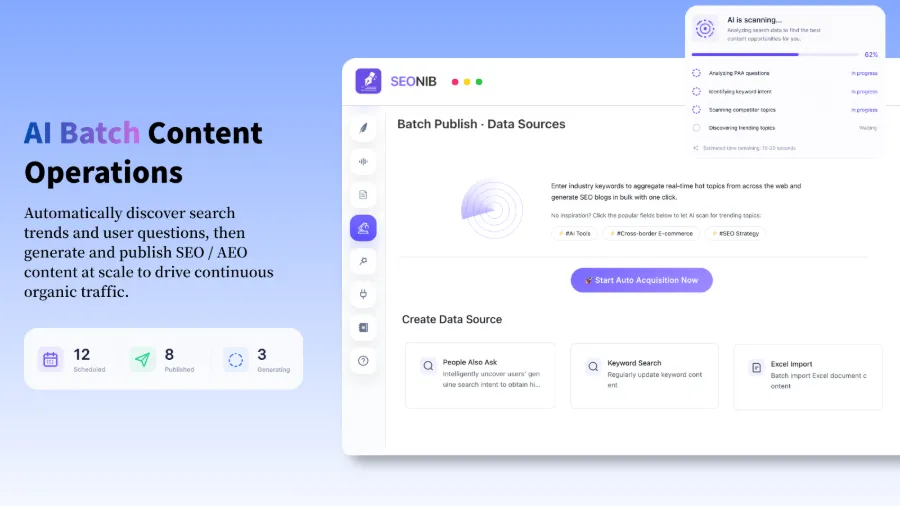
See, I don’t even need to log in daily. This week’s hot topics have already been auto‑pushed to the idea list; I just need to click confirm.
Finding Topics Is More Painful Than Writing Articles — Let AI Be My ‘Idea Editor’
The most painful part of content creation isn’t writing; it’s staring blankly at the idea board every day. I tried Axio Work’s ‘Discover’ feature—nice, but it’s tied to an entire supply‑chain platform, which a blogger can’t leverage for production integration.
What truly freed me was a more pragmatic tool. The first time I used SEONIB, I tossed in a product link, and five seconds later it auto‑generated a buyer’s guide. Not a keyword‑stuffed junk article, but a full blog with structure, meta description, and internal‑link suggestions. Input a product link → auto‑generated buyer’s guide; input a hot topic → instantly becomes a rankable article. SEONIB recommends 24 new topics each day, so when you open the backend each morning, the ideas are already waiting.
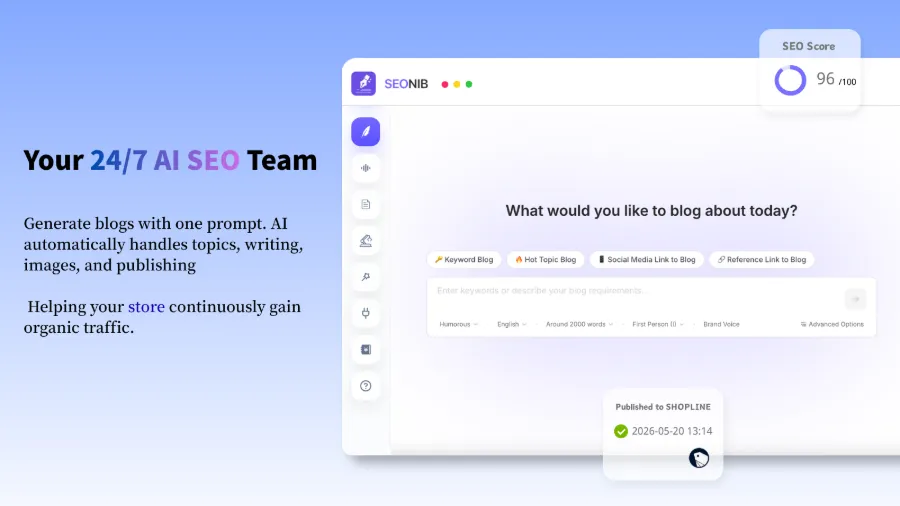
Just pick a template, and AI outputs in that direction. Product link → blog, keyword → blog, hot topic → blog—each mode comes with an SEO skeleton. If you want to dive deeper into turning product links into sustainable‑traffic blogs, see this detailed guide on product link to SEO blog. For independent‑site sellers, this is essentially a fully automated SEO content pipeline—check out this independent site auto‑publish SEO content guide for a more complete workflow.
Finished Writing? No, Automated Scheduling and Publishing Is the Real Liberation
Many AI tools only write; once they’re done, that’s it. You still have to open WordPress, copy‑paste, adjust formatting, add images, fill SEO metadata. The most frustrating part is having to log into three different platforms to publish three blog posts. I did this for two months; by the third month I gave up, stopped publishing for two weeks, and my rankings in Google Search Console plummeted by 50%.
SEONIB’s content calendar changed that habit. Set automatic publishing for Monday, Wednesday, Friday, and AI executes on schedule. I can preview and confirm in advance, or just let it run unattended. It supports custom publishing plans from Monday to Sunday; AI auto‑generates and publishes, so even if there’s no internet on Friday afternoon, I’m not panicked.
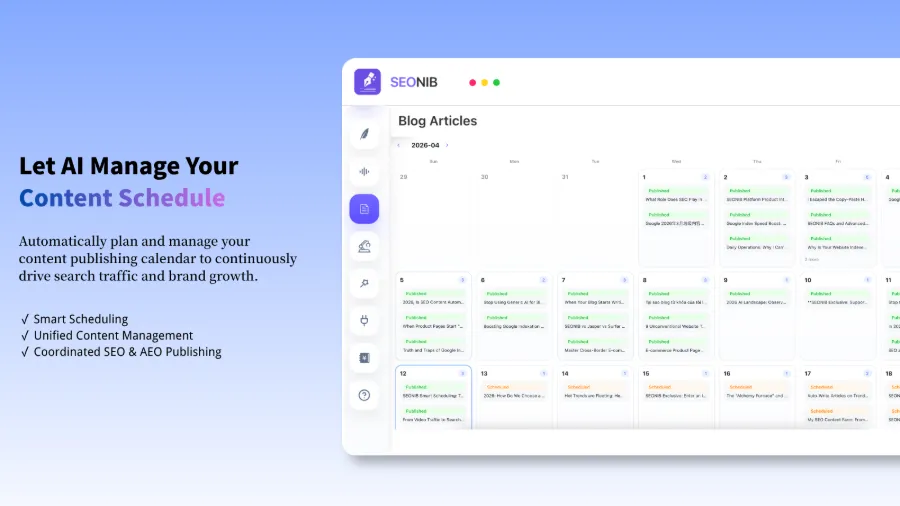
A glance at the calendar tells me this week’s content is locked in.
By the way, many don’t know SEONIB also supports generating blogs from social media links. Drop in a YouTube video link or a tweet URL, and it instantly converts it into an article. To learn how to use this feature, see the social link to blog guide. For Shopify’s own settings and store management, check the Shopify website.
More Than Just Blogs — Multi‑Platform Sync and SEO Optimization, All Covered
After generation, there’s a slew of trivial tasks: different platform formats, SEO metadata to fill, image sizes to adjust. SEO isn’t just surface‑level—beyond title tags and meta descriptions, there’s structured data. If you want to see how well AI optimized your page, use the methods in the complete page SEO audit guide.
SEONIB’s built‑in SEO optimization handles these: automatically inserting title tags, meta descriptions, structured data, and pushing to Shopify, WordPress, SHOPLINE, Medium, and other platforms. That’s why many sellers list SEONIB as their top Shopify AI SEO tool—read the detailed review of the 2026 Shopify Best AI SEO Tools.
In terms of efficiency, what used to take 20 minutes of manual work per piece—from editing to publishing—now takes 5 seconds from AI generation to publishing. As a content creator constantly chasing trends, I care more about grabbing traffic the moment a trend emerges. A practical case study: how AI helps creators capture trends first shares similar experience. Supports 40 languages, generating once for all platforms—very practical for multilingual independent sites. The quick‑start guide for the full feature set is in the detailed help documentation.
An interesting observation: many AI agent platforms tout ‘intelligence,’ but the real pain point in content marketing is the ‘tedious repetitive work,’ not decision‑making intelligence. Whenever a new platform launches, I ask the same question—while I’m manually copying and pasting every minute, what is the Agent platform actually doing for me? Another counter‑intuitive fact: big‑company Agent platforms and independent automation tools aren’t mutually exclusive. Axio Work is suited for strategic-level agent orchestration, while SEONIB excels as the execution engine for content production; they can complement each other rather than being a either‑or choice.
FAQ
Q1: What types of content can SEONIB automatically generate?
Supports keyword blogs, product‑link‑to‑buyer’s guide, hot‑trend‑to‑article, social‑media‑link‑to‑blog, and reference‑link‑derived articles. Covers 40 languages; virtually any information source can be turned into an SEO‑optimized blog.
Q2: Can I write blogs in my brand’s own tone?
Yes. Configure brand context in the backend (including industry terminology, product info, asset library, and internal‑link rules), and AI will create according to the brand style you set, rather than generating generic content at random.
Q3: What’s the difference between the free and paid versions?
The free tier limits the number of generations; the paid tier supports custom publishing frequency, multi‑platform sync, batch generation, and brand context configuration. If you need daily auto‑publishing and syncing across multiple sites, the paid plan is recommended.
Q4: Which site‑building platforms are supported? Do I need to know code?
Supports major platforms like WordPress, Shopify, SHOPLINE, Medium, Webflow, etc., with one‑click sync via API or plugins. No coding required; a few backend configurations suffice.
Q5: How can I ensure the generated content isn’t flagged as low‑quality by search engines?
SEONIB has a built‑in SEO optimization engine: it automatically adds title tags, meta descriptions, structured data, and generates content based on real‑time search intent. However, it’s recommended to do a manual preview before publishing to ensure core information isn’t off, especially for brand‑critical data and product specs.
Share Article