AI Search Didn't Kill SEO, It Just Turned Content Production into a Physical Labor
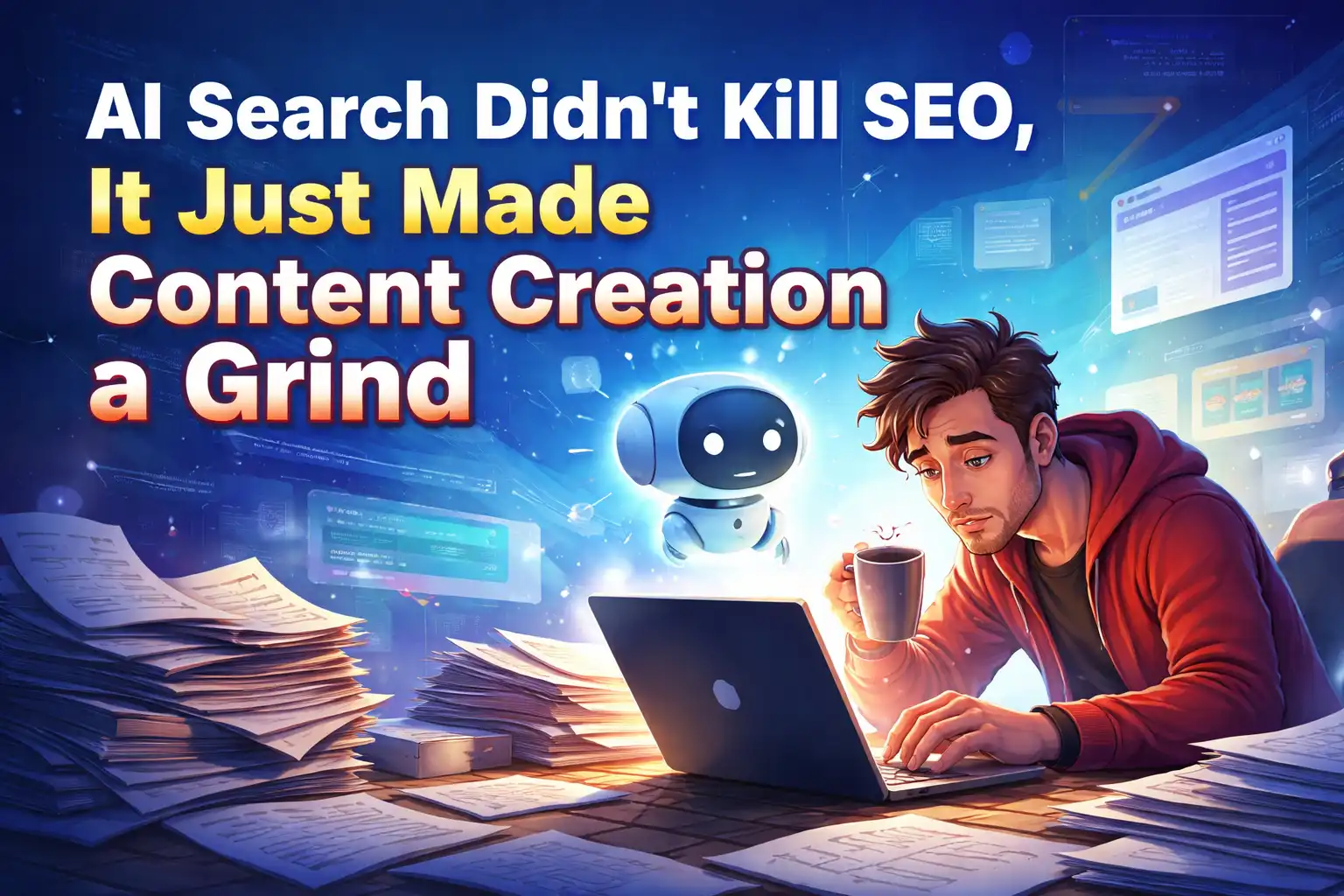
If you spent ninety seconds scrolling through LinkedIn in 2026 and still haven’t seen anyone declare “SEO is dead,” you were probably scrolling through a fake app. Every third post, a GEO entrepreneur in a turtleneck sweater tells you: traditional search is over, ChatGPT has eaten your traffic, and if you don’t do AI optimization, you might as well start a llama farm.
Interestingly, among the authors of those posts, eight out of ten happen to be selling a “AI visibility audit” service, priced at roughly $3,700 per month.
I’m not saying AI search hasn’t changed. It has changed a lot. I just think that in this discussion, very few people have actually done the work, while many are selling panic.
The Data That Keeps You Up at Night, and What It Doesn’t Tell You
First, admit one thing: the headline numbers are indeed scary. Seer Interactive ran 3,119 queries in 2025 and found that any search result page with an AI overview saw its organic click‑through rate drop from 1.76% to 0.61% — a 61% decline. Pew Research tracked 900 adults across nearly 69,000 Google queries and concluded that users click a link only 8% of the time when an AI summary is present, versus 15% when there is no summary.
All these data point in the same direction, and that direction indeed looks like a cliff.
But look at the other half of the data. Graphite and SimilarWeb analyzed the top 40,000 U.S. sites and found that Google organic search traffic fell only 2.5% year‑over‑year — not 25%. In WordStream’s 2026 Small Business Website Trends report, 60% of companies said AI search hasn’t impacted their traffic at all. Eli Schwartz, analyzing over 260 billion click sessions at ProductLedSEO, concluded that users aren’t replacing Google with ChatGPT — they use both for different tasks.
So which side is it? Is AI search the end of the world?
The answer is neither, and anyone who tries to reduce it to a binary choice basically misses the truly important point.
This Is What Actually Happens
My own feeling is this: over the past two years, the traffic curves for roughly a dozen B2B SaaS clients I’ve handled have indeed changed. But not a cliff‑fall; rather — how to put it — they’ve become “scattered.” Before, you secured three to five core keywords, the rankings held, and traffic was steady. Now that doesn’t work. Traffic sources have become more fragmented: some come from Google, some from ChatGPT citations, some from Perplexity summaries, and a tiny portion from an unknown source that Google Analytics still records.
In this situation, the most painful problem for me isn’t “how to optimize AI search citations.” The logic behind that problem is still the same as traditional SEO — you study the AI citation source data, find a few high‑weight sources, and target those. We’ve done this playbook a lot; ten years ago, that’s how we built backlinks.
The real sleepless‑night issue is another: the speed of content production can’t keep up with the rate at which traffic sources are fragmenting.
Before, publishing two blog posts a week covering five to eight keywords was enough. Now you need to cover not only Google keywords but also Reddit discussions that ChatGPT might cite, technical documents that Perplexity might pull, and product comparison pages that AI overviews might extract. For the same topic, you need at least three or four different content formats to satisfy varied citation preferences. Yet most teams’ content capacity remains at the stage of “one person writes two pieces a week and manually publishes to WordPress.”
This is not a strategy issue. It’s a stamina issue.
The Most Foolish Thing I Did in 2025
Last summer I did something especially foolish. I spent a full two weeks manually adding a bunch of “author bios” to a client’s blog, complete with personal photos and LinkedIn links, strictly following the then‑popular advice to “name authors to boost AI citation rates.” The result did change — two months later, the client’s brand term appeared three times in ChatGPT responses. Considering the time I invested, each of those citations was worth roughly forty hours.
I’m not saying the effort was useless. Research data indeed shows that pages with named authors and schema markup are 2.4 times more likely to be cited by AI than anonymous pages; if the author also has a Wikipedia entry, the multiplier jumps to 4.1. I also reviewed WindowsSEO’s audit report on 3,200 queries, and the data itself is solid.
But those two weeks made me realize something: I spent far more time on “adjustments” than on “production.” And my production speed was already far insufficient.
Later I changed my approach. I stopped treating manual optimization as a routine and started looking for tools that let me skip the repetitive steps. I tried several GEO platforms; most either repackaged traditional SEO features or suggested you “build a separate site for AI search engines” — the latter is not only foolish but also seriously harms your existing search rankings. WordStream’s Tom Demers has said this; the second type of suggestion is basically a trap.
The only thing that didn’t feel like a waste of money was SEONIB. Initially I thought it was “another AI writing tool” because I’d used at least five or six before — they only help with drafts, leaving formatting, images, SEO metadata, and CMS publishing to manual work. SEONIB is different; it doesn’t just “help you write,” it “connects the entire workflow from topic selection to multi‑platform publishing.” I set a schedule to automatically publish one piece per day, and then I truly didn’t have to worry. Three weeks later, the blog that used to publish four posts a month was publishing seven a week.
I must admit, this greatly relieved my content anxiety. Not because I suddenly started writing better articles — the quality is only average, often just passable — but because I no longer expend decision energy on “whether to write.” When content is generated automatically every day, you don’t waste three days wondering “what to write today.” Content accumulation itself is part of SEO, and many people forget that.
What Really Needs to Be Done, Not Panic
Looking back, in the 2026 AI search scenario, 99% of the advice missed the mark. People focus too much on “how to get AI to cite my content,” while overlooking a more fundamental reality: the volume of your content and the speed at which you produce it are the true prerequisites for being seen on any search engine (including AI).
If your blog hasn’t been updated for three months, Google won’t crawl it, and ChatGPT won’t cite it either. This has nothing to do with any particular year’s rules; it’s the underlying logic of search engines — no new content means no crawling, no crawling means no indexing, no indexing means no ranking. Whether the ranking is a blue link or an AI‑generated summary doesn’t matter.
So my advice is very simple, even a bit boring:
Ensure your content production mechanism is sustainable. Manual work isn’t sustainable; don’t overestimate your willpower. You need a system that lets you output continuously without daily decision‑making energy. SEONIB helped me a lot in this area, but it’s not the only option — the key is to find a truly functional automated pipeline rather than spending each month reminding yourself to update.
Add real author information and schema to pages. This change takes only a few days; the payoff period may be long, but the risk is minimal.
Conduct an AI citation audit each quarter to see how often and from where your content is cited in ChatGPT, Perplexity, and Google AI overviews. It doesn’t have to be complex; manually searching ten core keywords is enough.
Accept a fact: you cannot control how AI search engines cite your content. The only thing you can control is consistently publishing citable content. The rest is left to time.
Frequently Asked Questions
Will AI search really replace traditional search engines?
No, at least not in the short term. In the data we can see, Google still drives 71% of B2B SaaS traffic. However, AI search is the fastest‑growing channel, with an annual growth rate of about 4‑5×. The correct framework is “parallel,” not “replacement.”
Do I need to separately optimize content for AI search engines?
No fundamental redesign is needed. The focus is on having named authors, schema‑marked content structures, and a steady production rhythm. These are also correct in traditional SEO, and they now help with AI citations.
Can SEONIB really replace a content team?
It can’t replace a person who writes deep analysis. But it can replace the “weekly topic research → draft → format → image → publish” grunt work. If you’re a solo content creator, it can turn a weekly update into a daily one. Quality may be about 70% of before, but quantity increases sevenfold.
Which industries are most impacted by AI search?
B2B SaaS and financial services are most affected because these queries are often commercial intent, “comparison” or “data” types, with high AI citation rates. Consumer DTC products are least affected, as users still prefer to click directly to product pages.
What is the most important thing for SEO in 2026?
It’s not which GEO platform you choose, nor how perfect your structured data is. It’s whether you have a content system that can run continuously for six months and still hasn’t been abandoned by the seventh month. That’s it.
Share Article