AI SEO Platform vs. Freelance Writers: Which Approach Really Worths the Money?

After paying freelance writers each month, you check the backend—only 4 articles went live this month. Meanwhile, a friend using AI tools published over sixty pieces covering various long‑tail keywords in two months, and the Search Visibility curve started to rise. This comparison is becoming more common in the small circles of independent‑site operators, yet few people calculate the numbers: the cost gap between freelance writers and AI SEO platforms is far more than just fees and subscription costs. The real question isn’t how much you’re willing to spend, but what you actually get for that money and how much it truly contributes to content building.
Cost Structure Breakdown: Surface Prices vs. Hidden Expenses
First, look at freelance writer pricing. On Upwork and Fiverr, Chinese SEO articles typically range from ¥800–¥2500 per piece. This price usually includes basic keyword research and one round of revisions. For specialized fields—like industrial products or SaaS for independent sites—the price can be higher, with quotes up to ¥3000 per article not being rare.
AI SEO platforms charge subscription fees ranging from ¥200 to ¥1500 per month. Jasper’s monthly fee starts around ¥300, Surfer SEO’s content generation add‑on is close to ¥1000, and Writesonic’s low‑price plan is about ¥150. If you assume unlimited generation, the per‑article cost can indeed be driven down to ¥5–¥20—but only if you handle prompt writing and content review yourself.
The hidden costs lie beneath the surface prices.
Freelance writers’ hidden costs mainly fall on the operator. To produce a quality SEO article, you need to prepare a keyword brief, technical background, brand tone guidelines, then after the draft returns you need at least one round of edits, and finally upload to WordPress or Shopify and perform SEO optimization. These steps translate into 1.5–3 extra hours per article. Producing 8 articles a month means an additional half‑month of labor.
AI SEO platforms also have hidden costs. The learning curve varies; beginners spend the first two weeks to a month learning prompt structures, tweaking output quality, and configuring brand context. Without this upfront work, the output is generic, and only about 40% of it is usable with minor tweaks. Moreover, human review cannot be eliminated—AI‑generated factual content must be fact‑checked, especially product specifications and pricing, which are prone to errors.
From a total cost of ownership perspective, in scenarios producing over 20 articles a month, the AI SEO platform’s overall cost is less than one‑third of that of freelance writers—provided the operator is willing to invest 2–4 weeks upfront for configuration and tuning, and continuously monitor output quality.
Content Scale and Topical Authority Building Capability
Building Topical Authority is essentially a numbers game. Covering every sub‑topic of a domain, each relevant keyword you rank for adds a point of trust from search engines. Studies show sites publishing more than three related articles per week grow organic traffic about 3.5× faster than sites publishing only four per month. The gap widens after six months because high‑frequency updates trigger more crawling and keyword expansion.
Freelance writers hit a physical bottleneck here. A full‑time writer can produce 8–12 quality SEO articles per month, already demanding a lot of brief and communication time. If you run a multilingual site—say English, German, and French markets—each language zone needs its own writer, and coordination complexity rises sharply.
AI SEO platforms have a clear structural advantage at scale. Bulk generation, automated content calendars, multilingual synchronized output let a single person’s output jump from a dozen articles a month to hundreds. Adding multi‑platform auto‑publishing, the content production cycle shrinks from weeks to hours. When content volume and publishing frequency become limiting factors for Topical Authority, AI platforms dominate a scale dimension in a way freelance writers cannot match.
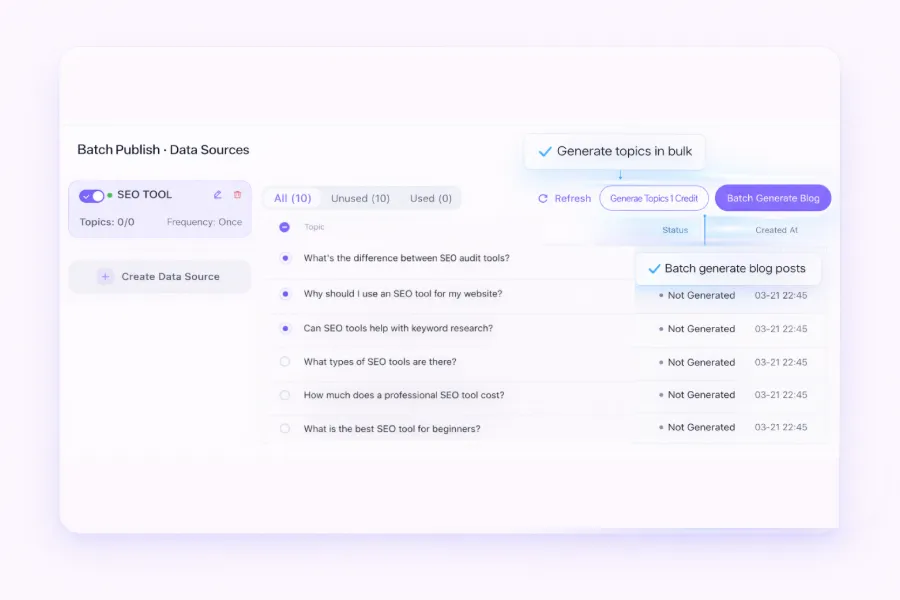
In cross‑border e‑commerce, the need for multilingual content amplifies this gap. A DTC brand covering North America, Europe, and Southeast Asia ideally wants fresh content for each market every month. With freelance writers, sourcing specialists for three languages, aligning brand tone, and maintaining a content schedule already equals a full‑time operator’s workload. AI SEO platforms natively support synchronized generation in over 40 languages; once brand context is set, they can output different language versions directly and push them to the appropriate regional sites.
A practical guide on bulk content production explains how to “turn a product link into an SEO blog” (https://xie.infoq.cn/article/b542f50b346275caa59ce63c9). The automation ideas discussed are especially useful at scale. If you’re debating quality differences between freelance writers and AI platforms, you can also refer to an internal comparison of “hand‑written blogs vs. AI blogs” (https://seonib.com/help/21/Handwritten%20Blogging%20Guide), which lists real‑world quality‑control differences.
Content Quality and Brand Consistency: Where Freelance Writers Truly Shine
It must be admitted that freelance writers have advantages AI cannot replace in certain dimensions. A writer with deep industry understanding produces narrative layers, industry context, and naturally flowing brand language. These traits are crucial for brand case studies, in‑depth reports, and founder interviews. If your content strategy includes long‑form pieces that establish a unique brand voice, a freelance writer’s value far exceeds generic AI‑generated text.
AI‑generated content suffers typical quality issues when brand context is missing. During the early rollout (usually the first 2–4 weeks), if the platform lacks a brand Knowledge Base, industry term library, and product information, the articles appear homogenized—flat tone, vague facts, missing core brand messages. In AI Search environments, such content sees a steep drop in recommendation probability. A notable data point: in Perplexity and ChatGPT Search citation tests, articles containing explicit brand entity information are cited about 40% more often than generic content.
AI SEO platforms are attempting to narrow this gap. Configuring a brand knowledge base, maintaining a term glossary, and setting product information citation rules can significantly improve brand consistency. Some platforms allow uploading product descriptions and brand documents, which the AI references during generation to adjust tone and information density. When configuration is poor, AI content’s brand recognizability suffers; when well‑configured, AI‑generated content can even surpass some writers in structural completeness because AI never forgets preset key points.
A community‑validated workflow for configuring brand context on AI platforms can be found in the article “Turn Product Pages into Blogs with SEONIB” (https://blog.csdn.net/SEONIB_Explorer/article/details/159613242), which details how to import product information into the AI knowledge base.
Another often‑overlooked observation: AI‑generated content’s drawbacks can become advantages in certain scenarios. A homogenized tone is not fatal for product description or long‑tail keyword articles—users searching those terms want clear information, not brand personality. For guides like “How to add product variants in Shopify” or “WooCommerce shipping settings,” users need precise, straightforward info, and AI’s standard template language can be more efficient than flamboyant prose.
Real‑World Workflow Comparison: End‑to‑End Efficiency from Topic Selection to Publishing
Typical freelance writer workflow: requirement discussion (half a day) → keyword brief preparation (1–2 days) → writing (2–5 days) → first‑draft review & revisions (1–2 days) → formatting, upload, metadata optimization (half a day). The shortest timeline is five days; disagreements can push it beyond ten days. If you work with monthly‑contract writers, schedule conflicts can delay delivery by two weeks.
AI SEO platform workflow is different. Trend discovery is automated, continuously monitoring industry hotspots and pushing them to a topic pool. Generation takes a keyword or product link and outputs an SEO‑optimized article. Publishing is tied to a content calendar that auto‑publishes at scheduled times. The whole topic‑to‑publish process can be compressed into a few hours, without relying on external scheduling. From keyword input to article live, AI platforms cut the total time by over 80% compared to freelance writers.
In Shopify independent‑site scenarios, the efficiency gap between content and product page linkage is even more pronounced. A freelance writer’s product‑related blog requires you to prepare product info, feature lists, and user cases first. After writing, you manually upload to Shopify, then edit the product page to add internal links. This repetitive process is error‑prone—missing product links, linking to the wrong SKU, or incorrect specs are common pitfalls for site operators.
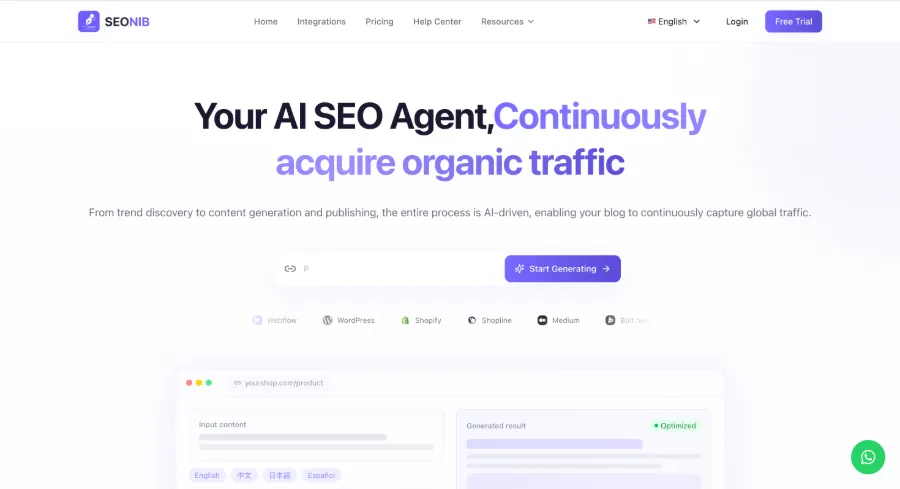
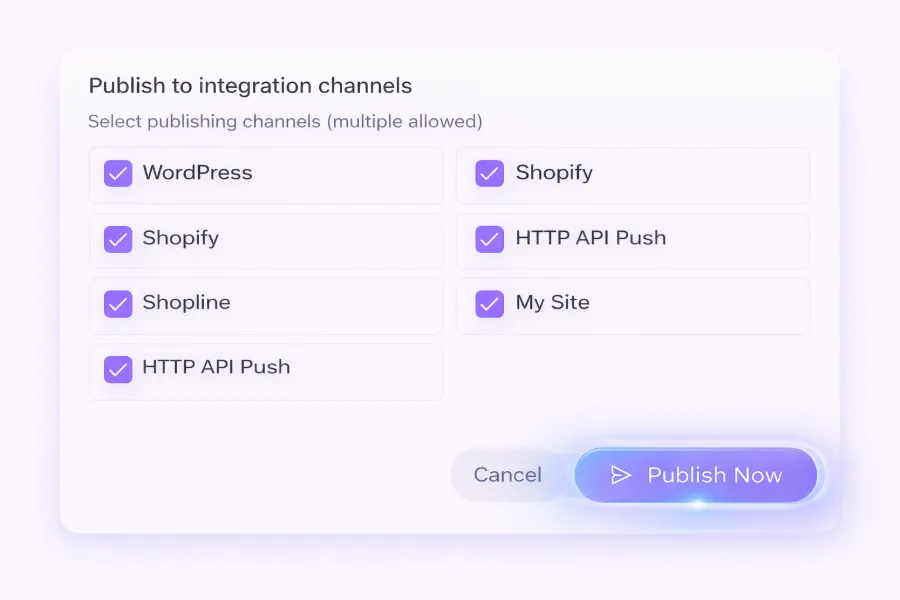
SEONIB handles this by triggering content generation directly from a product link. Input a product URL, the system extracts product info, price, and selling points, generates a buyer guide or review article, and automatically publishes it to the Shopify blog. The automation level is an order of magnitude higher than manual hand‑offs. A demo video shows the full process from keyword input to automatic publishing.
Automation pipelines also dramatically lower update and maintenance costs. When an old article needs refreshing, you simply regenerate a new version and replace it—no need to repeat the full communication‑writing‑revision cycle. For Shopify integration, see “How to Connect Shopify with SEONIB” (https://seonib.com/help/4/How%20to%20Connect%20Your%20Shopify%20Website%20with%20SEONIB) for technical details.
Of course, workflow efficiency isn’t free. The learning curve for AI platform operation is significant in the first week, especially brand knowledge base setup and content calendar management. If you intend for the AI platform to truly take over the content pipeline, you can’t skip the learning phase. A complete guide is available at “View SEONIB Full Help Documentation” (https://seonib.com/help), covering everything from basic configuration to advanced scheduling scenarios.
How to Choose Based on Business Stage
For early‑stage independent sites (monthly traffic below 5,000), budget is usually the tightest constraint. With a content budget under ¥5,000 per month, allocating everything to freelance writers yields only 2–4 articles. Such output makes it hard to achieve meaningful keyword coverage within six months. AI SEO platforms excel at this stage: per‑article cost is 60–75% lower than freelance writers, allowing the same budget to support 15–25 articles per month. Early sites still testing whether content drives search traffic benefit from using AI to experiment with directions. If you need to set up the basic site infrastructure first, refer to Shopify’s guide on independent‑site setup (https://shopify.com).
Mid‑stage sites (monthly traffic 5,000–50,000) are more complex. Operators have already confirmed content drives growth and now need scale while maintaining brand tone and depth. A hybrid strategy works best: freelance writers handle deep‑dive reports and brand case studies that require narrative skill, while the AI platform generates product blogs, long‑tail keyword articles, and routine updates. A typical split is 2 deep‑content pieces per month from writers plus 20 standardized pieces auto‑generated by AI. This combination provides authoritative depth and broad keyword coverage, producing a positive synergistic effect.
If you adopt a hybrid approach, product blogs are the easiest entry point for AI. SEONIB’s product‑link‑to‑blog feature fits perfectly, converting Shopify or WooCommerce product pages into SEO‑optimized reviews or guides. See the API documentation for “Generate SEO Blog from Product Link” (https://seonib.com/help/28/Product-to-Blog%20Conversion). After both systems run for a while, you’ll notice AI‑driven long‑tail traffic feeding more exposure to deep‑dive content.
Mature brands face different trade‑offs. Search traffic volumes are large, brand responsiveness is high, and the marginal cost of content quality flaws is much higher than in early stages. Freelance writers’ deep content remains the main driver of brand building and industry influence, while AI platforms act as content infrastructure—handling massive refreshes, multilingual sync, and continuous long‑tail coverage. The handoff point usually appears during traffic stability: core brand content is led by writers and internal teams, while the remaining 70% of non‑core keyword content is automated by AI.
When deciding, consider three dimensions: content type (brand story vs. informational), budget ceiling (acceptable cost per article), and team size (whether someone can configure and maintain the AI platform). Monthly budgets under ¥5,000 with no dedicated SEO staff should go straight to an AI platform for the lowest cost. Budgets above ¥10,000 with a content operator typically see higher ROI from a hybrid strategy than from a single approach.
Frequently Asked Questions
Will content generated by AI SEO platforms be penalized by search engines?
Search engines don’t penalize AI content per se; they penalize low‑quality content. Google’s official stance emphasizes the E‑E‑A‑T principle—actual value determines rankings. If AI‑generated content undergoes thorough fact‑checking, incorporates brand context, and ensures accuracy and structural completeness, its performance is essentially indistinguishable from human‑written content. The real cause of de‑ranking is misinformation, plagiarism, or lack of incremental value, regardless of whether the source is AI or a writer.
Does content written by freelance writers perform better in AI search engines?
Not necessarily. AI search engines (Perplexity, ChatGPT Search, Bing AI) prioritize entity coverage and structured information over writing style. Content that includes clear brand entity names, product models, price ranges, and industry terminology is cited more often—about 40% higher, as mentioned earlier. Freelance writers excel in natural language fluency, but if they’re not familiar with AI search citation mechanisms, their pieces may underperform compared to well‑configured AI content on the AEO dimension.
Is it worthwhile to use both an AI platform and freelance writers simultaneously?
Yes, and this is often the optimal solution for many mid‑stage sites. Freelance writers produce brand narratives and deep industry pieces, while the AI platform handles product blogs and long‑tail keyword articles. Staggered publishing in the content calendar makes this combination more efficient than any single approach, because AI‑driven page volume and long‑tail coverage amplify the authority of brand content, and the brand’s credibility in turn boosts trust in AI pages. The relationship is synergistic, not substitutive.
Can operators with no SEO background directly use an AI SEO platform?
They can, but the first two weeks will be challenging. The biggest hurdle isn’t the AI tool itself but the lack of SEO fundamentals: assessing keyword incremental value, SERP competition analysis, internal linking design, and facet indexing. These aren’t built into the platform by default. However, there’s a compensating mechanism: once the AI platform generates enough content, search engine feedback (which keywords rank, which content types get clicks) helps the operator develop SEO intuition.
Is it necessary to adopt an AI SEO platform when you have a small amount of content?
It depends on your stage goals. If a site has only 10–20 articles and near‑zero traffic, paying a freelance writer three months to reach 50 articles is prohibitively expensive. AI platforms have a clear advantage in early content building: low investment, sufficient output, and some keywords start ranking. The real question isn’t “whether it’s necessary,” but “whether anyone can spend time configuring the AI upfront.” If there’s no configuration effort, neither AI nor freelance writers will be suitable, because SEO groundwork still requires human involvement.
Share Article