Rise of AI-First Companies: The Next Phase of Cross-Border E‑Commerce Content Automation
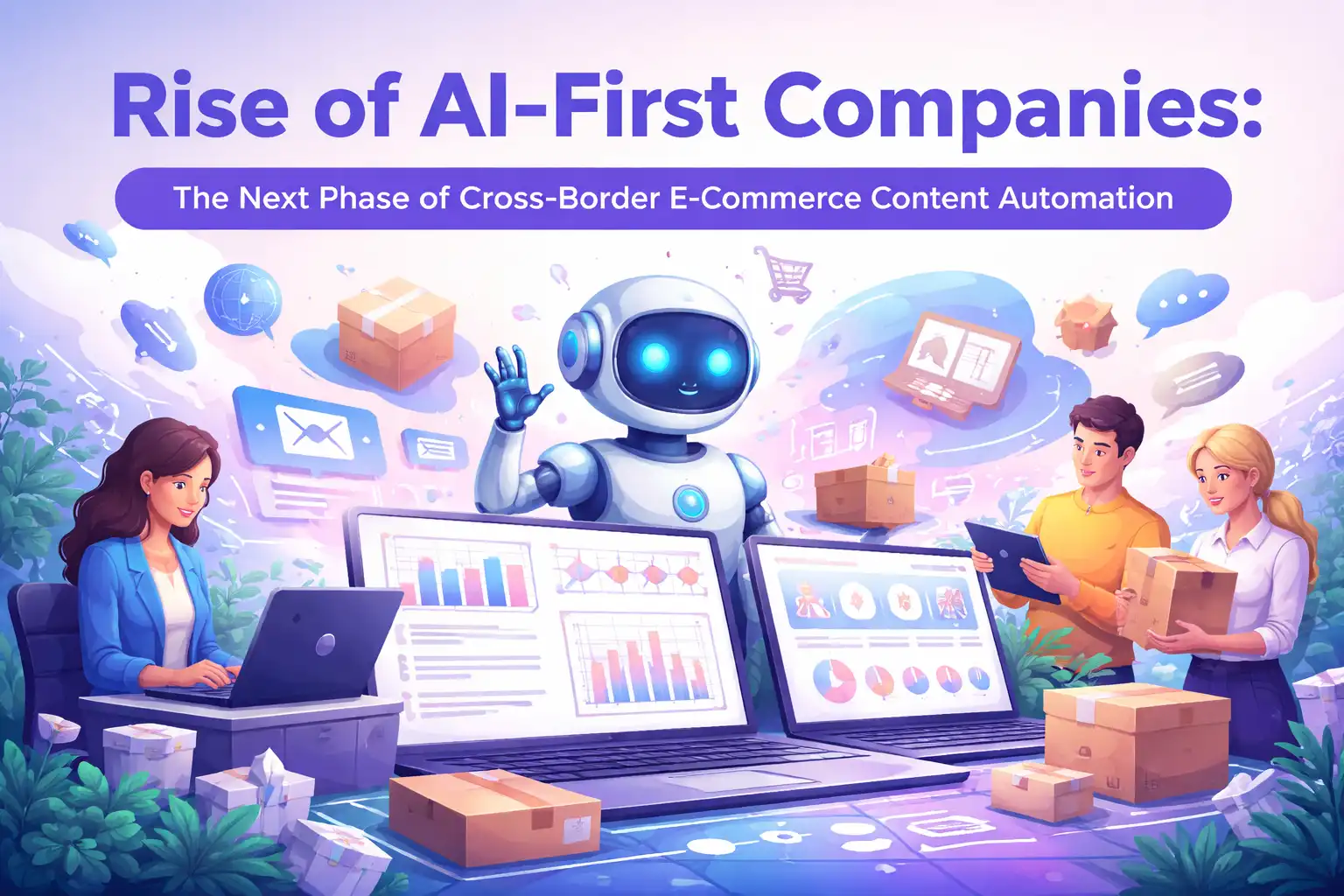
Three years ago, when I was on the independent‑site team, every Wednesday morning I rigidly performed the same routine: open Google Trends and Ahrefs to mine keywords, write an outline, urge the content team to deliver drafts, and then manually publish to the Shopify blog. Even the fastest product article took at least two days from idea to launch. Today, a group of cross‑border sellers dubbed “AI‑first companies” have compressed that cycle to hours—or even minutes—using automated pipelines. They no longer chase content scale with human hands; they let the system run itself.
What Is an AI‑First Company? Definition and Core Characteristics
An AI‑first company is not a team that writes a few blogs with ChatGPT; it is an organization that embeds AI into every step of content operations as the default option. From trend discovery, content generation, SEO optimization, to multi‑platform publishing, everything runs automatically with almost no human intervention. Traditional companies follow “human writes article → manual optimization → manual publishing,” whereas AI‑first companies follow “AI real‑time monitoring → automatic generation → automatic publishing → human judgment.”
There are three core characteristics. First, an automated content pipeline: topic selection, writing, image pairing, formatting, and publishing are all handled by the system; humans step back to review and strategize. Second, data‑driven topic selection: instead of relying on editorial intuition, tools analyze search trends and competitor content gaps in real time to decide what to write. Third, continuous authority building: AI‑first companies do not chase a single viral post; they publish large volumes of long‑tail content covering a vertical niche, gradually earning search‑engine trust.
It is important to stress that these companies do not completely replace people. Teams still include content strategists and editors, but their work shifts from writing to defining brand knowledge bases, setting content rules, and calibrating output quality. The core capability of an AI‑first company is not the technology itself but the redefinition of human roles.
According to a 2025 Forrester report, AI‑first companies produce content six times faster than traditional teams. For teams just encountering this concept, see this overview of major solutions: The 10 Hottest AI Content Marketing Tools in 2026.
From Trend Discovery to Content Production: How AI Takes Over the Workflow
What does the specific workflow look like? I’ll break down a few stages.
First layer – trend discovery. Traditional practice involves operators manually browsing industry news and checking Google Trends curves each week, then holding a topic‑selection meeting. AI‑first companies fully automate this step: the system continuously monitors industry trends and competitor content updates, automatically identifies keywords with search volume and manageable competition, and pushes them directly to the topic pool. When the team opens the dashboard, they see a pre‑filtered “write‑able list” without having to dig from scratch.
Second layer – content generation. After a topic is chosen, AI, based on the keyword’s search intent and the Topical Authority structure of related content, automatically generates a complete article containing a title, sections, meta description, internal links, and image captions. The tools use models already fine‑tuned for SEO, producing quality far above ordinary ChatGPT Q&A.
Third layer – formatting and resource injection. The system automatically inserts relevant internal and external links, selects images from the brand asset library, and adds structured‑data markup. The entire process is end‑to‑end with no human intervention.
Research shows that teams using AI for content discovery improve topic‑selection efficiency by 70 %. The direct result is that the bottleneck at the execution level virtually disappears; teams that once considered three‑to‑five articles per week high‑output can now produce far more. For industry dynamics, see the Cross‑Border E‑Commerce Trend Discovery Platform. For why some sites naturally earn higher citation rates, read the analysis “Why Some Sites Are Favored by AI Engines”.
Content Automation: Zero‑Human Process from Input to Publication
Having covered the macro workflow, let’s look at a concrete implementation case—SEONIB. The core logic of this system is: feed any form of material, AI automatically generates an SEO‑optimized blog post, and publishes it.
What can be input? A product link, from which the system extracts product information to create a buying guide or review. A set of keywords, which the system evaluates by search volume and then produces a target article. A social‑media post or YouTube video, from which AI extracts key points and expands them into a full article. A reference link, which the system analyzes for structure and outputs original content.
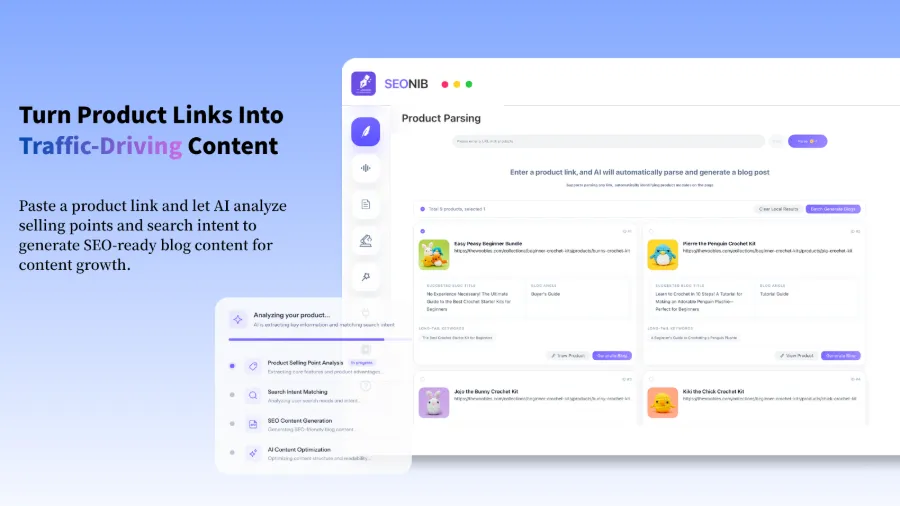
The generation process is more than just writing text. AI automatically configures SEO metadata, inserts relevant images, matches internal‑link strategies, and completes structured‑data markup. After generation, the system queues the article for publishing, automatically pushing it at the scheduled calendar time. If allowed, it can complete the entire input‑to‑live workflow unattended at 3 a.m.
According to a case study from an independent site, after adopting this automation, monthly article publication rose from 10 to 100, with no expansion of the operations team. Such scale effects are virtually impossible under traditional models.
However, this automation is not without risk. Google’s 2024 “Helpful Content” update heavily penalized sites that relied on massive AI‑generated low‑quality content. Automation cannot replace thematic depth—if each article is merely keyword‑filled without substantive information, the system’s scale advantage quickly turns into a liability. The most effective strategy is to combine automated output with human editorial depth: the AI system handles routine data‑type content, while humans review strategic pieces and core brand content. To learn which content ranks best in AI‑search‑engine scenarios, see the analysis “What Content Performs Best in ChatGPT Search”.
Multi‑Platform Synchronization and Continuous Publishing: The Growth Engine of AI‑First Companies
Publishing to a single platform is just the start. The next capability of AI‑first companies is cross‑platform synchronization and timed automatic publishing.
Once an article is generated and formatted in the system, it can be configured once and simultaneously pushed to Shopify, WordPress, Shopline, Medium, Webflow, and other platforms. No need to log into each backend repeatedly or manually adapt format differences.
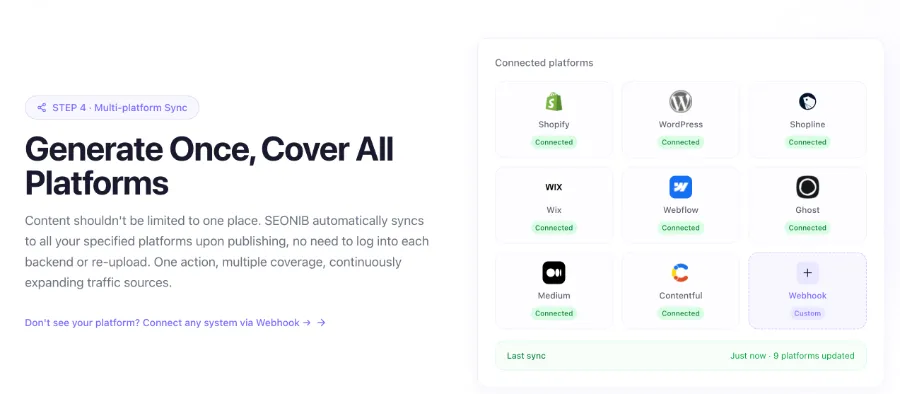
Combined with a content calendar and time settings, the system can continuously output at preset frequencies—for example, SEO strategy articles on Mondays, product reviews on Wednesdays, industry news on Fridays—fully automated without daily manual login. One of SEO’s core rules is update frequency: studies show that sites publishing more than 16 blogs per month receive 3.5 × the traffic of sites that publish none. AI‑first companies leverage this rule to establish a continuous update rhythm at low cost.
This capability also means that small sellers can build niche authority with minimal expense. Previously, a solo Shopify store owner might update only one piece of content per week due to time constraints, making it hard to cover enough breadth in a vertical niche. An automation system enables coverage of dozens of sub‑topics within a week, prompting search engines to treat the site as an information source for that field. SEONIB’s sync feature lets users set a publishing rule once and automatically cover multiple e‑commerce and content platforms, continuously accumulating content assets.
For technical details on building cross‑platform automation, see “How to Connect Third‑Party Websites to an Automation System”. For specifics on SEONIB’s marketplace entry, see “SEONIB in the Shoplazza App Store”. For the full system configuration guide, consult the “SEONIB Help Documentation”.
But there is a hidden trade‑off worth noting: fully automated publishing rhythms can lead to content homogenization. When all AI‑first companies rely on similar data sources and models, the diversity of output drops sharply. Early adopters enjoy efficiency gains; later entrants face competition from homogenized content—ultimately, the depth of the brand knowledge base and the quality of human strategy become the true differentiators.
FAQ
Are AI‑First Companies Suitable for Cross‑Border E‑Commerce of All Sizes?
Yes. Small sellers can launch content marketing at a lower cost, while large teams can free human resources from execution to strategy. The key is to adjust the level of automation to the team’s capability: small sellers may run basic content fully automatically, whereas larger teams should retain human review steps.
Is the Quality of Automatically Generated Content Guaranteed? Could It Be Deemed Low‑Quality?
Quality depends on input and configuration. When a mature brand knowledge base, internal‑link rules, and asset library are set up, AI‑generated content usually outperforms unoptimized manual writing in SEO performance. However, Google’s multiple algorithm updates explicitly target low‑quality AI content; the crucial factor is whether the content adds informational value, not how it is produced. Pure keyword‑stuffed automation will eventually be filtered out.
How Long Does It Take to See Search Traffic Effects from AI Content Automation?
Typically 3–6 months. Although the automation system can produce large volumes daily, search engines need time to crawl, index, and rank new content. The first two months focus on indexing accumulation; from the third month, long‑tail keywords begin to bring sporadic traffic, and around the sixth month a stable organic traffic stream may emerge.
Can It Support Multilingual Content Production? Do Different Languages Need Rewriting or Translation?
Yes. Most AI content automation solutions ship with generation capabilities for over 40 languages. The process is not a simple translation; content is regenerated based on target‑language keywords and search intent, adapting to local expression habits and SEO norms. This is highly useful for cross‑border e‑commerce covering Europe, Southeast Asia, and other markets.
If I Already Have Brand Style Guidelines, Can AI Maintain Consistency?
Yes, but it requires upfront configuration. By feeding the AI a brand knowledge base, terminology library, asset library, and content rules, the output style can stay highly consistent. Investing time in initial setup is essential; otherwise, the AI will default to its own style, causing a mismatch with brand tone.
Share Article