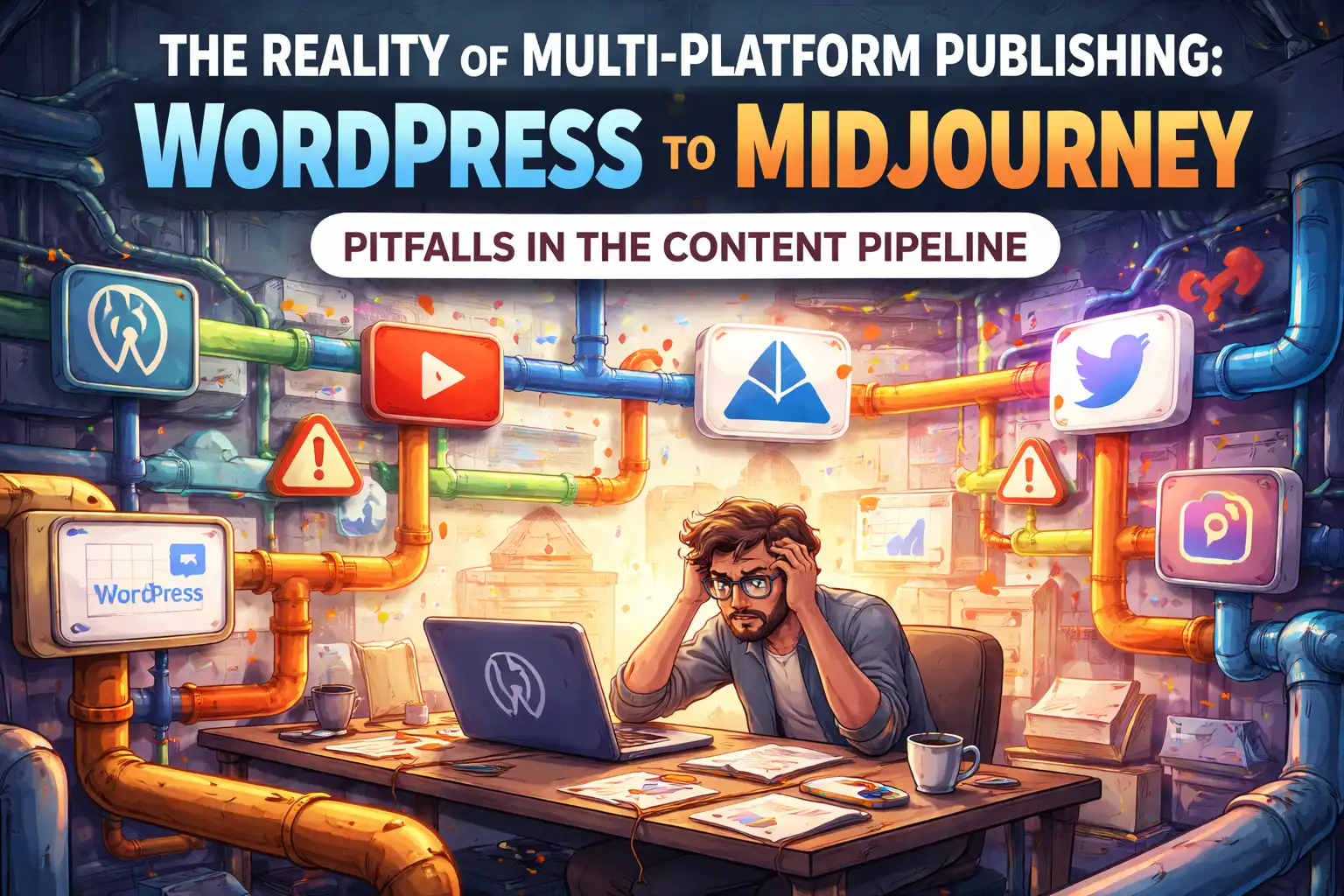
The Reality of Multi‑Platform Publishing: From WordPress to Midjourney, the Pitfalls in the Content Pipeline
When a cross‑border e‑commerce team decided three years ago to sync a product review to the Shopify blog, Medium, and LinkedIn, they thought it would take less than ten minutes. In reality, the article went through format breakage, broken image links, and SEO metadata being automatically truncated on each platform—nearly a full workday of hassle. Multi‑platform publishing sounds like a one‑click job in most marketing materials, but in real operations this layer of the pipeline is often the true bottleneck for content efficiency. Since then they have tried six different synchronization approaches, experienced WordPress plugin crashes that caused a site‑wide 404, Midjourney‑generated images that were automatically compressed on Shopify to the point of being unrecognizable, and AI‑generated articles that were demoted on Medium for being flagged as machine‑generated. These lessons are more persuasive than any tool comparison chart.
Hidden Costs Behind Sync Strategy Choices: Formats, Metadata, and Platform Differences
The earliest standard practice was manual copy‑and‑paste. It sounds simple, but each platform’s backend editor has its own quirks. WordPress’s Gutenberg editor automatically wraps paragraphs copied from Medium in extra <div> tags; Shopify’s blog system has incomplete Markdown support, causing tables and code blocks to disappear after saving; LinkedIn’s article editor doesn’t support any formatting tags at all, allowing only plain text with manual bolding. In Q4 2024 the team recorded that each manual sync of an article to three platforms averaged 47 minutes, with 22 minutes spent on format fixes and re‑uploading images.
Thus they turned to automation tools. The early solution was Zapier + custom Webhooks, using WordPress as the content source and triggering posts to Medium and LinkedIn after each publish. This worked for the first three weeks, then problems surfaced: Zapier passes image URLs instead of re‑uploading them, so when WordPress’s image CDN domain changed or an image was replaced, the images on other platforms broke. Worse, Medium and LinkedIn parse metadata (title tags, meta description, OG images) completely differently—Medium reads JSON‑LD on the page, while LinkedIn relies on Open Graph meta. The same article could generate completely different preview cards, and sometimes LinkedIn would fetch a cached version of WordPress’s wp‑admin login page.
By 2025 a more subtle issue emerged: the stability of platform APIs. Medium quietly tightened unauthenticated API call limits at the start of the year, causing some automated publishing tasks to return 429 errors during early‑morning windows. WordPress’s REST API occasionally returned 502 on batch requests, especially on shared hosting. The team once spent a week neglecting API status‑code checks, resulting in 14 articles being double‑published on Shopify while Medium never received them—Medium’s channel traffic dropped 37 % that month because duplicated empty articles pushed the older content down.
Later they switched to a headless, browser‑based solution using Puppeteer to log in and fill out forms one by one. This worked short‑term, but the biggest issue was maintenance: every time a platform updated its front‑end code, selectors could break. In June 2025 LinkedIn revamped its article editor, causing three weeks of automated publishing failures until the team found new CSS selectors. That three‑week content gap dropped LinkedIn’s monthly read count from 8,200 to 3,100, taking two months to recover.
Independence Issues for Images and Content Assets in Cross‑Platform Sync
Images are the most underestimated trap in multi‑platform sync. Most tools only handle text, copying URLs or embedding external links for images. But each platform has a completely different image‑handling logic.
Shopify compresses uploaded images to a maximum of 2048 px and renames the file, causing the SEO keywords in the original filename to be lost. Medium’s default image handling adds lazy loading but does nothing with ALT text. WordPress generates multiple thumbnail sizes by default, but if the sync tool passes the original large‑image URL, those thumbnails aren’t generated, leaving mobile users to load several‑megabyte originals.
Midjourney‑generated product images cause even more problems in this workflow. In Q3 2025 the team tried uploading Midjourney images directly via API to each platform. Midjourney’s default images are square (1:1), while Shopify recommends a 3:4 ratio for product images and WordPress recommends 16:9 for featured images. The automatic cropping tool (Cloudinary’s auto‑crop) often cut off key product parts when switching among these ratios—e.g., a shoe’s toe or packaging text being cropped out. This persisted for about six weeks until the team abandoned auto‑cropping and manually defined cropping regions per platform. In this case, automation actually increased workload.
Another asset issue involves non‑image files. PDFs, video embeds, and interactive 3D models render fine on WordPress via plugins, but Medium doesn’t support file uploads or embedded 3D viewers, and LinkedIn only supports YouTube and SlideShare embeds. Trying to maintain a consistent “content experience” across three platforms is an unrealistic assumption. The team eventually accepted that some content would be fully published only on certain platforms, with other platforms showing summaries plus links. This sounds like a step back, but it reduced sync problems by 90 %.
SEO Impact of Multi‑Platform Publishing: Duplicate Content and Indexing Strategies
When the same content appears on WordPress, Medium, and Shopify, search engines treat it as duplicate content. Even with canonical tags pointing to the original version, the differing domain authority of each platform can cause the engine to index the WordPress version over Shopify (or vice‑versa), depending on each platform’s Domain Authority.
At the beginning of 2025 the team ran a test: they synced a long‑tail keyword article to WordPress (company site) and the Shopify blog, both with canonical tags pointing to WordPress. After three months, Google Search Console showed the WordPress version ranking for 12 related keywords, while the Shopify version ranked for only three, and at lower positions. Two keywords had the Shopify version indexed as a separate page rather than a canonical one—because a WordPress plugin update broke the canonical tag format, turning it into a relative path (rel="canonical" href="/old-url"), which Shopify’s absolute‑path version didn’t recognize as the same content.
A subtler effect appeared on Medium. Medium’s domain has high authority, but it doesn’t allow external canonical tags—you can’t tell search engines “the original article is on my site.” Consequently, Medium’s content gets indexed independently and may rank above your site because of Medium’s higher DA. In 2024, one article ranked #3 on Google, while the Medium version ranked #2. That article’s traffic was 40 % from Medium, whose footer contained Medium’s own ads and recommendation links, rendering that traffic’s commercial value almost zero. There is no perfect solution—some teams publish only a summary on Medium with a deep link, but Medium’s algorithm reduces the recommendation weight for summary articles. This is a trade‑off, not a tool‑solvable problem.
In cross‑border scenarios, multilingual sync issues become even more complex. If an article is linked via hreflang to multiple language versions, but one language version is only published on Medium and not on the main site, hreflang links break. In April 2025 the team discovered a hreflang configuration error between the Japanese Shopify version and the Japanese Medium version, causing Google to show no Japanese results for two months—both platforms marked each other as alternatives but neither was recognized as the primary version. Fixing this took three weeks because the two CMSs handle hreflang tags differently: one requires manual insertion into the HTML, the other only via a plugin.
Content Quality Decline in Cross‑Platform Publishing: An Overlooked Metric
The most hidden cost of multi‑platform sync is the gradual decline in content quality. This isn’t about grammar or formatting errors, but about depth and relevance.
When an article is designed to “fit all three platforms,” it often becomes a bland middle ground that loses each platform’s unique character. Medium readers expect narrative and personal perspective; LinkedIn readers look for industry insights and opinions; Shopify blog readers want product information and purchase reasons. Trying to satisfy all with a single version usually leaves none satisfied.
In summer 2025 the team ran an A/B test: one group of articles was written and published separately for each platform (3 articles × 3 platforms = 9 articles per week), while another group synced a single article to all three platforms (3 synced articles per week). After eight weeks, the individually written version had a 23 % higher read‑through rate on Medium and a 41 % higher engagement rate on LinkedIn. Shopify blog conversion rates differed less (12 % higher for individual pieces), but the individual approach required about 11 extra hours of content work per week, making ROI calculations non‑trivial.
This finding made the team rethink “efficiency.” Automation saves publishing time, but if that time is saved by sacrificing platform‑specific adaptation, overall content performance can decline. From a 2026 perspective, the team prefers to apply automation only to parts of the workflow that truly lack added value—image compression, metadata filling, formatting—while keeping the core content (title style, paragraph length, case selection) manually adapted.
During this process the team tested several tools for the “dirty work” in the pipeline. The use case for SEONIB was the clearest: when needing to automatically generate multi‑platform‑compatible blog content from product pages and handle cross‑platform image and metadata differences in scheduled publishing, it compressed what used to be many manual steps into a single configuration. The team later found SEONIB’s stability for automatic theme scheduling and content calendar management better than expected—after four consecutive months of operation, no missed posts due to API throttling occurred. Of course, human review of output quality is still required, especially for simultaneous releases of different language versions in cross‑border markets, as fully trusting automated translation still shows cultural adaptation issues.
The Real Limits of Content Automation Pipelines
Multi‑platform publishing is not a problem that can be solved perfectly. Each platform has its own editor rendering quirks, unpredictable API behavior, and inconsistent SEO interpretation—hard technical constraints. Cross‑border businesses also face language, timezone, and cultural adaptation challenges. Whether using manual sync, Zapier workflows, browser‑based automation, or integrated publishing tools, trade‑offs exist on every dimension.
At the end of 2025 the team reviewed the investment (tool subscriptions + development + maintenance + troubleshooting time) versus output (time saved + traffic growth + content consistency). On paper the balance was positive, but far from the ROI advertised by tools. The biggest benefit was a stable content rhythm—automation freed the team from logging into each platform daily, so content output didn’t halt during vacations or peak business periods. However, quality adaptation decline and SEO conflicts across platforms remain hidden costs that require continuous monitoring.
For teams considering building a multi‑platform publishing pipeline, the most honest advice is: first define each platform’s actual role. If Medium’s primary goal is brand exposure rather than direct conversion, you can accept its SEO conflict with the main site and actively manage canonical signals. If the Shopify blog is the core sales channel, prioritize optimization for it and use summaries plus links on other platforms. Trying to “maximally benefit all platforms” usually ends up with none doing well.
Automation should handle repetitive mechanical tasks—formatting, uploading, scheduling, status‑code checking—but not replace content strategy decisions. The latter requires human understanding of platform ecosystems, audience behavior, and search intent, which in 2026 remains outside the strong suit of machines.
Frequently Asked Questions
What’s the most common pitfall in multi‑platform publishing?
Image and metadata differences across platforms are the most overlooked. Shopify, WordPress, and Medium each parse images, ALT text, and OG tags differently, leading to broken images, distorted compression, or overwritten SEO metadata during automatic sync. After publishing on each platform, separately check the featured image and meta description display, and monitor for at least two weeks.
Will synced content be flagged by Google as duplicate content?
Yes, if identical content appears on multiple platforms without proper canonical handling. The reality is more complex—some platforms (like Medium) don’t allow external canonical tags, so their content gets indexed independently and may outrank your site due to higher DA. Distinguish platform roles: let the main site publish the full version with a self‑referencing canonical, and have other platforms publish summaries with deep links. In cross‑border scenarios, also verify hreflang tag compatibility across platforms.
Can automated publishing tools completely replace humans?
In 2026, the answer is still no. Automation can handle formatting, scheduling, image compression, and metadata filling, but the content itself—title strategy, paragraph pacing, cultural adaptation—still needs human judgment. A realistic division of labor is: automation performs about 70 % of the mechanical work, while humans handle the remaining 30 % of quality review and platform‑specific adjustments. Fully unattended publishing in a multi‑platform context still frequently fails due to platform updates or API changes.
How often should I check that the sync workflow is working correctly?
At least weekly. Review key metrics: publishing success logs per platform, API response status codes, and image loading status. If you use scheduled publishing, also verify that content goes live at the intended time and isn’t shifted by timezone settings. In 2025 the team missed a daylight‑saving‑time adjustment, causing all articles to publish one hour later than planned and disrupting two promotional launches.
Which platform’s experience should be prioritized in multi‑platform publishing?
It depends on the business scenario. If the main site’s blog is the primary traffic source, prioritize content quality on WordPress or Shopify and use summaries plus links on other platforms. If the goal is to build industry influence on LinkedIn, write a dedicated, narrative‑driven version for it. No single account can achieve optimal results on every platform; proactive reductionism is more effective than trying to cover everything.
Share Article