AI search made me panic for three months, but I finally realized I need to get the fundamentals right
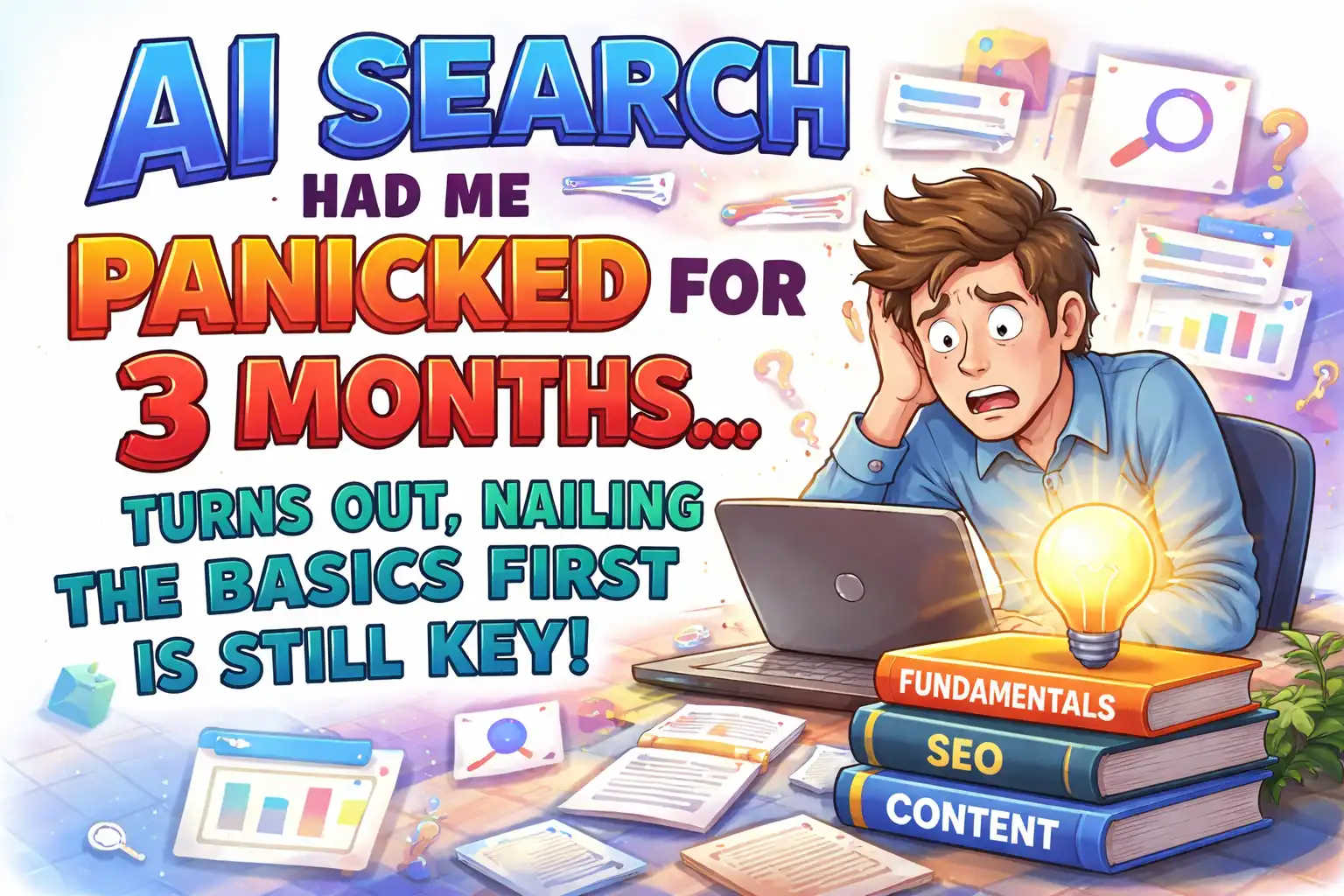
This story starts last autumn. I’m in charge of SEO for a SaaS product. The team is small, the budget is limited, but the boss’s demand for traffic growth has never been low. At the end of 2025, Google began rolling out AI Overviews on a large scale, and ChatGPT’s search feature also launched. My SEO peers on WeChat were sharing posts every day that said “SEO is dead” or “AI SEO will disrupt everything.” I didn’t take it seriously at first, until the click‑through rate for one of our core keywords dropped by almost 40 % in a month, and the data in Search Console looked like someone had quietly cut it.
I panicked.
What foolish things did I do during that time? I spent two whole weeks studying AI‑optimization courses, downloading a ton of LLM prompt templates, trying to make our content “more AI‑friendly.” I even created a dedicated page, structured an FAQ block, and added every possible schema that AI might reference—yet after three weeks, no AI engine cited it, not even Google’s own AI Overviews. Later I realized that 99 % of the time I spent on so‑called “AI SEO” was just guessing what AI would like. Google’s official guide released in May 2026 says it very clearly: “Our generative AI features rely on core search ranking and quality systems.” In other words, if your content can’t hold its own in traditional search, AI won’t even glance at it.
This information comes from the Google generative AI search guide—in plain terms, don’t cut corners.
If the fundamentals aren’t solid, AI optimization is just wasted effort
Our site has a product‑category page whose mobile loading speed hovers around a score of 70, and the LCP is creeping up toward 3 seconds. I used to think “users can wait a little” because we’re an enterprise SaaS, not an e‑commerce site with short conversion cycles. But AI crawlers won’t wait. AI Overviews need to pull relevant paragraphs quickly from the index; if your page loads slowly, has a chaotic structure, or uses the wrong schema, the AI engine will push your content far down the list. It’s not mystical—if you leave a crumpled business card on a desk, the secretary will have a hard time finding it.
During that period I did a few things that later proved to be the most effective: I rewrote the hierarchy of H1 and H2 tags, fixed 35 broken links, and added genuinely useful FAQ structured data (not the fake “Q: Do you love me? A: Of course” type). After doing this, our technical SEO score rose from 72 to 89. Then I noticed that Google’s AI Overviews began citing a few of our pages—not because I wrote any “AI‑optimized content,” but because the pages became clearly understandable and crawlable.
There’s an interesting detail: we have an article about SaaS renewal strategies that was originally mediocre but had a clear information hierarchy. Google’s AI Mode cited it once, even though I never made any “AI‑targeted” changes. Conversely, a “trend‑forecast” article that I painstakingly rewrote for AI has never been referenced by any AI engine. This experience made me realize that what people call GEO (generative engine optimization) and AEO (answer engine optimization) are essentially old‑school SEO with a new name, and many people sell courses on it.
When content production fell apart, I finally understood what automation is really for
My team consists of just me full‑time on content SEO and one part‑time writer. Previously I would browse industry news every day, pick topics, write or have the writer write the article, upload it to WordPress, add images, fill in the meta description, and email the ops team—one whole workflow that took about two days from idea to publication. Publishing eight articles a month was considered good. This created an awkward pattern: traffic was decent in the first two weeks of each month, then fell in the latter two weeks because we weren’t updating often enough.
I tried various AI writing tools, but most of them only helped me “write” the article; I still had to handle publishing, syncing, and scheduling myself. The breakthrough came when I discovered SEONIB, which stitched the whole process together. Honestly, I was skeptical at first—there are so many AI tools that claim to be fully automatic. But with a “desperate‑as‑a‑horse‑treatment” mindset, I fed it a keyword, and it generated a reasonably structured article and published it directly to my site. I didn’t even click “publish”; it followed the calendar I set and pushed a new post each day. The coolest part was that it detected a tweet I posted about a topic and automatically turned it into a blog post. In the first week I felt this tool was far more diligent than I was.
It’s not perfect. Some article titles sounded too “robotic,” so I had to tweak them manually. Occasionally it wrote “SaaS” as “Sass.” Overall, it rescued me from the pain of constantly wondering what to publish tomorrow. Now I maintain a cadence of five posts per week; traffic hasn’t doubled, but at least I no longer hit a weekly low on Mondays.
Reading the 2026 Unmanned SEO Operations Practice Guide later confirmed many of these details. For example, keep quality‑check checkpoints and never fully trust AI‑generated factual statements; also set a keyword blacklist. These are lessons I wouldn’t have considered before hitting the pitfalls.
I stopped two “AI‑optimization experiments” and nothing happened
At the height of my AI SEO tinkering, I performed three experiments: breaking some pages into ultra‑short paragraphs (thinking AI likes that), changing all internal links to anchor text that mentioned the brand name (thinking AI would treat them as citations), and generating an LLM‑friendly Markdown version for each article. The three experiments ran for six weeks. When I compared the data with a control group—pages that I didn’t touch—there was no difference in AI Overviews citation rates, and even the traditional search rankings were slightly higher. The embarrassing part was that I spent about 40 hours on this, only to conclude “no difference.” Google’s May guide also says: there’s no need to rewrite content for AI to capture long‑tail keyword variants; AI can understand synonyms.
So I stopped those experiments and redirected the time to improve page load speed and content structure. The decision came a bit late, but it was worth it.
When should you consider a product? After realizing manual syncing is stupid
Earlier I mentioned using SEONIB for automatic publishing. The thing that truly earned my trust was a multi‑platform syncing pain point. Besides publishing on our website, we also cross‑post to Medium and LinkedIn. I used to copy‑paste manually each week and sometimes forget to update a revised article. Later I linked a Shopify store (where we sell e‑books). Every time I updated the website blog, it automatically synced to Shopify’s blog and Medium. I didn’t do any extra configuration; it just pushed automatically. This made me realize that the value of content automation lies not in generating text but in eliminating repetitive work.
Of course, no tool solves everything. I still need to review AI‑suggested topics each week and occasionally adjust the tone. But at least I no longer have to open three back‑ends every day.
What’s the future? I’m still not sure
It’s mid‑2026, and the AI search landscape is still unsettled. Google’s AI Mode is still iterating, the data sources for ChatGPT’s search are not fully known, and Perplexity and Claude are also vying for traffic. One thing is clear: solid technical SEO is more important than ever. Page speed, structured data, content quality, authority—these things have not lost value in the AI era; they have become the entry ticket. I’ve heard some peers talk about a “post‑generative shift,” suggesting we should move beyond pure content creation when. That sounds right, but executing it isn’t simple—after we started using AI for content creation, we ran into operational issues like monitoring AI‑generated accuracy and maintaining consistent style across platforms. Those problems can’t be solved with a single click.
At least I’m no longer scared by the “AI SEO” hype. Update what needs updating, test what needs testing, deliver the data that’s required. The biggest scam in this industry is telling you there’s a “ultimate solution” when there never was one.
Frequently Asked Questions (FAQ)
Does AI search mean traditional keyword research is obsolete?
No. Keyword research is still the first step for search engines to understand intent. But you need to focus not just on search volume, but on semantic relevance and entity relationships. Our team still uses keyword tools, but we no longer look only at monthly search volume—whether an article gets cited by AI is more important than its rank.
Do I need to optimize content specifically for Google AI Overviews?
According to Google’s official stance, if your content is high‑quality and well‑structured in traditional search, it has a chance to appear in AI Overviews. I don’t do special “optimizations,” but I make sure articles have clear subheadings and paragraphs to make it easy for AI to extract summaries.
Will using AI‑generated content affect my site’s ranking?
It depends on quality. If AI‑generated content is accurate, in‑depth, and reviewed by a human, it usually isn’t penalized. But if you mass‑produce low‑quality, shallow paragraphs, Google’s spam detection will flag them instantly. I recommend at least one round of human review, especially for data‑driven statements.
Should SaaS companies do traditional SEO before AI optimization?
Start with traditional SEO. Fix the fundamental technical issues on the site, raise content quality, then naturally transition to formats that suit AI presentation. Skipping the basics and jumping straight to “AI‑friendly optimization” is like trying to decorate a room before the foundation is solid.
Share Article