Shopline Merchant AEO Optimization Guide: From Manual Editing to Automated Publishing
Last year I took over a Shopline store, manually tweaking product descriptions and FAQ content every day. After three months, traffic stayed flat. The most frustrating moment was spending an entire afternoon editing 20 FAQ keywords in the backend, only to get two clicks. That’s when I realized that “optimizing” AEO is simply a task a person can’t finish. This guide is written from the perspective of a seller who’s been through the pitfalls, discussing how to let machines handle the repetitive work and get your content into the recommendation pool of AI search engines.
What AEO Actually Is and Why Shopline Merchants Should Pay Attention Now
AEO (AI Engine Optimization) differs from traditional SEO mainly in the target platform. Traditional SEO focuses on Google’s search results page, dealing with keyword density, backlinks, and page titles; AEO targets AI tools that provide direct answers, such as ChatGPT, Perplexity, and Google AI Overviews. Buyers no longer click through ten links one by one; they simply ask “What are good outdoor insulated bottles?” and the AI returns three recommendations after scanning its knowledge base. If your store isn’t structured and ingested, you’re out of the game.
A data point that sticks with me: 73% of modern “searches” happen outside Google—Reddit, YouTube, Amazon, ChatGPT have all become starting points for information. If Shopline merchants still focus only on traditional SEO page optimization, they’re likely missing a high‑conversion audience that asks AI directly.
When I manually edited those 20 FAQs, the content wasn’t bad; I wrote product specs, usage scenarios, and common questions clearly. Yet three days later, Google Search Console showed only two additional clicks from a long‑tail query match. I repeatedly compared the preview results after AI search crawling and found that it ignored my carefully formatted paragraphs, instead pulling a few lines from scattered structured data. Human effort simply can’t outrun AI’s matching logic—because AI seeks entities, relationships, and Q&A pairs, not a smooth block of copy.
SEO vs AEO: Content Strategy Needs Redefinition
| Dimension | Traditional SEO | AEO |
|---|---|---|
| Target Platform | Google, Bing | ChatGPT, Perplexity, Google AI Overviews, Bing Copilot |
| Content Form | Keyword‑driven articles | Structured Q&A, knowledge pages, entity descriptions |
| Core Strategy | Keyword density + backlinks | Entity matching + topical authority + Q&A structure |
| Workflow | Manual writing + manual publishing | Automated generation + automated scheduling |
The table shows that SEO and AEO are complementary, not substitutive. The problem is that your existing product pages, FAQs, and blogs are written for Google rankings, not for AI Q&A. Structurally they’re far apart: AEO requires explicit entity tagging, Q&A pairs, and knowledge links, while many Shopline merchants only have simple parameter lists for product descriptions. Converting product content into an AEO‑ready format essentially means rebuilding a knowledge base.
I tried manually rewriting each product’s FAQ, turning “How to use the product” into “Most asked consumer questions + answers,” but I hit a wall after the tenth one—efficiency was too low. Later I discovered a more reasonable approach: first organize brand context and product information, then use a tool for bulk conversion. For example, I referenced a complete guide on product‑to‑blog conversion, which explains how to turn product links directly into blogs and Q&A. The idea is similar: you don’t need to reinvent the wheel; just input the product link, and the system automatically extracts entities and matching questions.
Additionally, someone shared a method for one‑click conversion of product links into SEO blogs that continuously attract natural traffic. Turning product detail pages into a Q&A matrix is especially useful in the AEO context.
How to Optimize Your Shopline Product Content for AEO
What to do? Step 1: gather keywords and product information. Keep it simple—extract high‑frequency words from your product titles, specs, common customer questions, and competitor reviews. Step 2: configure brand context— I loaded my brand knowledge base (brand story, core selling points, applicable scenarios), asset library (product images, usage videos), and internal linking rules, so the AI‑generated content stays on target. Step 3: generate AEO‑ready content: FAQ pages, knowledge Q&A, entity descriptions. I ultimately used SEONIB to convert product links directly into AEO Q&A, eliminating manual formatting.
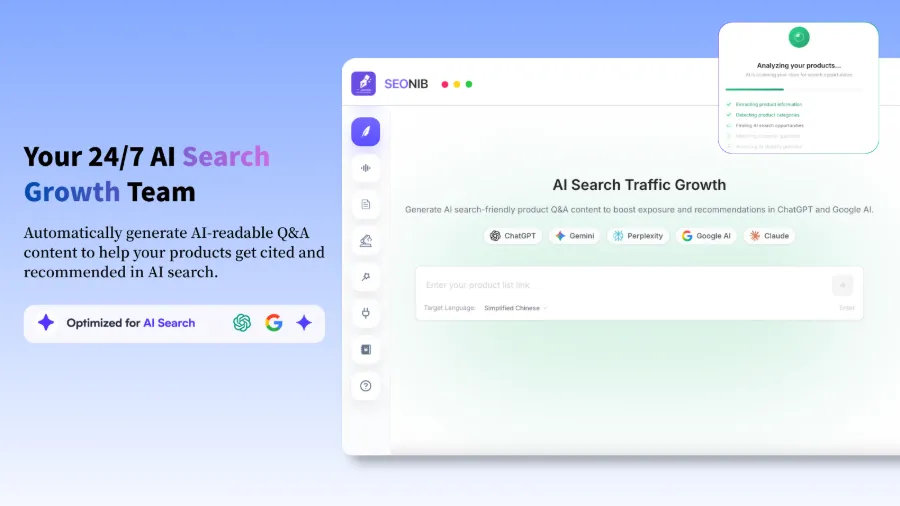
After setting up brand context, I followed the simple blog‑writing guide to create a schedule. From then on, I only needed to regularly add new product information. An unexpected benefit was that the generated content could automatically embed shoppable cards, allowing buyers to checkout directly while reading, shortening the conversion path by more than half.
Multilingual support is also crucial. My store targets Southeast Asian and European markets; manually translating into dozens of languages is impossible. This tool supports automatic generation and translation in 40 languages, letting you turn AEO Q&A into multiple language versions with a single click, covering global entity matching searches.
Automated AEO Content Workflow: Let the System Work for You
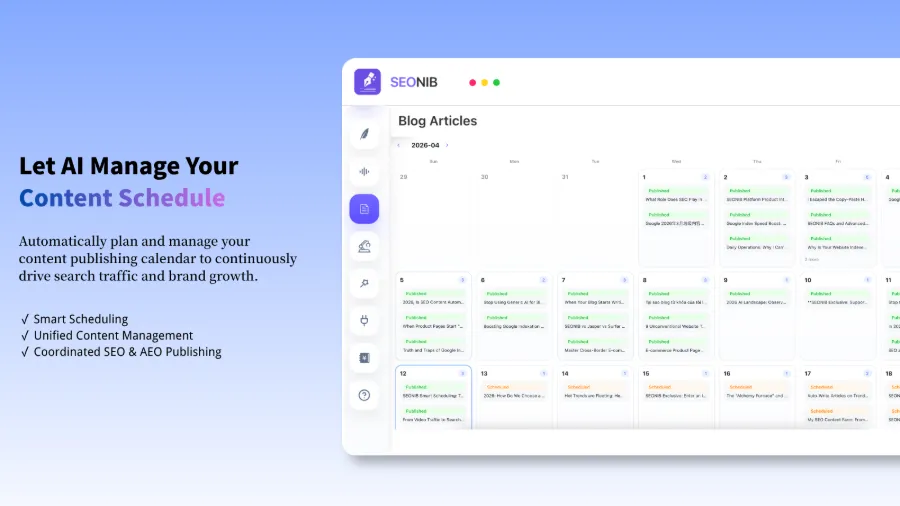
The hardest part of manual optimization isn’t writing the content itself, but maintaining frequency. Write one today, forget it tomorrow; then a week later you add two more, and traffic growth becomes intermittent. An automated workflow solves this problem.
I set up a content calendar that automatically generates and schedules an AEO Q&A every Tuesday, Thursday, and Saturday. The most comfortable feature of SEONIB is that once you subscribe, you no longer need to manually translate it the system runs according to the schedule. The trend discovery module monitors industry hot words in real time and pushes high‑potential topics to a “to‑write” list, so I don’t even have to think about what to write.
Integration is straightforward. Find the corresponding app in the Shopline App Store—after installing the Shopline App Store – SEO AI Blog, bind your store, authorize the API, and all generated content automatically syncs to Shopline product pages and the blog section. One‑time setup synchronizes across multiple platforms; Shopify and WordPress can also receive pushes simultaneously.
For why automated content boosts AI citations, see How to Get Your Content Cited by AI Answer Engines: 7 Proven Methods. It notes that structure and consistency matter more than the quality of a single piece. I also read What Marketing Tasks Can SEONIB Help With? What It Can and Can’t Do, and How to Use It to understand the tool’s limits—e.g., it’s not suited for highly personalized niche product content, but standardized product Q&A and knowledge pages are perfectly fine.
If you want to set it up yourself, refer to the detailed workflow configuration guide for trend discovery, bulk generation, scheduled publishing, and API sync.
FAQ
Q1: Is AEO the same as SEO?
No. SEO targets traditional search engine page rankings; AEO targets AI search engines that generate direct answers. They require different content structures: AEO relies more on structured Q&A and entity relationships.
Q2: Can I manually optimize Shopline product pages for AEO?
Yes, but it’s extremely inefficient. I spent 3 hours manually revamping 20 FAQs and got only 2 clicks. Maintaining a Q&A matrix for dozens of products manually is virtually unsustainable.
Q3: Does AEO content need frequent updates?
Not daily. Once you’ve built a structured knowledge base, you only need to update when product information changes or industry trends shift significantly. Updating monthly or less is sufficient, and automated tools can refresh weak points on a schedule.
Q4: How important is multilingual support for AEO?
Very important. AI search engines cite content in the local language of each market. Covering 40 languages with AEO content dramatically increases the chance of being referenced by ChatGPT/Perplexity in different languages.
Q5: Can I use automated tools for AEO without a technical team?
Yes. As long as you’re willing to spend an hour or two setting up brand context and a content calendar, the system runs mostly on its own. No coding or API knowledge required.
Share Article