AEO Content Not Appearing in AI Search? These 5 Mistakes Might Be the Reason

When I performed a quarterly AEO audit last month, I noticed a demotivating pattern: several teams spent three months on content optimization—FAQ structured data, detailed guides, keyword coverage all passed—but their brand never showed up in the responses from ChatGPT and Perplexity, looping back and forth.
The problem isn’t that AEO wasn’t done. The problem is that the approach is still stuck in the inertia of traditional SEO: focusing on click‑through rates, hiding answers deep within paragraphs, treating Schema as a one‑off task. AI engines extract information in a way that is completely different from what you expect.
This article breaks down five fatal errors that repeatedly appear in these audits, including a few technical details that are rarely discussed.
Using the Wrong Metrics: Still Stuck in Traditional SEO Evaluation Frameworks
In July 2025, Muck Racks released an AI citation study that contains a repeatedly worth noting: 52 % of top brands rotate in AI search results each quarter. Being cited today does not guarantee you’ll be cited tomorrow. If your team’s KPI is still “opportunity conversations” and page click‑through rate, you have no idea when you lose position.
AI engines provide answers directly. Your brand may appear in an answer and influence a purchase decision, yet your Google Analytics shows zero additional sessions. Alternative metrics should be citation rate—the frequency your content appears in AI responses; model share—the proportion of your brand in AI answers for your category; and source attribution.
The consequence of lacking a feedback loop is immediate: you don’t know which content has been cited by AI, nor which adjustments were effective. I recommend tracking visibility across platforms such as ChatGPT, Perplexity, Gemini, and Claude, rather than focusing solely on Google Search Console. Google AI Overviews data is also useful, but it isn’t the only place you should look.
Answer Structure Is Wrong: AI Can’t Grab Your Core Point
AI engines extract answers differently from how humans read articles. They don’t read entire paragraphs—they scan the most direct opening statement. If your core answer is hidden in the seventh paragraph after a 400‑word background intro, even if it’s the best answer, AI won’t cite it.
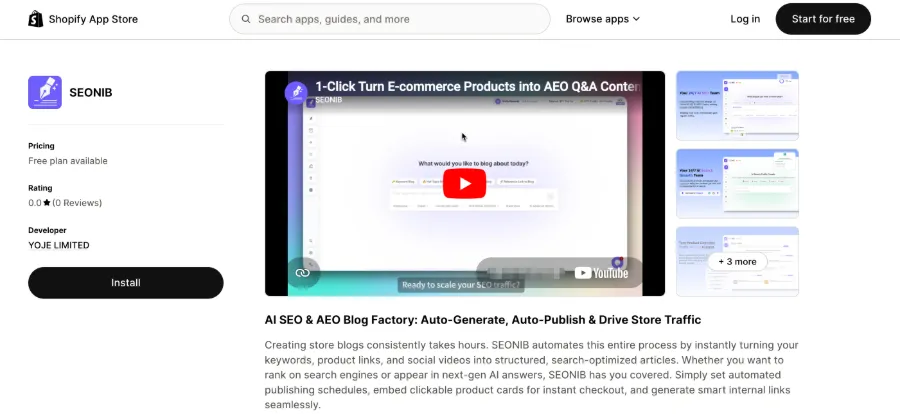
When I generated content with SEONIB, I found that simply adjusting the output structure—placing the answer within the first 50 words of the paragraph—significantly increased citation frequency. This principle is called BLUF: Bottom Line Up Front. Muck Racks’ research confirms that over 85 % of AI citations come from third‑party media rather than brand‑owned pages. The reason is simple: media editors start with a direct statement, no preamble.
Check your current content: Is the answer buried after an introduction? Can the core point be expressed clearly in a single sentence? I try to keep each block self‑contained within 400‑800 words so AI doesn’t need to pull context across paragraphs—this works better in RAG scenarios.
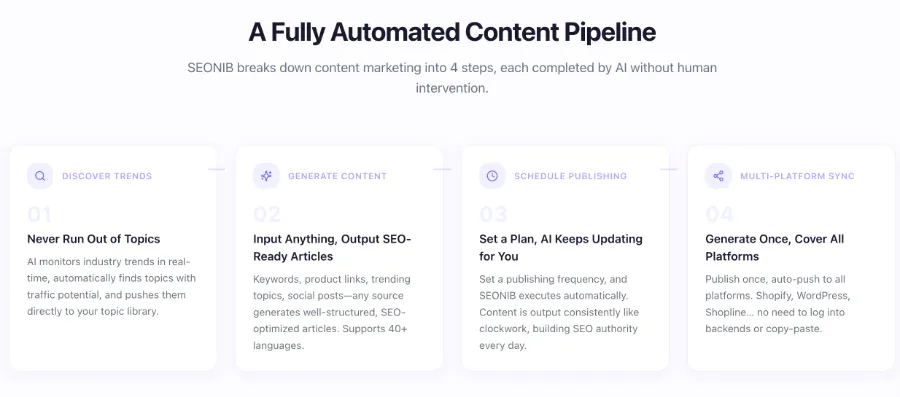
If you need to generate this structure at scale, refer to SEONIB’s five ways to auto‑generate blog posts. It doesn’t bury the answer at the beginning—starting with the answer is a built‑in rule. Also, the case study “Use SEONIB to turn product pages into blogs” demonstrates the same writing principle.
Schema and Robots.txt: Two Easily Overlooked Technical Pitfalls
Many teams know that FAQPage Schema is useful, but they stop after adding it to the homepage or product page. The question is: does your Schema match the actual page content? In one audit I found a client who added FAQPage type to an article page that contained no Q&A at all—just a product description. That’s not much better than having no Schema.
Common schema type differences: FAQPage fits Q&A, HowTo fits tutorials, SpeakableMarkup fits voice‑search scenarios, Article Schema needs author markup to align. If you mix schemas across pages without maintaining consistency, AI engines encounter contradictions when checking page content, reducing citation probability.
Another more hidden issue is robots.txt. Many sites added wildcard rules years ago to block generic crawlers, inadvertently also blocking GPTBot (OpenAI’s crawler), OAI‑SearchBot (OpenAI search crawler), ClaudeBot, and PerplexityBot. I encountered a real case: a team spent three months on AEO content optimization with zero citations; the root cause turned out to be a Disallow: / rule in robots.txt combined with a wildcard—preventing all AI crawlers from accessing any site content. From deployment to problem discovery took six months. The fix is to check robots.txt for any blocking rules targeting these crawlers and ensure they can access the pages you want cited.
Content Type Is Monolithic: Only Covering “What Is” Misses “Which Is Best”
Most AEO content answers “What is X” questions—what a tool is, what a concept means, how a feature works. These informational queries are important, but commercial‑intent queries are rapidly increasing in AI search. Users no longer ask only “What is autonomous driving”; they ask “Which autonomous driving car is the best?” or “Which is more suitable for small teams, A or B?”
Returning to the 52 % rotation data—brands that dominate informational queries rotate frequently in AI, while brands that dominate commercial‑intent queries have lower rotation because they are directly tied to purchase decisions. If you only cover informational queries, you hand the citation slots for commercial intent to competitors.
How to identify these commercial‑intent queries? Keyword research or AI trend tools can reveal them. In SEONIB’s “Trend Discovery” feature, I observed many commercial‑intent keywords have potential—product comparison terms, review terms, buying‑guide terms. These topics face less competition overall than informational queries, but AI citations have higher conversion potential.
When building commercial‑query content, refer to the case “GEO for Shopline Stores: Cited by AI Search Engines” to see how cross‑platform AEO optimization is done. The practical article “Turn Product Links into SEO Blogs That Continuously Attract Organic Traffic” also explains how to transform commercial‑intent query content.
FAQ
Q1: My site already has FAQPage schema, why is the AEO citation rate still low?
FAQPage schema is only a technical prerequisite; it doesn’t guarantee citations. More likely, the content structure doesn’t match AI’s extraction method—your answer isn’t at the paragraph start, or the schema content doesn’t align with the actual page content. Another common cause is robots.txt unintentionally blocking AI crawlers; a perfect schema won’t help.
Q2: How can I know if my content is being cited by ChatGPT or Perplexity?
There is no unified tool that reports citations across all AI engines. You can manually ask your core keywords in ChatGPT, Perplexity, Gemini and see if your brand appears in the responses. A more systematic approach is to use third‑party AI visibility tracking tools or build a cross‑platform citation monitoring checklist and regularly check changes in model share.
Q3: How long does it take to see results after optimizing AEO?
Typical cycle is 2–4 months, depending on whether your content structure follows BLUF, your schema is complete, and AI crawlers can access the pages. If robots.txt has blocking rules or the structure doesn’t follow BLUF, the timeline lengthens. The case mentioned above took six months to discover the robots.txt issue, so technical checks should be the first step.
Q4: Can AEO and SEO be done simultaneously? Will they conflict?
No conflict; they should be done together. SEO targets traditional search‑engine click‑through scenarios, while AEO targets AI‑engine direct‑answer scenarios. Both can share the same content pool, but the structure and format need to be adapted separately. Many teams that restructured the endings of traditional SEO content into BLUF saw improvements in both AI citations and rankings.
Q5: Which mistake should I start fixing first?
Start with robots.txt. It’s the lowest‑cost, highest‑impact change. Ensure GPTBot, OAI‑SearchBot, ClaudeBot, and PerplexityBot are not blocked. Then verify that your core content pages follow the BLUF principle—answers within the first 50 words of the paragraph. Finally, track schema types and citation rates. Doing it in the wrong order can, to a six‑month delay like the team mentioned.
Share Article