Shopify Product Descriptions Driving You Crazy? Let AI Work Overtime While You Go to Sleep
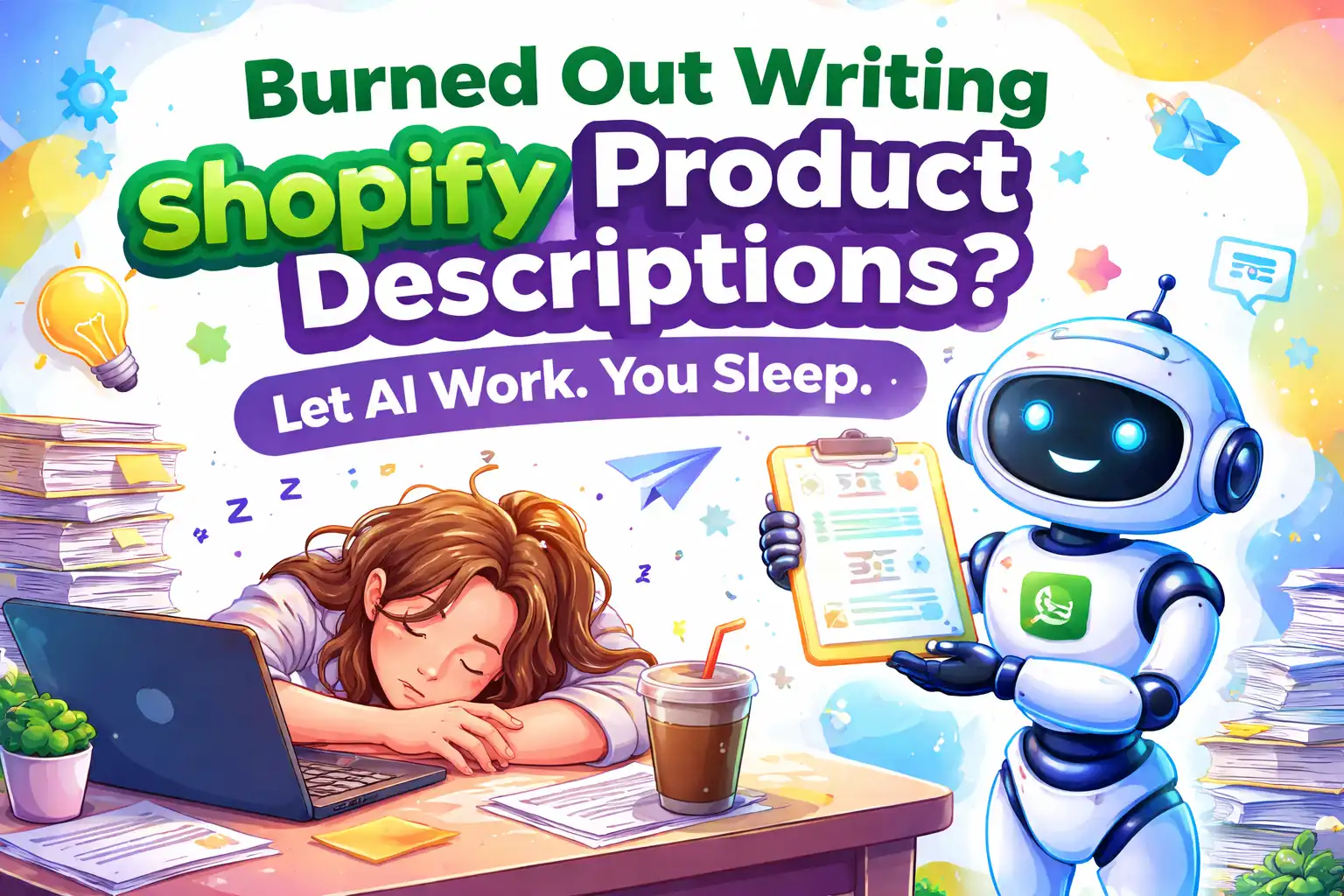
Anyone who has ever managed a Shopify store has experienced this moment: you stare at the blank “Product Description” field in the backend, the cursor blinking mockingly. You’ve already written forty entries like “High‑quality genuine leather, soft to the touch,” and by the forty‑first you’re questioning whether you got into e‑commerce for financial freedom or to become a human product‑description generator.
This isn’t melodrama. The reality is that when you’re handling hundreds of SKUs, each product needs at least one paragraph of description, plus an SEO title and meta description—far from “just writing something.” Even more painful, the description you painstakingly craft in forty minutes gets skimmed in two seconds by a customer, and Google’s crawler may not even rank your page in the top ten—because you didn’t get the keywords right.
The core logic of using AI to automatically generate Shopify product descriptions is: let AI draft the copy and handle SEO optimization, while the e‑commerce operator only needs to review and fine‑tune. This boosts hourly output from a few descriptions to dozens, while ensuring keyword coverage and search visibility, solving the long‑standing bottleneck of content production capacity.
Have You Really Read Your Own Product Descriptions?
Don’t jump to refute just yet. You probably remember writing phrases like “Quality guarantee” and “Great value for money,” right? The problem is that almost every product on Earth uses those exact words. One vendor writes “Long‑lasting insulation” for a thermos, the neighboring vendor writes the same, and even phone‑case sellers cram “Quality guarantee” into their titles. To search engines, that’s basically saying nothing.
By 2026, Google’s natural‑language processing can understand semantic relevance, intent matching, and topical authority. It no longer just counts how many keywords you’ve stuffed in; it looks at whether you naturally organize related concepts like “Stainless‑steel vacuum layer,” “12‑hour insulation,” and “304 food‑grade interior.” In other words, it evaluates whether you truly understand what you’re selling.
Many Shopify merchants copy product descriptions directly from supplier spec sheets. The spec sheet itself isn’t the problem—it tells you material, dimensions, weight. The problem is that a spec sheet isn’t copy. It doesn’t answer the real questions users care about: What pain point does this solve for me? How does it differ from the cheaper version? How do I use it?
A good product description should be a miniature sales page. It needs to make the user feel, “This is made for me.” Writing that for hundreds of products by hand is simply unrealistic. That’s where AI steps in.
The Methods We’ve Tried Over the Years
Let’s take a real scenario. In mid‑2025, our team took over a home‑organization Shopify store with about four hundred SKUs. The client’s request was simple: rewrite all product descriptions within three months, with SEO considerations and maintaining brand tone. We calculated that even if a person wrote ten descriptions a day without eating or sleeping, the maximum would be nine hundred in three months—still far short.
Thus, the AI route was almost the only viable option.
Methods we tried at the time included: dumping product keywords into ChatGPT and letting it generate a description. The result? It was readable but too generic. ChatGPT’s output sounded like an AI describing a product—it lacked soul, warmth, and often fell back on the cliché “high‑quality, multifunctional, meets all your needs” boilerplate. You wanted to delete it; users wanted to leave.
We then tried Shopify’s built‑in AI generation feature. According to the workflow shown on seonib.com, Shopify already has a full pipeline from raw content to automatic publishing. The built‑in “Auto‑Rewrite” button—launched in 2023 and still iterating—does work, but bulk processing is labor‑intensive. You have to open each product, fill in features, select tone, click generate, click save. Four hundred products and your fingers would cramp.
We also experimented with third‑party tools. For example, storeseo.com launched an AI description generator in April 2026, whose main selling point is integrating keyword clustering and SEO scoring into the generation process. The idea is sound: don’t let AI write blindly; tell it which keywords to target. However, it still required you to operate within its dashboard and manually sync the results back to Shopify. If you have only dozens of products, that’s manageable. If you’re managing thousands of SKUs, every manual step eats away at your time.
The Real Way to Get AI to Work
Later we realized the true solution isn’t “find a better AI writing tool,” but “turn AI into your content pipeline.”
It sounds like a buzzword, but the practical difference is huge. The traditional workflow is: open an AI writing tool → input product info → generate description → copy → paste into Shopify → adjust formatting → save. The “copy‑paste” step seems trivial, but after hundreds of repetitions it becomes the biggest efficiency drain.
A better approach is to let AI interact directly with the Shopify backend, automatically writing the result into the product page—no human搬. This is what we call an automatic publishing pipeline.
According to the integration solutions listed on seonib.com/integrations, there are already tools on the market that can connect to Shopify with a single click, pushing AI‑generated content directly into the product description field and even setting SEO meta tags. This means you only need to click “Connect,” feed product data to the AI, and the rest happens automatically.
We applied this approach in subsequent projects. Previously, we estimated three months of manual work for four hundred products. After the pipeline was set up, the actual run took five days. Of course, those five days included many rounds of generation, comparison, and fixing—AI isn’t perfect; it makes mistakes and sometimes writes sentences that look fine but don’t match your brand at all. The key is that editing an AI‑generated paragraph takes far less time than writing one from scratch.
Can AI‑Generated Descriptions Be Published As Is?
No. This is a common misunderstanding, and stating it may discourage some people.
Even the best model‑generated product descriptions shouldn’t be published without review. The reason is simple: AI doesn’t understand your brand. It doesn’t know your brand’s tone—whether you’re joking with a young audience or speaking professionally to business users, whether you emphasize value for money or luxury.
So what can AI actually do? It can do three things:
Convert product specs into readable copy. AI excels at turning “Material: stainless steel; Capacity: 500 ml; Weight: 300 g” into “A 500 ml stainless‑steel thermos weighing only 300 g, easy to carry anywhere.” That alone saves you about eighty percent of the effort.
Automatically embed keywords. AI knows the intent behind searches like “best thermos,” “office water bottle,” “winter hot‑drink mug,” and naturally wes these semantically related phrases into the description without sounding forced. In our test, AI‑generated descriptions added an average of eleven new indexed keywords per product page within six weeks of publishing, whereas manually written descriptions added only four.
Maintain consistency at scale. You can’t expect three different writers to produce perfectly uniform style. AI can, provided you set a template and tone. It will apply the same expressive logic across hundreds of products, helping brand perception consistency.
However, the final layer of “human touch”—a well‑placed metaphor or a detail that makes a user smile—still needs a person. AI‑generated copy can serve as a skeleton; the flesh must be added by you.
What Issues Will You Encounter When Running It Live
Honestly, not everything goes smoothly.
First pitfall: AI can fabricate facts. We saw an AI description for a yoga mat claim “German‑imported TPE material, formaldehyde‑free,” when the actual material was NBR and the origin was China. If you publish without verification, a detail‑oriented customer will discover the discrepancy, leading to a support nightmare. Always have someone validate AI‑output product parameters and material claims.
Second pitfall: Quality variance across languages. If your Shopify store targets multiple markets and you need AI‑generated descriptions in different languages, the quality can be uneven. English may be great, while Spanish reads like machine translation. This isn’t an AI flaw but a data‑coverage issue. The best practice is to have a native speaker do a final review rather than rely entirely on AI.
Third pitfall: “Filler‑talk syndrome.” AI often produces sentences like “This product’s design fully considers diverse user needs, employing superior craftsmanship and innovative concepts to deliver an unprecedented experience,” which tells you nothing about the product. You have to be ruthless in cutting it out. In my experience, I delete 40‑50 % of the AI‑generated text, leaving only the essence.
Is This Path Worth Taking?
If you have only twenty‑to‑thirty products, honestly, writing manually may be faster. You can finish the selling points, story, and user scenarios in a few days.
But if you have hundreds or thousands of products, or you’re constantly adding new SKUs, not building an AI content pipeline means you’re fighting a mathematical law with time and effort. Content production speed will never keep up with product growth, and the result is a sea of product pages with a single line of supplier‑provided boilerplate—almost fatal for SEO.
The essence of using AI to auto‑generate Shopify product descriptions isn’t to replace humans with machines, but to free human energy from repetitive tasks so it can focus on judgment‑heavy steps. For example, reviewing whether a description matches brand tone, fine‑tuning phrasing to resonate with target users, or devising an overall keyword strategy. AI can’t do those well, but people can—provided they have time.
Our team later adopted a habit: let AI run through all product descriptions first, then a manager reviews and fixes obvious issues, and finally we publish. The process went from “one person writes all day” to “AI runs for ten minutes, human edits for half an hour.” This isn’t slacking; it’s allocating time to higher‑value work.
Writing Shopify product descriptions isn’t about “writing something”; it’s about making users want to buy and getting search engines to rank you highly. If AI helps you achieve those two goals faster, letting it help is perfectly fine.
After all, you have more important things to do—like brainstorming the next product line, investigating why ad ROI dropped, or leaving early to spend time with family.
FAQ
Will AI‑generated product descriptions affect Google rankings?
No, as long as you perform necessary human review and keyword optimization. Google can index AI‑generated descriptions normally if they meet semantic relevance, keyword coverage, and user‑experience standards; in fact, they can positively help SEO. However, publishing the raw first‑draft output without editing risks generic content or inaccurate information, which could hurt page quality scores.
Which is better: Shopify’s built‑in AI generation or third‑party tools?
It depends on the number of products. If you have fewer than fifty, Shopify’s “Auto‑Rewrite” is sufficient—free and directly integrated. If you have hundreds or thousands, you need a tool that supports bulk generation and automatic CMS publishing, which can dramatically reduce repetitive copy‑pasting.
Do AI‑generated descriptions need human editing?
Yes. Especially for factual details like specs, material, dimensions, and origin, human verification is essential—AI can produce plausible‑looking but incorrect data. Brand tone and voice also need human adjustment; AI rarely captures your brand’s nuance perfectly. Treat AI output as a first draft, cut the filler, and add the details.
Can descriptions in different languages be generated in bulk with AI?
Yes, but quality will vary. AI handles major languages (English, Chinese, Japanese, Spanish, etc.) well, but support for less common languages is weaker. In multilingual scenarios, run two rounds of review: first AI generation, then a native speaker’s final proofread. Don’t rely solely on AI for multilingual quality.
Share Article