
AI Small Teams: The Winning Strategy for Future Marketing

Three years ago, a typical cross‑border e‑commerce team consisted of three copywriters, two designers, one SEO specialist, one data analyst, plus operations and channel distribution staff. A content cycle from topic selection to publishing took an average of 12 to 18 days. Today, a team of three to five people, leveraging AI tools, is achieving the same output, and even more. This is not a linear efficiency gain but a fundamental shift in production structure—people’s effort moves from execution to strategy, while machines take over repetitive work. This article starts from real workflows, breaks down what this change means, and how cross‑border sellers can truly implement it.
From “Manpower Stacking” to “AI‑Driven”: Paradigm Shift in Marketing Teams
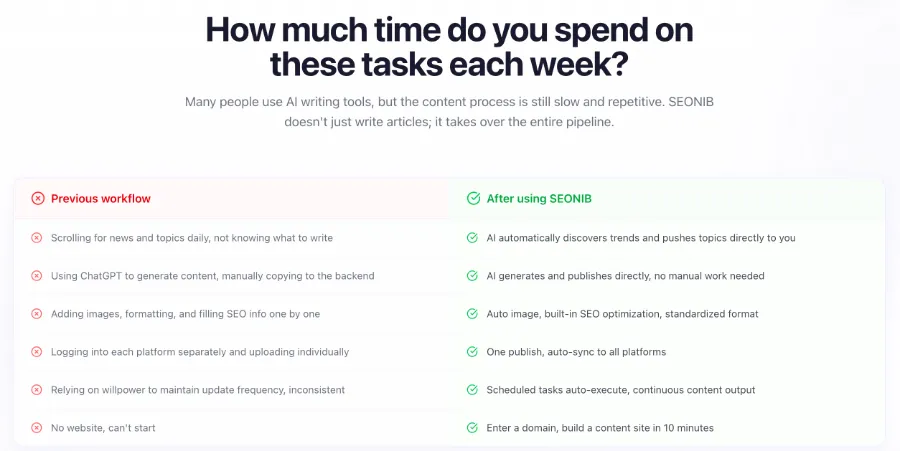
Traditional content marketing suffers from the “human bottleneck”. Topic selection requires discussion, writing needs repeated revisions, image creation requires separate design, SEO optimization follows a checklist, and publishing requires logging into each platform’s backend to upload. Putting these steps together, a medium‑length blog post consumes about one to two days of a person’s work from conception to launch. The problem is not low efficiency of a single step, but that every node in the chain depends on manual operation; any absence or distraction breaks the chain.
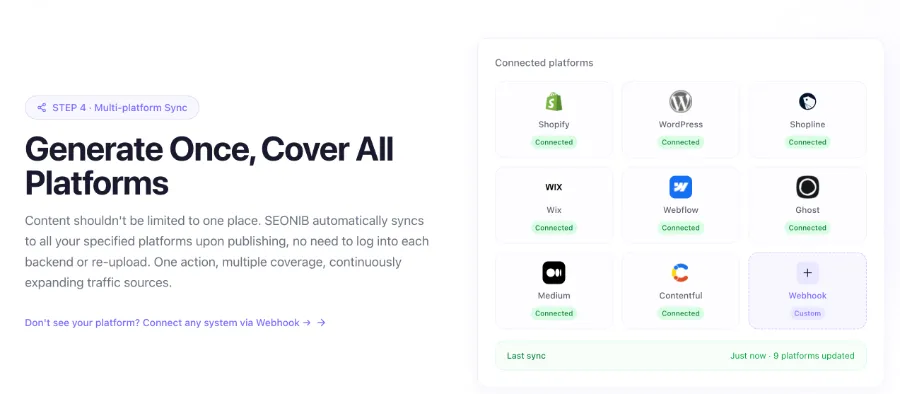
After AI involvement, changes occur at every node of the chain. Topic selection no longer depends on manually scrolling social media; the system monitors industry trends in real time and automatically identifies directions with search potential. For example, during a real‑time trend monitoring of e‑commerce SEO strategies, the hottest topic scored 94 points—such data previously took analysts two to three days to compile from scattered tools. Writing no longer requires repeatedly polishing the opening paragraph; AI, given keywords, product links, or reference articles, directly outputs a fully structured SEO piece. Image creation and formatting become auto‑filled, and SEO meta information is embedded during generation. The publishing step also shifts from logging in one by one to a single configuration with multiple synchronizations.
The core change is not “AI replaces humans”, but “human effort shifts from execution to strategy and judgment”. Previously you tweaked the wording of the third paragraph’s opening; now you decide whether to chase that hot topic. Previously you checked whether image alt text was correct; now you evaluate whether the content covers all search intents of the target users. This shift means that the future belongs to organizations that can leverage a minimal team to generate maximal traffic, not to those with the most people. The judgment of a three‑person team, combined with AI’s execution power, can match the output volume of a twenty‑person team.
An “All‑Round” Creator’s AI Workflow: From Zero to Continuous Output
Assume an entrepreneur named Anna. She has no writing experience, doesn’t know HTML, and can’t design pages. Her only resources are a small pet‑supplies store on Shopify and two hours of free time each day.
Anna’s workflow runs like this. Every morning she opens the trend dashboard of an AI content platform and sees that the system has already filtered potential writing topics for the day. One topic is “How to Choose the Right Litter Box for Cats”, which is on an upward trend with moderate competition. She clicks “Generate” and inputs the product link from her store. AI automatically extracts product specs, user reviews, and common questions, and outputs an SEO‑optimized buyer’s guide. Anna spends five minutes reading the draft, adjusts a key paragraph—she notices the AI‑recommended litter box model doesn’t match her store’s actual inventory—then clicks confirm to publish.
The whole process from trend discovery to content live takes less than twenty minutes. This is not an idealized narrative but the actual flow with tool support. Anna’s case illustrates a key point: the barrier to content production has been dramatically lowered. Previously she would have needed to learn keyword research, SEO writing techniques, HTML formatting, and multiple platform back‑ends. Now she only needs to do two things—judge which trends are worth pursuing and verify that AI‑generated content is factual.
Interestingly, Anna is not an exception. Many small teams find that once they hand over rapid idea execution to AI, the real bottleneck is no longer content production speed but the ability to “continuously make correct strategic judgments”. AI can generate content, but it doesn’t know whether your brand tone fits a topic, nor whether a hot trend aligns with your target audience. These judgments still require human input. As discussed in the article on SEO blogs that turn product links into sustainable natural traffic with one click, tools solve efficiency problems, while direction selection remains a human responsibility.
How Content Production Automation Amplifies a Small Team’s Real Output
Back to Anna’s case. Two weeks later, her small store starts showing keyword impressions in Google Search Console. Four AI‑generated buyer guides rank on the second to third pages of search results. For a shop with zero SEO foundation, this speed isn’t bad. But the real amplification comes not from the quality of a single piece, but from the rhythm of continuous accumulation.
Anna set up a scheduled task: every day at 10 a.m., AI picks a topic from the library, generates an SEO blog post, and automatically syncs it to her Shopify blog, Medium account, and a newly created Shopline store. She doesn’t need to log in daily to confirm, nor manually copy‑paste. The content accumulation process becomes like machine maintenance—she spends half an hour each week checking the data dashboard, seeing which topics brought natural traffic and which content fell short of expectations, then adjusts next month’s topic direction.
An often‑overlooked detail: automation solves not the “write a good article” problem, but the “continuous update” problem. Most small teams can maintain a cadence of three posts per week in the first month, but by the third month enthusiasm wanes and the frequency drops to one post per week or less. Search engines are highly sensitive to the signal of continuous updates—when a site’s update frequency declines, crawler visits usually decrease as well. Automated scheduling precisely addresses this pain point.
When configuring multi‑platform sync, you first need to complete each platform’s authorization and API integration. For complex integration scenarios, refer to the help documentation. After configuration, AI‑generated content is automatically pushed to the designated platforms, with no human intervention needed.
Writing Process Optimization
Many teams underestimate the value of the step “from product link to content”. In fact, a seller’s product page naturally contains a wealth of information usable for content generation—specs, usage scenarios, high‑frequency questions from customer reviews. Transforming this structured product data into unstructured readable content is exactly where automated tools excel. By learning how to easily write a blog, you can further shorten the path from product input to content publishing.
Back to Anna’s practice. After a month, she accumulated 15 blog posts. The topic library adds about 24 new suggestions daily; she only needs to filter 3–5. This rhythm continuously expands her content library, and search rankings rise slowly but steadily. In the fourth month, a guide on “Pet Travel Accessories” reached the first page of search results—the traffic for that piece came from the cumulative effect of three months of content, not a one‑off surge. This is the true value of automation: not a miracle, but the elimination of interruptions.
Overlooked Pitfalls and Limits for Small AI Teams
After covering the good parts, we must be honest. The risks of automated content are real, not just theoretical “what‑if‑it‑fails” scenarios, but predictable “specific‑time‑point” problems.
The most typical pitfall is content homogeneity. When AI generates content based on similar keywords and product information without human intervention, the tone and structure tend to converge. Readers will notice the repetitive style after three articles, and search engines will detect the pattern. Google’s algorithm is quite sensitive to patterned content; once it determines a site’s content lacks diversity, rankings may stagnate or drop.
From practical observations, teams that rely solely on automated content without human strategic adjustments usually hit a traffic ceiling between the sixth and ninth month. The first three months are growth, months four to six plateau, and thereafter, if content quality and topic selection don’t improve, traffic slowly declines. This isn’t because AI‑generated content gets worse, but because competitors also use similar tools, flattening content‑level differences.
Another often‑overlooked issue is reliance on topic judgment. AI’s topic suggestions are based on data—search volume, competition, trend heat. Data can tell you “many people search this”, but not “whether your users should search this”. An AI for a pet‑supplies store might suggest writing “How to Train a Search‑and‑Rescue Dog” because the term has search volume, but for a shop selling litter boxes and climbing frames, that content would almost never convert. AI lacks commercial context; it doesn’t know which traffic is valuable to you.
That’s why small teams must retain two human steps: review and strategic adjustment. Review ensures facts, links, and product descriptions are accurate—AI can make mistakes on unfamiliar data, like recommending a product model you never sold. Strategic adjustment controls content direction—not every high‑traffic topic is worth writing; only those that align with your product line, brand positioning, and user persona generate real value.
When handling technical integration involving multiple content sources and rule configurations, refer to the HTTP API Integration Guide to design automation flows. However, no matter how perfect the technical side is, the authority over content strategy cannot be delegated.
A reasonable balance is “human + AI” rather than “AI replaces humans”. AI handles all standardizable steps—initial topic screening, content generation, formatting optimization, multi‑platform publishing. Humans handle all judgment steps—direction selection, fact‑checking, brand consistency review, and strategy adjustments based on traffic data analysis. The best team structure isn’t one person plus a pile of tools, but one person who can make the right judgments plus a set of tools that execute the right tasks.
FAQ
Will AI‑generated content be penalized by search engines?
It won’t be directly penalized, but there is a quality risk. Google’s guidelines oppose “low‑quality automatically generated content”, not all AI‑assisted content. If your AI content provides useful information, has clear structure, and includes genuine viewpoints, it should not be penalized. The key is human review—publishing without review will, over time, lead to traffic decline.
How can I, as a single person, use AI to complete the entire marketing process?
From trend discovery to content publishing, a complete workflow is: use AI tools to monitor industry hot topics and generate topic ideas, input keywords or product links for AI to output SEO articles, set up scheduled publishing for automatic release, and spend half an hour each week reviewing traffic data and adjusting direction. The whole process takes less than an hour per day; the core skill is not writing but judging which topics are worth pursuing.
Will automated content cause a drop in quality?
If there is no human intervention at all, yes. Typical issues are homogeneity, lack of real cases, and missing viewpoints. However, adding simple human tweaks after AI output—adding a real customer story, correcting an inaccurate product description, inserting a personal experience—significantly improves quality. A small amount of human input combined with automation yields far better results than pure manual or pure automation.
Which human steps should a small team retain?
It is recommended to keep three steps: deciding the topic direction (not every hot topic is worth chasing), content review (facts and brand consistency), and periodic strategic review (analyze traffic data and adjust content direction). Decision authority for these steps stays with humans; machines can assist in data collection but cannot replace commercial judgment.
Share Article