
Creator Economy: Better Systems, Not More Effort
Opening the dashboard in the morning, replying to late‑night comments, gathering topic ideas from five platforms, copy‑pasting text back and forth between ChatGPT and note‑taking apps, and finally logging into each publishing platform to format manually—this is the morning ritual for most content creators and the starting point of an efficiency trap.
If you spend more than two hours a week on repetitive formatting and publishing, you’ve already hit an invisible growth ceiling. Independent creators average 12 hours a week on these steps, time that is fundamentally unrelated to actual creation. It’s just moving finished work from one interface to another. The underlying assumption is tempting: work a little harder and output will double. In reality, marginal returns diminish, fatigue accumulates, and dropout rates peak between the 4th and 6th month.
This article won’t tell you to work harder. It discusses how a single automated content system can turn topic selection, generation, optimization, and publishing from manual tasks into a closed‑loop pipeline—giving back time to real creation instead of repetitive labor.
When Do Manual Operations Become a Growth Bottleneck?
Manual processes are perfectly reasonable in the early stage. When you have only 10 articles, hand‑writing, manual formatting, and manual publishing are controllable in time and quality. But starting around the 50th article, systemic costs start to surface.
The most hidden category is time consumption. Logging into a platform, uploading a cover, filling a summary, selecting a category—each takes just two or three minutes. But if you maintain five platforms, each article adds an extra 15 minutes per platform. Publishing five articles a week therefore consumes almost five hours in the publishing step alone.
The second category is publishing inconsistency. Each platform has different format requirements—Shopify’s field structure, WordPress’s category hierarchy, SHOPLINE’s tag rules—making it easy to miss or misfill fields when switching manually. The direct consequence is that brand expression becomes fuzzy to search engines. When search engines crawl these scattered pieces, they struggle to extract consistent entity information, which is almost fatal in the AI‑search era.
The third category is scalability constraints. One person only has so many hours a day; eventually you hit a wall—not because inspiration runs out, but because output speed is limited by physical capacity. Many creators notice their growth curve flattening in the fourth month, not because content quality declines, but because capacity has hit a ceiling.
The root of the bottleneck isn’t low content quality; it’s a misallocation of energy. The creation part is diluted by a large amount of non‑creation tasks. No matter how diligent you are, you can only write one article a day—but with a different system, you could trigger multiple articles a day without sitting in front of a screen.
Core of Systems Thinking: Automated Content Pipeline
Once you view content as a production process that can be pipelined rather than a fresh creation each time, systems thinking naturally emerges. The core of an automated pipeline is turning four stages from “manual completion” to “no human intervention”: trend discovery, content generation & optimization, scheduling & publishing, and multi‑platform synchronization.
Trend discovery is the easiest stage to overlook. Most people rely on scrolling social media or checking competitor blogs to “feel” which topics will blow up. This process consumes at least 30 minutes a day and is highly intuition‑driven. In contrast, a monitoring system can continuously scan industry dynamics and search demand changes in the background, automatically pushing high‑potential topics into your idea list. You just glance, decide whether to write, or even let the system auto‑select and trigger downstream steps.
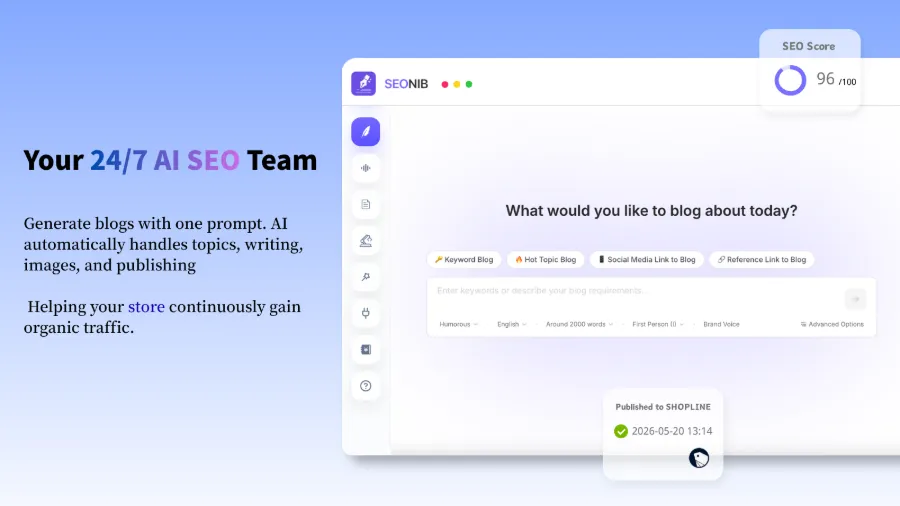
The technology for content generation is relatively mature. For example, platforms like SEONIB can take a keyword, product link, or trending topic and automatically output a fully structured SEO article, complete with image insertion, formatting, and meta‑information. You spend five minutes reviewing and tweaking; the rest requires no further manual intervention.
The most underestimated stage is publishing and synchronization. The time truly saved by the system isn’t the writing part but the “after‑writing” part. When a piece is automatically pushed to Shopify, WordPress, SHOPLINE, and all target platforms, you don’t need to log into any backend. The table below directly compares manual time per stage with the automated version:
| Process Stage | Manual Time Required | Automated Time Required |
|---|---|---|
| Trend Discovery | 30 min/day | 0 (AI auto‑push) |
| Content Writing | 2 h per article | 5 min (AI draft + human tweak) |
| Formatting & SEO Optimization | 30 min per article | 0 (built‑in rules auto‑complete) |
| Multi‑platform Publishing | 15 min per article × platform count | 0 (one‑click sync all platforms) |
Using this pipeline, an independent creator can increase weekly output from 3 to 15 articles, while publishing time drops to zero. After the time is freed, you can refocus on topic quality, content depth, and reader interaction—this is the real value of a creator.
Why is this model especially important in the AI‑search era? Because system‑generated content tends to be more structured and entity‑rich than ad‑hoc writing, making it easier for search engines to extract your brand’s core entities. For more on this, see our previous article on 7 Ways to Get Your Content Cited by AI Answer Engines. If you want a concrete case, the real‑world “cheat” record of a content creator demonstrates the system’s effectiveness.
Building Your Creator System from Scratch: Four Steps
Creating an automated system isn’t as complex as you might think. You don’t need to know code or have a team. Before you start, check out how to quickly validate a project idea with a simple website; the same mindset applies to content systems—build a minimum viable version first, then iterate.
Step 1: Record Brand Context and Knowledge Base
This is the system’s “brain.” You need to tell the AI what your brand is, who the target audience is, tone, common terminology, and prohibited wording. It sounds tedious, but you only do it once. All generated content will automatically respect these boundaries thereafter.
Step 2: Set Automatic Topic‑Selection Rules
Define a set of keywords or industry topic ranges; the system will track relevant trends and push a curated topic list to you each week. You can also set a minimum search‑volume threshold so low‑volume topics are filtered out, saving you time.
Step 3: Configure Scheduling and Platform Connections
This is the main work done in SEONIB’s backend—choose your publishing frequency (e.g., one article each Monday, Wednesday, and Friday) and connect to your target platforms. If you use WordPress, see this guide on how to connect a WordPress site to SEONIB. Shopify, Shopline, and WordPress are all supported.
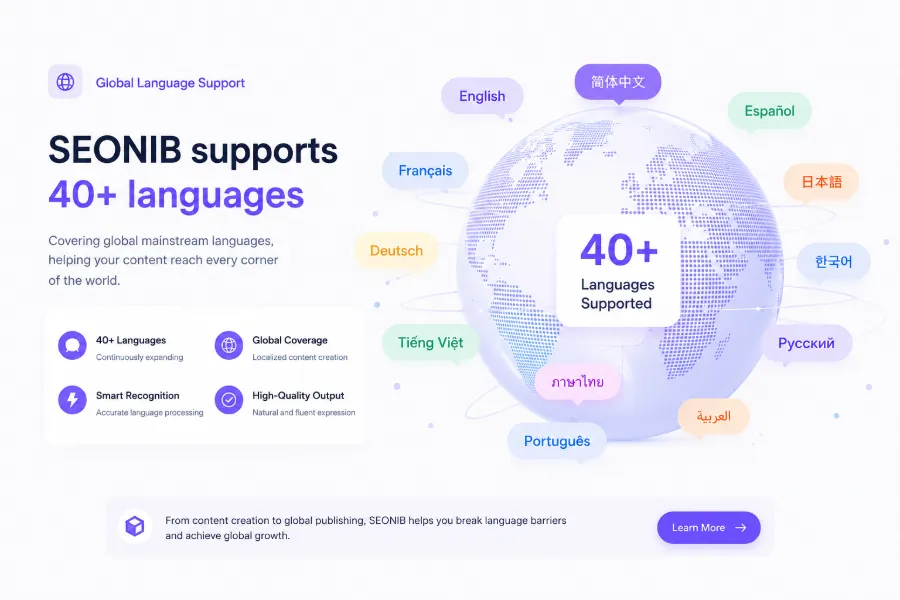
Step 4: Launch and Iterate
The initial configuration of the whole system takes about 40 minutes on average. After that, daily maintenance is only five minutes—reviewing upcoming drafts, checking data feedback, and tweaking topic direction. This ROI is fully manageable for a solo creator. If you encounter detailed questions during setup, the complete SEONIB Help Documentation provides specific explanations for every feature.
Common Pitfalls and Real‑World Trade‑offs in Content Automation
Automation isn’t free of cost. Frankly, without any human oversight, the system quickly produces a lot of repetitive content.
The most basic pitfall is over‑reliance on default templates. Many AI tools ship with very similar structures—“intro → bullet points → conclusion.” If you don’t customize the system for your brand, the resulting articles may look like the same template with different keywords. Search engines detect this patterned output. I’ve seen a brand that, in 2023, relied entirely on AI generation without a configured knowledge base; three months later, organic traffic dropped 30% because the content was repetitive and lacked brand depth. After two weeks of configuring brand context and knowledge base, traffic gradually recovered.
Brand consistency is the easiest aspect to overlook in automation. The system may use wrong terminology, drift in tone, or produce expressions that conflict with your brand’s voice. That’s why a brand knowledge base isn’t a nice‑to‑have add‑on; it’s essential. For a deeper dive, see our analysis on Brand Consistency: The Hidden Ticket to Winning AI Search, which discusses how to maintain brand tone within automated systems.
Fact errors are another real risk. AI sometimes “creates” data, cites nonexistent sources, or distorts facts. In a fully automated publishing mode, these errors go live. A sensible strategy is to let the system draft but keep a human review step, especially for data, citations, and brand statements.
Balancing efficiency and quality is actually simple: don’t try to automate everything at once. Start by automating the two most painful stages—trend discovery or publishing sync—and you’ll already free up a lot of time. Trend‑discovery automation, in particular, not only saves time but can fundamentally shift the direction of your content selection because you’re no longer limited to what you personally see; you can see a broader data landscape.
A system isn’t a silver bullet. It requires you to design boundaries, adjust signals, and define brand rules. The tool won’t automatically make you better; it will amplify the direction you set.
FAQ
Will automation make my content look the same?
Yes, if you never configure brand context. But if you spend time recording a brand knowledge base and industry terminology, AI‑generated content can stay diverse in style and depth. The key isn’t whether you automate, but whether you define variables before automating.
I’m a solo creator—can I still build this system?
Absolutely. The whole system can be configured and launched in about 40 minutes by one person. After that, five minutes a day of review is enough. Solo creators actually benefit the most because their time is scarce and the marginal gains from automation are highest.
Can system‑generated content pass search‑engine quality checks?
Yes, provided it’s been human‑tuned. Fully unattended auto‑publishing may get indexed early on, but over time, content lacking brand depth and entity coverage will be filtered out by search engines. A “machine draft + human review” workflow is recommended.
What technical background do I need for the initial setup?
No coding required. Core actions are: fill in brand info, connect backends, set rules. All interfaces are visual; the learning curve is mainly understanding how to craft a “brand context” rather than learning any software.
How should I balance AI automation with human creation?
Use AI for routine updates and bulk SEO coverage, and reserve human effort for long‑form, deep‑analysis, and brand‑story pieces. A 70 % AI / 30 % human split lets you maintain efficiency while preserving brand depth.
Share Article