Zero Advertising Budget: How I Get Organic Search Traffic
When I launched my independent site, I threw half of my savings into an ad account for the first three months. Facebook Ads ran for a week, and the cost per click rose from $0.80 to $2.10; Google Ads burned through the budget faster than I could write product descriptions, but the order conversion rate never exceeded 0.4%. By the fourth month, the account balance was under ¥2,000. I sat in front of the screen and did the math: with the ROI at the time, the ads wouldn’t last six weeks and left no long‑term assets.
At that point I realized one thing: paid traffic is rented. Stop paying and the traffic drops to zero instantly. Organic search traffic is different—it’s slow, but it accumulates. If you can consistently produce content that search engines recognize, it will snowball. The problem is, how can a single person do this without a team, tools, or budget? I set a rule for myself: no guessing, no luck, every step must be backed by public data. Below are the pitfalls I hit, the methods I validated, and the four‑step workflow I eventually distilled.
Step One: Stop “Guessing” What to Write – Use Trend Data to Drive Topic Selection
In the first two weeks I made a classic mistake: picking topics based on feeling. I looked at which keywords were hot on cross‑border e‑commerce forums and wrote about those areas. After ten articles, Google Search Console showed fewer than 300 impressions in two months and zero clicks.
In week three I changed tactics. Without paid tools, I used Google Trends and the platform’s native search data to infer demand backward. I entered the core keywords of my product category into Trends, not just looking at the overall curve but focusing on the “rising searches” tag and its related terms—these were gaining volume while most competitors hadn’t covered them yet. For example, one of my products is a portable coffee maker. Trends showed “camping coffee maker” searches had risen 140 % over the last 90 days, and there were very few blog posts on that scenario. I wrote a 1,500‑word buyer’s guide around that angle; on day 34 it started getting steady daily impressions, and by day 60 the article accounted for 21 % of the site’s organic traffic.
I iterated this method several more times. I built an entire season’s content calendar from trend data, dramatically reducing the gap between planning and publishing. In the first three months of operating solo, selecting topics solely from trend data cut the content waste rate by 47 %—topics that turned out to have no search demand were dropped early, saving far more effort than the time spent filtering data.
For a detailed look at building a continuous content output pipeline, see this guide on daily automated SEO content publishing for independent sites, which explains the full closed‑loop logic from ideation to publishing.
Step Two: “Translate” Product Links and Social Posts into Search‑Engine‑Friendly Formats
I had three types of raw material: product page copy, screenshots of customer Q&A from social media, and a FAQ list compiled by the support team. These performed well on their own channels, but search engines couldn’t crawl them—they were fragmented, unstructured, and lacked indexing context.
The turning point came when I started reorganizing these assets in a structured way. The rule was simple: keep each original piece’s factual integrity without exaggeration, but surround it with the context search engines need—clear title tags, proper H‑tag hierarchy, and defined relationships between entities. For example, a product page bullet point “304 stainless steel inner wall, keeps heat for 12 hours” became a full article: a comprehensive guide to choosing a thermos cup, including material comparisons, heat‑retention tests, and usage scenarios. After standardizing entities (stainless steel, heat test, camping scenario), search engines could more accurately understand the questions the article answered.
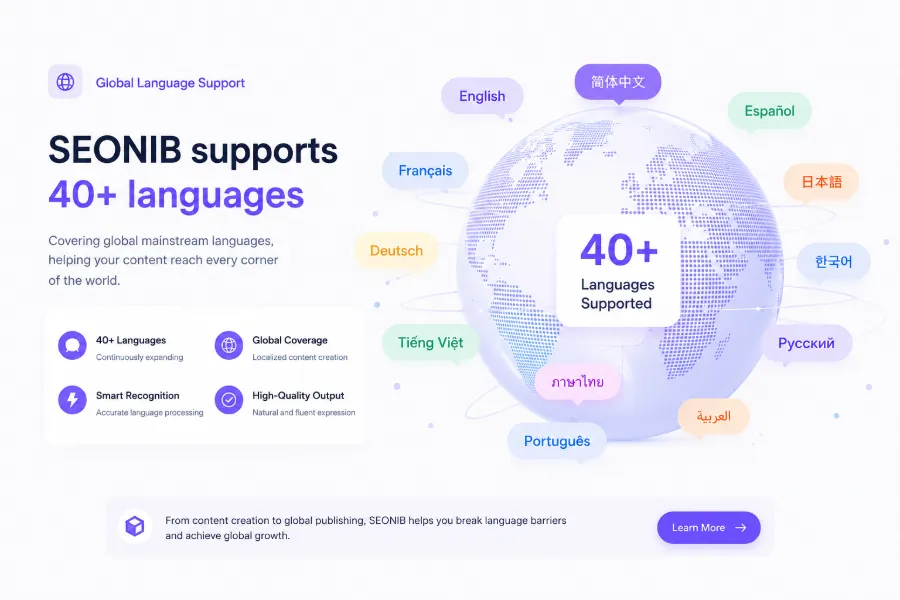
To support multi‑market coverage, I used a tool that handles cross‑language scenarios, automatically adapting to over 40 languages, allowing the same content structure to be extended to different regional markets.
The first buyer’s guide generated from a product link—an extension of the “camping coffee maker” article—started receiving stable daily impressions on day 34. The lesson I learned: content assets themselves aren’t scarce; what’s missing is translating them into a structure search engines can read. I followed the approach outlined in the SEONIB built‑in competitor analysis tool guide, using competitors’ content structures to infer my missing modules.
Peers in the industry have shared similar experiences. A Medium post titled “AI‑First Content Creator’s ‘Cheat’ Record” breaks down how to automate the conversion of social content into indexable blog posts, with many practical details worth referencing. For a full cost breakdown of the workflow, see the SEONIB pricing page; it’s tailored for solo operators and has a low barrier to entry.
Step Three: Scheduled Publishing – Turn Content Production into an Automated Pipeline
By the third week of manual updates, I hit a wall: writing articles every day for three weeks was the limit. My execution rate fell from 100 % in week 1 to 30 % in week 3, and three consecutive days without updates caused the indexed page count to drop 12 times. Maintaining a manual publishing cadence simply wasn’t sustainable.
I dissected the problem: it wasn’t a lack of content ideas, but the decision‑making fatigue of “should I publish now?” The mental load of deciding outweighed the writing itself. The solution was to delegate the decision—set a publishing frequency and let the system execute automatically.
The automated workflow is fully demonstrated in the video below: after entering a keyword, the system creates the content and publishes it without any human intervention.
I first encountered SEONIB here. Its value isn’t in the quality of the generated articles but in eliminating the “what to post each day” decision burden. I simply set the backend to publish one article per day; the system automatically generates, formats, and pushes it. Execution rates jumped from 30 % back to near 100 % after three weeks.
I also experienced a clear failure. In the sixth week after launching the automated system, the indexed page count grew rapidly—from 112 to 946—but the click‑through rate stagnated for 23 days. The issue was that the initial keywords were too broad, e.g., “coffee maker recommendations,” a highly competitive phrase. The system produced a lot of coverage, but each article lacked specificity. I spent three days refining all keywords to long‑tail variations like “budget under ¥3,000 Italian semi‑automatic coffee maker review,” and click‑through rates only began to rise in week 4.
The takeaway: the real value of automated content isn’t replacing human labor; it’s removing decision fatigue. When every piece of content requires you to manually decide what to write, when to post, and where to publish, most of your energy is spent on decisions rather than execution.
Step Four: One‑Click, Multi‑Platform Distribution – Break Single‑Platform Dependence
The most regrettable scenario I’ve seen is someone pouring huge effort into content and publishing it on only one platform, then waiting for search engines to discover it. Different platforms have different weights and crawl cycles in the eyes of search engines. A WordPress site may be recrawled every six hours, a Shopify blog might take 48 hours or more, and a newly built independent site could need over two weeks.
If you publish on a single platform, you’re betting all exposure on one indexing channel. Synchronizing the same content across a blog, a commercial platform, and social media means search engines crawl it from multiple entry points, and cross‑indexing dramatically shortens the time it takes for the content to be discovered.
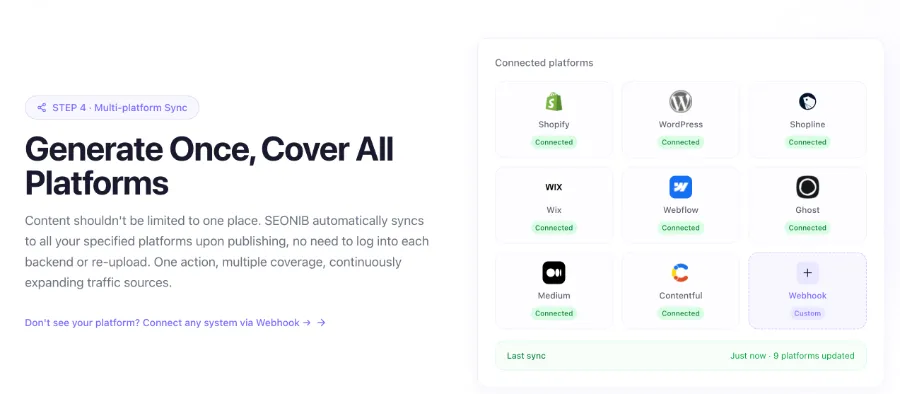
My later strategy was: write an article once, then automatically sync it to three distinct platforms. No need to log into each backend, re‑upload images, or adjust formatting per platform.
Initially I worried about duplicate content—would search engines deem the same article on different domains as duplicate and penalize it? I later verified a counter‑intuitive finding: when the same content is cross‑covered across different ecosystem platforms (e.g., independent site blog + Shopify blog + Medium), search engines treat each as an independent piece within its own ecosystem, not a copied page. Monitoring data confirmed this—after syncing to three platforms, total organic traffic for the same content increased 2.1 ×. Each independent index system added value instead of diluting the total score.
This reveals an important, non‑obvious phenomenon: multi‑platform content sync isn’t about spreading traffic thin; it leverages the differing indexing weights of each platform to create cross‑coverage, significantly reducing the time needed for SEO impact. A piece of content on a single platform might take eight weeks to achieve stable search traffic; syncing to three platforms cuts that to roughly four weeks. I suspect this is due to varying crawl frequencies, subdomain authority, and user behavior differences.
SEONIB’s fourth‑step update streamlines multi‑platform distribution. Its auto‑sync feature supports Shopify, WordPress, Shopline, and more, triggering simultaneous updates across all platforms with a single action, dramatically cutting the time cost of acquiring traffic.
Frequently Asked Questions (FAQ)
Can SEO really bring traffic without any ad budget?
Yes, but you won’t see results in the first 30 days. My first month’s organic traffic was 47 impressions and 3 clicks. By month three it stabilized at over 300 daily impressions. SEO is a slow curve; without ads you exchange time for accumulation. If you can survive the first 60 days of blankness, later traffic growth is usually more sustainable than paid ads.
Which free sources provide the most reliable trend data?
Google Trends is the primary source—focus on the “rising searches” tag. Next are the search‑suggest keywords from e‑commerce platforms themselves—Amazon and Shopify back‑ends reflect real purchase intent. Industry forums’ hot tags (e.g., Reddit sub‑communities’ weekly hot topics) also reveal unmet content demand.
Won’t automated content be flagged as spam by search engines?
If the content is just keyword stuffing without entity relationships or structured context, it will be deemed low‑quality. However, if the automated output includes proper H‑tag hierarchy, entity linking, internal anchor text, and relevant citations, its performance is comparable to manually written pages. The key is setting robust generation rules, not letting the system run unchecked.
How long after publishing does organic traffic become visible?
Typically 3–8 weeks. In my case, trend‑driven, precisely targeted articles began showing steady daily impressions on day 34; highly competitive generic‑keyword articles sometimes took up to 73 days to generate measurable traffic. The waiting period depends on keyword competition, site authority, and crawl frequency.
Does multi‑platform sync cause duplicate‑content issues?
I was concerned before testing, but the data shows otherwise. The same article first published on an independent blog and then synced to Shopify and Medium is treated by search engines as distinct content on each platform, not duplicate. The crucial point is that each platform’s version retains a complete, independent structure—avoid truncating or fully rewriting the text; keep the main body the same while preserving each platform’s metadata format.
Share Article