The Rise of AI Search: How SEO Strategies Will Evolve in 2026

In the second half of 2025, I was monitoring the Google Search Console backend and noticed an unsettling trend: several keywords that had consistently ranked in the top three on the homepage saw their click volume drop by almost 40% within a month. The rankings stayed the same, but the top of the search results page now featured an AI‑generated summary—users read the summary and left, never scrolling down to my link. This is not an isolated case. By 2026, more than 60% of search queries will be answered directly by AI‑generated summaries, and the click‑through rate of traditional blue links is expected to fall by over 30%. This means your SEO workflow must shift from “keyword matching” to “entity coverage and topical authority,” otherwise traffic decline is inevitable.
How AI Search Reshapes User Search Behavior and Traffic Allocation
After the launch of Google AI Overviews, the most immediate change has been the steady rise in the “zero‑click” rate on the results page. When users ask a complex question, AI provides a comprehensive answer at the top, eliminating the need to click into any site. Conversational engines like Perplexity and ChatGPT Search go even further—users engage in back‑and‑forth dialogue with AI, obtaining information entirely outside the traditional list page.
The cascade effect of this change is that traffic is no longer concentrated on a single search engine. Users are getting accustomed to completing the search loop across multiple platforms—reading product discussions on Reddit, watching review videos on YouTube, asking comparative advice in ChatGPT. Whether a brand is recognized and recommended by AI depends on its entity visibility across these disparate contexts, not just its Google ranking.
Entity Recognition becomes crucial here. AI engines assess a brand’s credibility based on its relational density in the knowledge graph—connections among the brand name, product lines, industry terminology, and authoritative citation sources. If your site’s content is not organized around a clear entity structure, AI will struggle to include you among answer candidates.
The New SEO Battlefield in 2026: From Keyword Rankings to Topical Authority
Keyword stuffing is virtually ineffective in AI search. When generating answers, Google AI Overviews and Perplexity do not list a page as a source simply because it repeatedly contains the phrase “best running shoes.” They evaluate a site’s overall coverage depth of the “running shoes” topic—whether you systematically discuss selection logic across different scenarios, brands, and foot types.
This is the core logic of Topical Authority: AI engines crawl a site’s entire content and assess the completeness of its information within a domain. A site with only three to five generic articles versus one that has built a comprehensive content cluster—from basic concepts to advanced applications, from product comparisons to usage tutorials—can differ by more than a factor of five in the likelihood of being cited in AI search results.
Entity SEO is another often‑underestimated dimension. You need to ensure that both search engines and AI engines can clearly identify what your brand is, what products it offers, and which industry concepts it relates to. This requires naturally embedding structured data, internal linking, and brand terminology in your content so that entity relationships in the knowledge graph are sufficiently explicit.
| Traditional SEO Strategies | AI Search Optimization Strategies |
|---|---|
| Keyword matching → | Entity and topic coverage |
| Article count → | Content depth and structure |
| Backlink count → | Information authority and citation quality |
| Single‑page optimization → | Site‑wide knowledge base construction |
There is an insightful analysis on how AI engines select sources: why some sites are cited more often by AI engines. The core conclusion is that the clarity of information structure matters more than the number of backlinks.
Upgrading Content Production: From Manual Writing to Automated Pipelines
The bottleneck in traditional content production is not the writing itself but the repetitive steps of topic selection, layout, publishing, and synchronization. Spending a few hours each week scanning industry news for topics, generating drafts with ChatGPT, manually copying them into the backend, adding images one by one, filling in SEO metadata, and then logging into each platform to publish—this workflow allows a single person to produce three articles per week, which is already considered efficient.
The competitive pace of 2026 demands a completely different level of efficiency. Teams that adopt automated content pipelines see content output increase by more than tenfold while reducing labor costs by 70%. Automation does not replace writing; it connects the entire pipeline: AI monitors industry trends in real time and automatically pushes topics with traffic potential; after entering a keyword, it directly generates an SEO‑optimized article, automatically selects images and fills metadata; it publishes on a set schedule and synchronizes across all platforms.
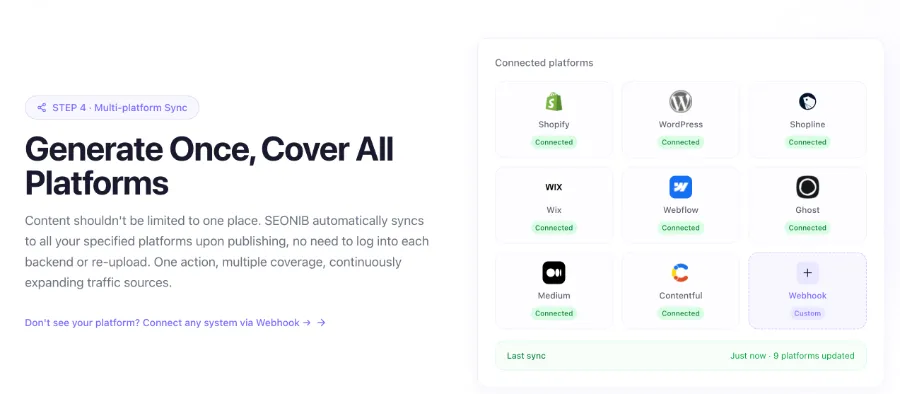
A typical automated workflow is: input a keyword, AI automatically generates the article, configures SEO information, schedules publishing, and pushes to WordPress, Shopify, Medium, and other platforms. This is what SEONIB does— from trend discovery to multi‑platform publishing, the entire chain is executed by AI without human intervention at any step.
But automation is not an excuse for mindless execution. A cautionary case study: in the second half of 2025, a cross‑border team relied entirely on AI content automation without establishing a brand knowledge base, resulting in inconsistent tone and contradictory product information; AI search downgraded their citations, and traffic fell by 40% within three months. This lesson shows that automation tools must be paired with a brand knowledge system to produce stable output. For brand‑new sites starting from scratch, you can first refer to how such sites win the start line with the right strategy before building a content pipeline.
New Capability Requirements for the 2026 SEO Tech Stack
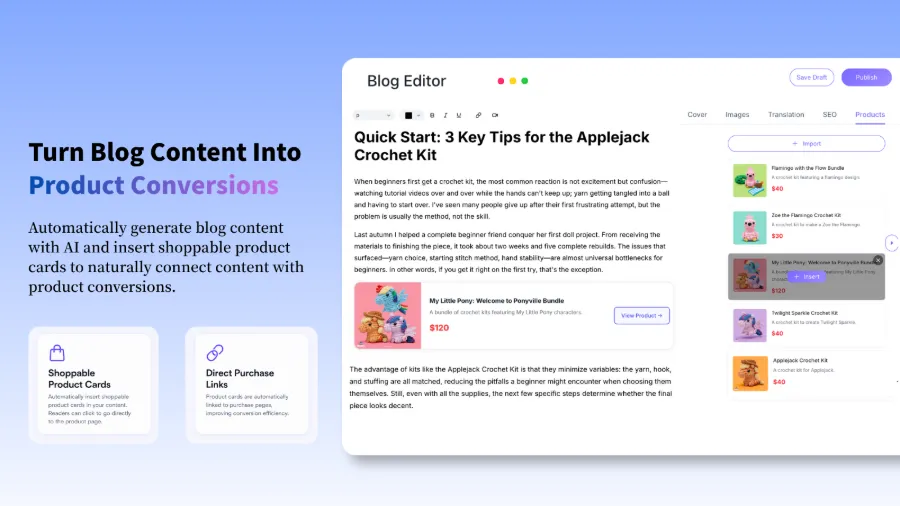
The criteria for choosing automation tools will change markedly in 2026. Previously, tools were evaluated mainly on generation speed and quality; now three capabilities are paramount: the depth of Brand Knowledge Base configuration, the automation of internal linking strategies, and a continuous monitoring loop for content quality.
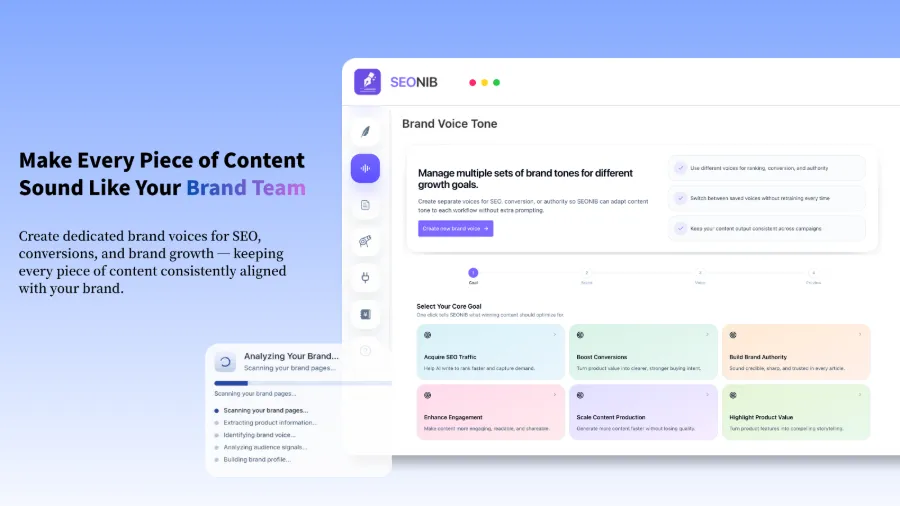
The brand knowledge base determines the consistency of AI‑generated content. With a well‑configured knowledge base, the error rate of brand inconsistency in AI‑generated content drops by 90%. The knowledge base should contain a Brand Voice definition—tone, common terminology, prohibited words, product description templates—as well as an industry terminology glossary and standardized product information. SEONIB’s brand context management feature is designed for this; it lets you pre‑configure brand assets, product data, internal linking rules, and media libraries so that AI automatically adheres to these standards when generating content.
Automated configuration of internal linking strategies is equally important. AI search optimization requires a tightly knit network of entity relationships within a site, and manually maintaining internal links across hundreds of articles is practically impossible. An automated internal linking strategy can intelligently insert relevant links during content generation, enhancing user browsing depth and reinforcing search engine understanding of the site’s structure.
Content quality monitoring is the final often‑overlooked step. As automated output volume rises, quality fluctuations also increase. A regular audit mechanism is needed—checking AI‑generated content for factual accuracy, timeliness, and brand consistency. The discussion of three AI models that can grow traffic without advertising includes valuable ideas on balancing continuous content production with quality.
A content creator documented his real‑world experience of using AI to jump on hot topics, automating everything from trend capture to content publishing. His core conclusion: automation tools are merely amplifiers; the credibility of the information is the fundamental logic behind AI search citations.
When configuring automation tools, the SEONIB documentation provides detailed step‑by‑step guides covering brand knowledge base setup, internal linking rule configuration, and multi‑platform synchronization. However, it must be clear: tools are not a panacea. Automation solves efficiency issues but does not guarantee that the information is worth citing. Human review and strategic adjustments remain essential—spending 30 minutes each week checking AI‑generated content quality is far safer than complete hands‑off.
For more analysis on why certain sites are cited more often by AI, see Why Some Websites Get Cited More Often by AI.
If you want to explore strategies for increasing traffic without using ads, read the Ad‑Free Traffic Growth Guide.
For details on SEONIB’s features on the Doubao platform, see Doubao: SEONIB Feature Overview.
For the full set of steps, refer to the Help Documentation.
FAQ
Will AI search completely replace traditional search engines?
It will not completely replace them, but the proportion of traffic allocation will continue to shift. Traditional list search remains dominant for navigational queries (e.g., “log in to Facebook”) and local searches, while informational queries (e.g., “how to choose running shoes”) are increasingly answered directly by AI summaries. In 2026, both search modalities will coexist, and SEO strategies must address both scenarios.
Do we still need to focus on link building for SEO in 2026?
Yes, but its weight is decreasing. In AI search citation criteria, the completeness of information structure and clarity of entity relationships are overtaking the importance of backlink quantity. Backlinks still have value—especially citations from authoritative industry sites—but the strategy of simply purchasing low‑quality backlinks is largely ineffective.
How can small sites with little content get indexed by AI search?
Focus on a niche and build depth using a content cluster strategy. You don’t need to cover the entire industry, but you should achieve information completeness within your chosen sub‑domain. Also, ensure solid technical SEO foundations—structured data, a clear site architecture, and reasonable internal linking—these are critical for AI engines to crawl and recognize entities.
Can content automation cause a site to be deemed low‑quality?
It depends on whether the automation workflow includes quality control steps. Purely generating homogeneous content in bulk without a brand knowledge base or human review does carry a risk of downgrade. However, if the automation tool works together with a brand knowledge base, internal linking strategy, and regular audit mechanisms, the generated content can maintain an acceptable quality level.
What new skills do SEO practitioners need to learn to adapt to 2026 changes?
Entity modeling — understanding the fundamentals of knowledge graphs and entity recognition; content strategy design — shifting from keyword matching to topical coverage planning; automation tool configuration — mastering the setup of brand knowledge bases, internal linking rules, and bulk publishing workflows; data analysis — monitoring trends in AI search citation rates and zero‑click rates.
Share Article