
After Google Search Is Taken Over by AI, Paid Ad Clicks Remain, but Conversion Logic Has Changed
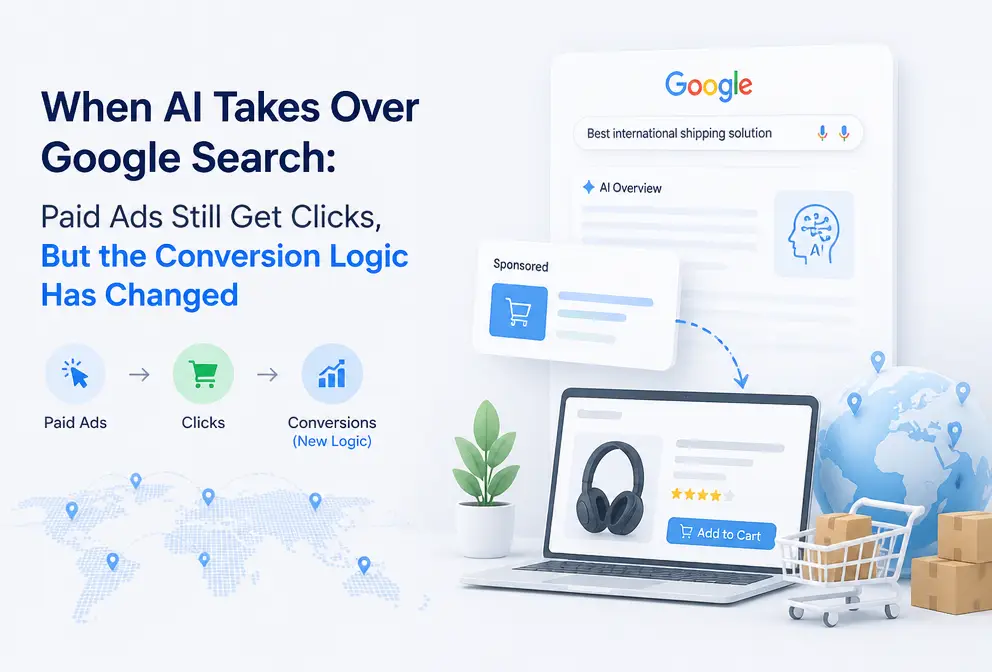
An independent‑site seller of home‑goods recently noticed an inexplicable phenomenon while reviewing quarterly data: the click volume in the Google Ads dashboard barely changed, even slightly increased, yet ROI fell from 4.2 to 2.1, and the “click → purchase” path in attribution reports became increasingly vague. After asking around, it wasn’t ad fatigue, landing‑page speed, or competitor price cuts. The real puzzle was that ads kept spending money, visitors kept arriving, but they stopped buying.
Click traffic does not equal conversion traffic. This judgment became strikingly clear after AI search became widespread. In the past, users clicked ads because they “wanted to learn more.” Now they click ads because they “already decided what to buy and just need confirmation.” The click action itself hasn’t disappeared, but the decision‑making path before the click has been rebuilt by AI search—users come with answers, not questions.
What Happens “Before the Click” — AI Takes Over the Decision Path, Not the Traffic Entry
The traditional search path was “search → browse results → click → compare → decision,” with ads acting as information providers in the middle. Now this path is compressed. ChatGPT, Perplexity, Google AI Overview complete information filtering and preliminary decision‑making before the user clicks any ad. A user asks in a chat, “recommend storage cabinets for a small apartment,” and the AI instantly provides brands, price ranges, material comparisons, and even purchase links.
Ad slots still exist, so clicks remain. But the psychological state of the clicker has shifted from “exploratory” to “confirmatory.” They are no longer browsing shelves; they are verifying whether the AI’s answer is reliable. This difference changes the mission of the landing page—previously the landing page had to persuade, now it only needs to confirm.
Industry research often cites a figure: about 73 % of modern search behavior occurs outside Google. The number may not be exact, but the trend is real—decision paths are moving to chat windows, social media, and vertical communities. Cross‑border e‑commerce product‑search queries were the first to be covered by AI summaries because product information is highly structured and price‑comparison needs are clear, making it easy for AI to give definitive answers.
A noteworthy detail: after AI provides a direct answer, the user’s information‑need level drops by one tier when they click an ad. They no longer need “what is this product”; they only need “is the price right, is shipping fast, are the reviews good?” Stacked product introductions and brand stories on the landing page become almost useless for these visitors. For observations on what kind of content gets recommended in ChatGPT search, see What Content Performs Best in ChatGPT Search. The core insight is that structured, entity‑clear, verifiable information is more likely to be cited.
Why Clicks Remain — Analysis of Three Types of Paid‑Ad Slots
The lack of a clear drop in paid‑ad clicks needs to be unpacked. Different ad formats have completely different intents behind the clicks.
| Ad Format | Intent Behind Click | Conversion Path | Attribution Transparency |
|---|---|---|---|
| Traditional Search Ads | Exploration + Confirmation | Search → Click → Compare → Decision | Relatively Complete |
| Shopping Ads (Performance Max) | High‑Intent Price Comparison | Search → Price Comparison → Click → Purchase | Moderate |
| AI Overview Recommendation Slot | Low‑Info‑Need Confirmation | AI Recommendation → Click → Confirm → Purchase | Very Low |
Traditional search ads still capture users with clear search intent, but this traffic is shrinking. Shopping ads (Performance Max) capture “already decided to buy” high‑intent traffic, so click data stays strong—these people were going to buy anyway, and the ad just tells them where to buy. AI Overview recommendation slots are completely different; users click with very low information need, the conversion path is extremely short, and attribution is almost impossible to track.
A clear signal is that buyers are using AI tools instead of traditional search to discover supply‑chain options. Platforms like Accio show that B2B procurement decisions are also moving from the search box to AI dialogue. The C2C situation is similar, just faster.
Replacing “click quantity” with “click quality” as a metric gets closer to the truth. Click volume hasn’t fallen, but the session depth and purchase intent per click have declined—landing‑page dwell time shortens, bounce rates rise, and add‑to‑cart rates drop. These metrics explain the problem better than raw clicks.
Core Change in Conversion Logic — From “Landing‑Page Persuasion” to “AI Pre‑Screening”
The old conversion logic was built on “in‑site persuasion”: using landing‑page copy, user reviews, limited‑time discounts to persuade after the user arrives. This logic assumed users arrived with an open mind and were willing to spend time learning about the product.
The new conversion logic is the opposite. AI completes about 80 % of price comparison and trust assessment in the chat—brand reputation, price reasonableness, functional fit—before the user clicks. Those who reach the landing page have already been “pre‑persuaded.” They are not there to be persuaded; they are there to confirm.
This creates a serious attribution dilemma: clicks remain, attribution reports credit the ad, but the real decision happens inside the AI dialogue. The ad platform can track “user clicked ad → visited landing page → purchased,” but cannot track “user asked three questions in ChatGPT → compared two brands → chose this one → searched brand name on Google → clicked ad.” The latter is the true decision path; the former is just the final touchpoint.
Cross‑border e‑commerce therefore needs a new asset: brand information that AI can cite. Knowledge bases, entity data, unified product descriptions—these are the contents AI actually pulls when generating recommendations. The core of AEO (AI Engine Optimization) and Entity SEO is to make brand entity information clear, consistent, and verifiable in AI knowledge graphs. The value of topical authority shifts from “high ranking on Google” to “being cited in AI answers.”
The statement “ranking no longer equals revenue” points to the same fact: brands need to appear in decision‑making places like TikTok, Reddit, ChatGPT, not just Google search results. The definition of search visibility is being rewritten—from “visible in search results” to “visible in decision contexts.”
Cross‑Border E‑Commerce Sellers Must Reallocate Budget and Workforce — Content Assets Become the New Conversion Infrastructure
The marginal cost change of ad spend versus content‑asset investment is the core of this shift. Ads are a continuous cash outflow—stop spending, stop volume, no accumulation effect. Content assets are cumulative compounding—one AI‑cited product Q&A can generate conversions for months, with marginal cost approaching zero.
The shape of content assets in the AI‑search era is clear: structured Q&A, brand knowledge pages, product taxonomies, multilingual content. These share high structure, clear entity information, and unified phrasing, making them easy for AI to cite.
Independent‑site sellers face a practical problem not of not knowing what to do, but of high production cost and difficulty updating. A Shopify store can have dozens to hundreds of SKUs, each requiring its own Q&A page and knowledge content; manual maintenance is almost impossible. Inability to deliver unified brand information to AI is a more hidden problem than “no content”—content scattered across platforms, languages, and phrasing prevents AI from forming a consistent brand perception.
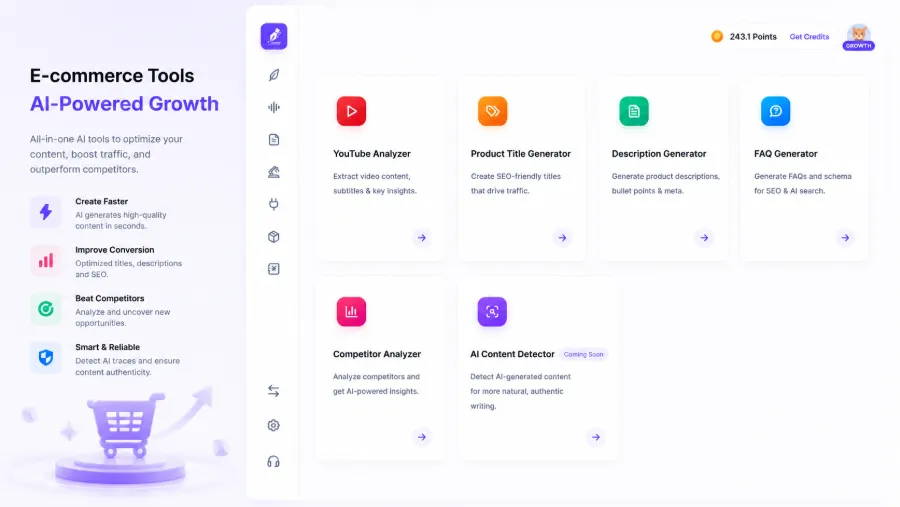
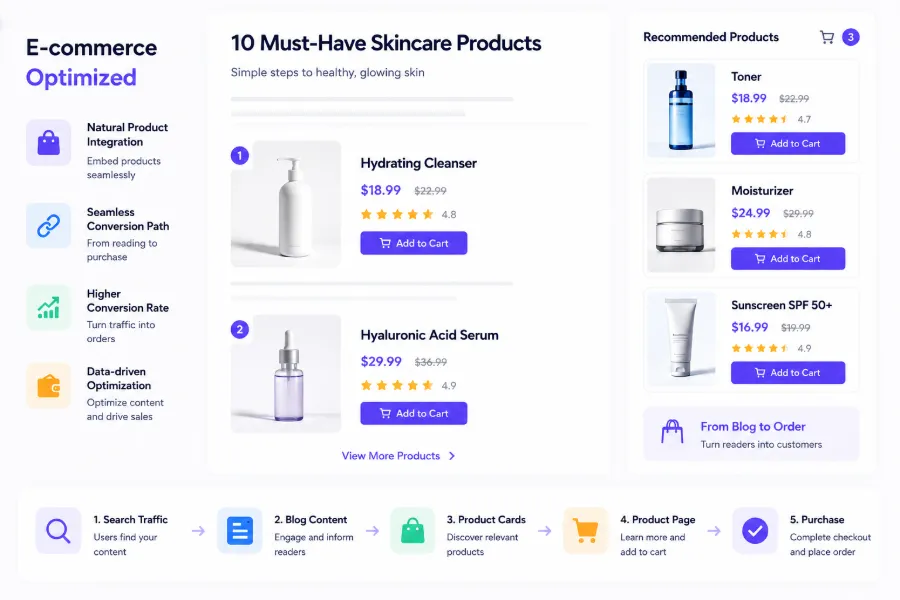
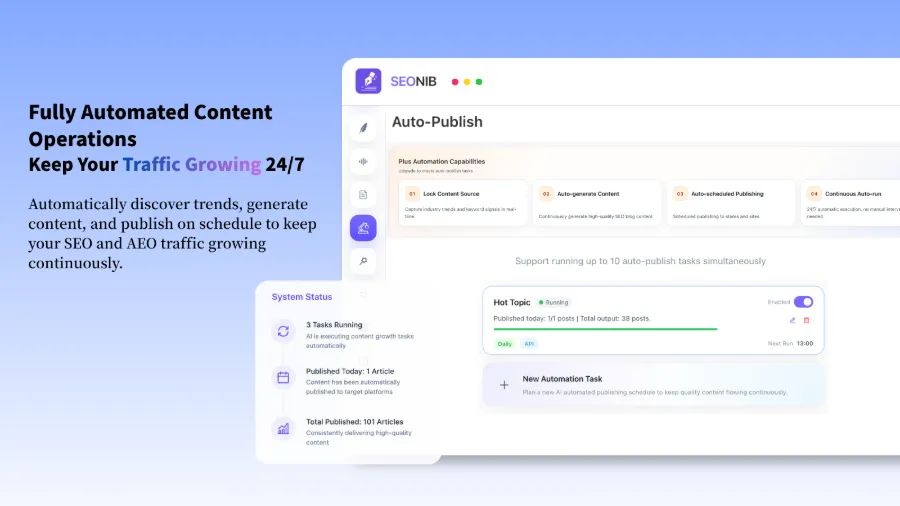
Tool‑based approaches are emerging: automated pipelines that batch‑convert product links into AI‑citable blog and Q&A content, embedding orderable product cards to connect “content → conversion.” The essence is turning content production from “hand‑crafted” into a “assembly line.” A typical example is SEONIB, which generates buyer guides, tutorial blogs, and Q&A from product links, automatically fills SEO fields, and publishes across multiple platforms. For sellers without a dedicated SEO team, this is far more realistic than hiring writers.
A Shopify seller ran a content pipeline for three months, automatically publishing five product articles per week. In the third month, organic traffic grew 140 % month‑over‑month, with about 30 % coming from AI‑search citations. The numbers aren’t dazzling, but given the investment was essentially a subscription fee, the cost‑effectiveness is clear. A new site with zero backlinks can also get a start through content accumulation; the article “How a Zero‑Backlink New Site Can Win at the Starting Line with the Right Idea” explains this logic—content itself can replace backlinks as a ranking signal. Tool selection for beginners is also discussed in “SEO Tools Recommended for Beginners.”
Switching the Content Pipeline from Manual to Automated — Scalable Production Roadmap
The bottlenecks of a manual process are clear: topic selection requires browsing news, writing involves copy‑pasting, image selection is done one‑by‑one, SEO fields are filled manually, and each platform requires separate upload. A seller can easily spend over 20 hours per week on content and only produce two or three pieces. Update frequency is unstable, topical authority never builds, and AI‑search citations are impossible.
An automated pipeline can be broken into four steps: trend discovery → content generation → scheduled publishing → multi‑platform sync. Trend discovery is handled by AI monitoring industry hot topics and pushing topics. Content generation supports creating articles from keywords, product links, social posts, etc. Scheduled publishing executes at predefined frequencies, and multi‑platform sync pushes a single article to Shopify, WordPress, Medium, and other channels. The whole process runs 24⁄7 without human triggers.
Multilingual support is another undervalued value. An independent site targeting the US/EU market that only produces English content forfeits AI‑search traffic from German, French, and Spanish markets. An automated pipeline can generate English content, then automatically translate and publish to the corresponding language versions, covering the global market at a fraction of manual translation cost. Scheduled updates keep content fresh, a key signal for AI search relevance.
The practical recommendation is to start with a single‑platform integration. First, close the loop on WordPress or Shopify, verify content quality and AI citations, then expand to other platforms. Deploying across many platforms at once risks uncontrolled content quality. The WordPress integration guide can be found in “How to Connect a WordPress Site with SEONIB.” A complete feature and price comparison is detailed in “SEONIB Full Feature Breakdown and Pricing Comparison.”
Before deployment, there’s an often‑overlooked step: validate the idea with a simple website. The article “Quickly Validate a Project Idea with a Simple Website” provides a concrete method. The content pipeline is infrastructure, but it presupposes product demand. Operational details before deployment can be found in the “SEONIB Help Documentation,” which includes platform‑specific integration steps and FAQs.
FAQ
Q1: Why do paid‑ad clicks stay the same after Google Search is taken over by AI?
Because the ad slots still exist and users still click. However, the intent behind the click has changed—they are not exploring, they are confirming. AI has already completed information filtering and preliminary decision‑making before the click, so most landing‑page visitors have low information needs; high‑need users stay in the AI dialogue.
Q2: What practical impact does the change in conversion logic have on ad attribution?
Attribution confidence drops dramatically. When the decision happens in an external AI dialogue, the ad platform can only track the final touchpoint and cannot trace the true decision path. Reports show “ads lead to conversions,” but the reality is “AI does the persuasion, ads do the confirmation.” This attribution is neither complete nor verifiable.
Q3: Can cross‑border e‑commerce sellers survive by relying solely on paid ads without AI‑search optimization?
In the short term, yes, but costs will rise over time. Competition for paid ads will intensify as AI‑search traffic grows, while content‑asset accumulation provides a compounding effect that ads cannot. For highly commoditized products with thin margins, relying only on paid ads will become increasingly unsustainable.
Q4: What kind of content is most likely to be cited by AI search and drive conversions?
Structured Q&A, clear entity information, and unified phrasing. The clearer the product name, specifications, price, and use cases, the easier it is for AI to cite. Multilingual versions are also crucial because AI generates answers in the user’s language.
Q5: For small independent sites without a dedicated SEO team, where should they start to make the most efficient adjustments?
Start with product Q&A content. It has the highest AI‑search citation rate and the lowest production cost. Organize common questions for each core product into structured Q&A, publish them as blog posts, and embed orderable product cards. Once a single‑platform loop is working, consider scaling; avoid spreading thin across many channels from the outset.
Share Article