Independent Site Keyword Strategy: Planning Your SEO Roadmap from Scratch
When I first started an independent site, I stared at the blank Google Keyword Planner interface for several days. It wasn’t a lack of ideas, but an overload of them—today I thought “how to choose a down jacket” would definitely be searched, tomorrow I thought “sunscreen reviews” should appear early. In the end I did something foolish: I wrote both down jacket and sunscreen content on the same page. The search results were predictable.
Later I realized that keyword planning isn’t just stuffing hot terms into a page. Essentially, it’s about establishing a shared language system between you and potential customers. This article won’t turn you into an SEO guru, but it will help you understand one thing: how to actually plan your keyword list.
Finding the “Veins” of Keywords: From Competitors to Search Suggestions
My starting point for keyword research was very naive—directly looking at what competitors were ranking for. I entered a competitor’s domain into Ahrefs, got a few hundred words, and judged competition, which felt like gambling: the odds of winning were tiny.
Later I developed a slightly more systematic approach that can be completed without paid tools.
First, Google Keyword Planner, free but requires a Google Ads account. Enter a broad product term, and it tells you monthly search volume and competition level. Search volume is “foot traffic,” and competition is “stall density”—high foot traffic but also high stall density means a new stall owner will barely be seen. Next, Google Trends, which is especially useful for spotting trends. For example, sunscreen searches start climbing in April and peak in June. An article published in March catches the traffic surge.
Another source I discovered later: internal search data from your own site. If your site has a search box, the backend can show what users actually typed. These terms are far more accurate than your guesses.
Honestly, for the first three months a newcomer can get by entirely with free tools. Ahrefs and Semrush start at about $99–$199 per month, so I don’t recommend buying them initially. I made the mistake of signing up for Ahrefs in the first month and spent every day refreshing the “keyword difficulty” score, which kept me up at night.
If manual research feels too exhausting, check out this free keyword research tool guide that compiles several more efficient methods. For deeper systematic learning, the official help documentation also provides a more detailed workflow.
Understanding “Search Intent”: Stop Pushing Routers to People Who Want to Buy a Tablet
In 2022 I performed extensive keyword research for a new site, listed a few hundred terms, and felt confident. Then I spent four months writing content, optimizing pages, and publishing articles. The traffic stayed flat.
Later, using Google Search Console to backtrack the data, I discovered that all my content was optimized in the wrong direction. For instance, I wrote both “how to choose a tablet” and “Huawei tablet,” but my store sells Brand A tablets—Brand B terms are useless to me.
Search engines already put the answer in front of you—look at the top of the SERP to see the page types. Searching “how to choose a tablet” yields all blog review articles—informational intent. Searching “tablet discount” shows product collection pages and landing pages—transactional intent. Searching “Huawei tablet” shows only Huawei’s official channels—navigational intent. If you run an independent site selling off‑brand tablets, optimizing for navigational intent keywords is a waste of resources.
| Search Intent | User Example | Keyword Example | Optimized Page Type |
|---|---|---|---|
| Informational | Wants to know what’s available | How to choose a tablet | Blog article |
| Transactional | Wants to buy now | Tablet discount | Product collection / landing page |
| Navigational | Has already chosen a brand | Huawei tablet | Brand official site / homepage |
Even search engines know what users want—don’t fight them.
Transactional intent keywords should ultimately point to your product pages. If you’re on Shopify, the site‑building process is mature and product page structures are clear, making it a good starting point for SEO. For more tool insights, see the 2026 Hot Keyword Analysis Tool Recommendations.
From identifying search intent to seeing the first ranking lift usually takes 3–6 months. Search engines need time to “understand” your site; don’t expect traffic in the first week.
Creating a Keyword “Map”: Awareness, Consideration, Decision Stages
Having a list of words isn’t enough; you must organize them according to the user journey. I split it into three stages: Awareness, Consideration, Decision.
Using tablets as an example: In the Awareness stage, users search “how to choose a tablet” or “are tablets good for studying,” which calls for blog articles. In the Consideration stage, users search “tablet performance review” or “tablet recommendations for students,” which calls for comparison articles. In the Decision stage, users search “tablet discount,” leading directly to a product landing page.
Core principle: each stage’s keywords correspond to a different page type. Never send an awareness‑stage user straight to a checkout page—just as you wouldn’t open an app and instantly pay for a takeout order.
I made a mistake while building my keyword map: I listed 100 words, half of which were navigational brand terms, and the other half were products I don’t even sell. The filtering criterion is simple—add a “relevance” column in Excel and delete any term that isn’t strongly relevant.
Publish at least two high‑quality articles (over 1,000 words) per week; after three months you may see modest traffic growth. No regular updates equal zero updates, so don’t expect miracles. When writing content, I often use ChatGPT to generate a draft quickly, then manually adjust tone and facts.
If you have product pages you want to turn into blog content, try the Product‑to‑Blog One‑Click Content Generation feature, which saves a lot of time.
Content Execution and Link Building: Don’t Let Your Keywords Become “Dead Words”
Keyword research is done, the map is drawn—now comes execution. Content formats aren’t limited to blogs: videos, ebooks, user‑generated content are all viable. But initially, blogs are the cheapest and fastest way to see results.
Backlink building is a slow process. Don’t chase quantity. For a beginner‑level core keyword, acquiring one high‑quality external link from scratch usually takes 2–4 months. I spend about 10–15 hours per month reaching out to relevant sites. Use Google Search Console regularly to check link status, and don’t let bad links hold you back. When looking for link sources, tools like accio can help match potential partners.
Here’s a turning point: when you realize all operations are manual—manual keyword research, manual content writing, manual article publishing, manual link building—it becomes a continuous burden. Repeating the same tasks weekly is exhausting.
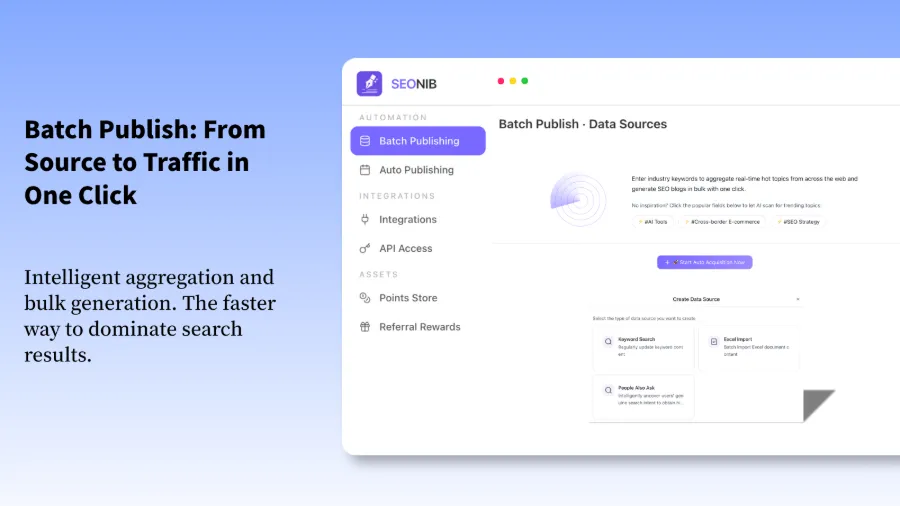
I later switched to SEONIB’s scheduling feature, which finally rescued me from the daily grind of manual posting. Its scheduler lets me sleep while content stays fresh. This isn’t a recommendation—just a note that when manual work turns into a nightmare, there’s always another path.
When choosing tools, see the Practical SEO Tool Comparison – Best Choice for WordPress to understand how different platforms fit.
FAQ
Q1: How long does it take for an independent site’s SEO to show results? Can I tolerate the waiting period?
Usually 3–6 months to see noticeable traffic growth, provided you keep publishing content. Paid ads can give you results within a week, but they’re costly; SEO is a slow‑burner with low ongoing maintenance costs. Early on, allocate budget to PPC ads and shift the ratio once SEO traffic picks up.
Q2: What if I skip SEO and rely solely on ad traffic? What’s the cost?
You can, but you need to do the math. CPC in highly competitive categories can reach $2 or more per click. If you need 1,000 clicks per day, that’s $2,000 daily. SEO is a front‑loaded investment with long‑term “rent‑free” clicks—first year may require a lot of time, but from the second year onward the clicks are essentially free.
Q3: My competitor sites are much larger. Can my new site still compete for keywords?
Yes, but choose the right battlefield. Big sites go after “head terms,” you go after “long‑tail terms.” For example, “tablet” is highly competitive, but “tablet under $500 for students” has far less competition. Long‑tail keywords often have higher conversion rates because the search intent is clearer.
Q4: When planning a keyword strategy, should I consider voice search or AI search (e.g., ChatGPT recommendations)?
Absolutely. Since 2024, Google AI Overviews generate answers directly in search results, changing traditional traffic distribution. Your content must be optimized not only for Google ranking but also for AI to extract your structured information. Entity markup, FAQ rich snippets, and clear paragraph hierarchy are increasingly important for AI search. Reviewing keyword performance quarterly is essential because algorithms and user habits evolve.
Share Article