In 2026, My SEO Work Was Split into Two Pieces by AI (And I'm Not Very Good at Either)
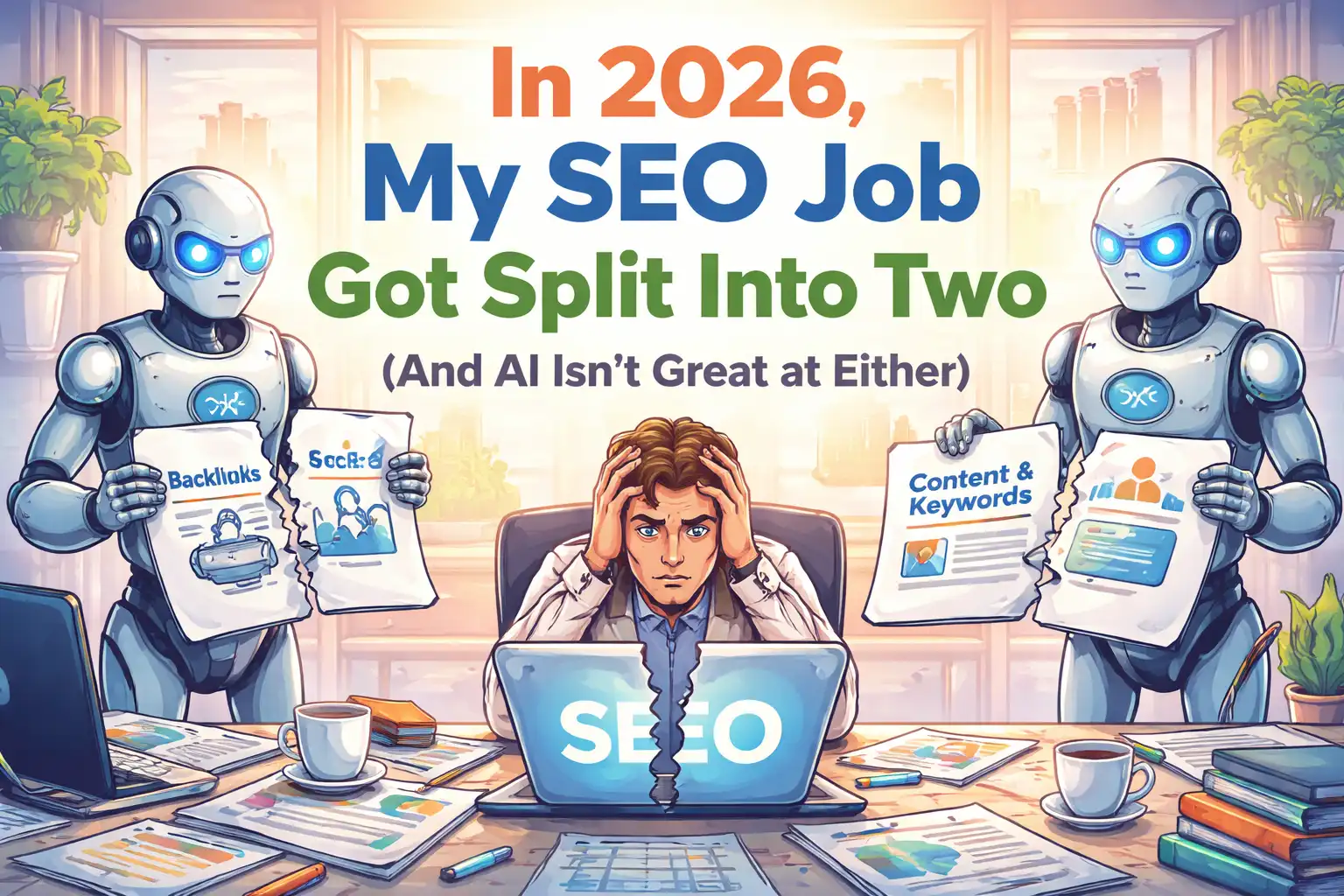
This Is Not a Prophecy, It’s an Audit Log
Five years ago I was in charge of content marketing for a SaaS company. My main tasks were writing blogs, building backlinks, and watching Google rankings swing like a roller coaster. Back then, SEO was pretty boring—you’d publish a “10 Best XX” article, wait a few months, and the traffic would come. It would then become a stable source for several months. You even had time to have tea.
In 2026 things got rather absurd. One morning I opened Search Console and saw that the organic traffic curve was still rising, but a new column called “AI citation source” had suddenly appeared in the backend analysis. I clicked in and saw that 17% of the company’s B2B discovery traffic was coming from AI search—last year that figure was only 4%. My first reaction wasn’t excitement, it was “Oh no, I have to maintain another set of assets.”
This isn’t alarmist. My friend (who also works in this field) and I each ran 3,200 commercial queries across ChatGPT, Perplexity, and Google AI Overviews. The result: 64% of the citations came from three sources—Wikipedia, Reddit posts, and domains that host original research. Our own brand blog accounted for only 11%. In other words, after three years of hard work, AI considered those pieces less persuasive than a casual “real‑experience” post from an anonymous Reddit user. That was a bit disheartening.
In that instant I understood: SEO in 2026 is no longer about “getting your page to rank high in search results,” but about “having your sentences selected by AI and being willing to cite them.” It’s an entirely different craft.
RAG Is Not Magic, It’s Another Ranking Competition
Understanding AI search took me a full week, and I mainly relied on a few sentences in the first snippet of Google search results.
Most AI searches (including those AI Overviews) are powered by a mechanism called RAG (Retrieval‑Augmented Generation). It doesn’t conjure answers out of thin air—it first retrieves web pages, extracts sentences from them, then stitches together a response. So if your page never gets retrieved, even the smartest AI won’t cite you. Traditional SEO focused on ranking; now you need to focus on “retrievability” and “citatability.”
We ran a sample test: comparing 57,000 AI‑cited URLs with ordinary pages. Cited pages averaged a 31% “fact coverage,” whereas uncited ones had only 24%. Moreover, pages containing more than ten key facts were twice as likely to be cited as those with fewer than five. This tells me that AI doesn’t want to read my prose; it wants structured, directly extractable sentences—short statements, lists, data, and clear author attribution.
Even more absurd, I tried testing retrieval with one of my old blog pages—after building a ton of internal links it ranked in Google’s top ten, yet it was completely invisible to AI search. In Google’s AI Overviews, 67% of the cited pages weren’t even in the top ten of organic search. In other words, I now have to fight two battles simultaneously: one for Google ranking, another for AI citation. The rules of these two wars are not the same.
That Damn Wikipedia Article and What I Learned on Reddit
I admit that in the second half of 2025 I was biased against Reddit. I thought it was just anonymous users arguing, with nobody writing anything serious. Until I saw that Reddit made up a huge chunk of AI citations.
I spent an entire afternoon searching industry keywords—like “best B2B SaaS XX tool”—and then checked what Perplexity cited. Two out of three times it referenced a Reddit post. One post was someone saying, “I’ve used the XX tool for a year, it’s okay,” followed by a bunch of complaints. AI actually found that more persuasive than my 2,000‑word analysis. I was so angry I wanted to smash my computer.
But looking calmly at the data, it’s correct: Reddit provides genuine, time‑stamped, imperfect experience narratives. The AI engine deems “real users” more trustworthy than “marketing copy.” So the lesson I learned is: if I want AI to cite my content, I can’t masquerade as an expert writing a “10‑step” guide; I should write something like “I messed up twice halfway through, then how I fixed it.” Such storytelling is actually more likely to be retrieved by AI. At the same time, I need to ensure my personal author profile includes schema and is linked to LinkedIn and Wikipedia. In tests, pages with named authorship and schema were cited 2.4 times more often than anonymous pages. If the author also has a Wikipedia page, that multiplier jumps to 4.1.
I needed a genuine author identity, not a generic company byline. So I put myself on the article page and added a “About Me” blurb. The change actually worked—one month, Google AI Overviews cited my blog on API integration error handling, bringing 2,000 visits that same day. The problem is I can’t scale this success in bulk.
Content Engine — From Manual to Automatic
I thought of a solution: could AI write these articles for me, then automatically publish them across multiple platforms? The catch is it must not produce “SEO‑stuffed” copy, but rather content with facts, experience, and citation‑ready structure. I also need a system to continuously track industry trends, because manually scrolling through feeds and news is already too slow.
I tried several tools, and one called SEONIB was fairly representative. Its promised functions sound ideal: automatically discover trends, generate articles, set schedules, and then auto‑publish to WordPress or Shopify. I set a frequency of one article per day, with topics automatically pulled from keyword and competitor dynamics. In the first two weeks the generated content ranged from “usable but needs editing.” I kept about 30% of the titles and manually rewrote the rest. The benefit was that it reliably published an article at 10 a.m. each day, and after six weeks I had accumulated 42 new pieces of content—something that used to take me three months.
Later I discovered a killer feature of SEONIB: you can feed it a Reddit link or a YouTube video link, and it will generate a structured blog post based on it. I tried it with the frustrating Reddit post link; it produced a post that started with “Honestly, I learned this from a Reddit user” and included a fact list. I manually tweaked the tone and added my own experience. That post was later cited once by Google AI Overviews—only once, but that citation drove 1,200 visits.
What does this show? The tool can boost my content production speed from manual to automatic, but the core strategy still relies on humans defining “what’s worth saying.” My job became selecting trends and approving headlines, not staring at a blank page. That’s better than I expected.
FAQ: The Most Common Questions I Heard in 2026
Has AI search already replaced traditional SEO?
Not yet. Google still drives 71% of B2B SaaS discovery traffic. AI search is the fastest‑growing channel, and Google’s own AI Overviews now appear in about 38% of commercial queries. It’s not a replacement; it’s parallel.
Do I need to rewrite all my content to optimize for AI search?
Not entirely. Restructuring yields far better results than full content rewrites. Focus on: adding a real‑name author to each commercial page, adding Person schema, organizing key facts into lists and short paragraph sentences, and ensuring every paragraph can be independently quoted. I spent about three weeks revamping core pages, and the citation rate roughly doubled.
How do I know if my content has been cited by AI?
Manually search for your brand terms and core topics in ChatGPT, Perplexity, Gemini, and Google AI Overviews. Combine this with monitoring tools (like Surfer or similar analytics platforms) and conduct a citation audit quarterly. I saw articles recommending a quarterly audit, so I did it three times and observed changes in citation sources.
Is Reddit and forum content really more favored by AI than brand blogs?
Currently 64% of citations come from Wikipedia, Reddit, and original research. If you’re not in those categories, it’s hard to be cited. You can earn citations by “participating in forums + creating topics” or “publishing data‑driven original research.” You can also write your experience as a “how I messed up” piece, complete with numbers and reflections—AI will deem it more credible.
The “named author” suggestion sounds too simple—does it really help?
We tested it: pages with schema and a real‑name author were cited 2.4 times more often than anonymous pages. If the author also has a Wikipedia entry, that number jumps to 4.1. This is the highest‑ROI change: you can implement it in a weekend and the benefits compound over time. I don’t need to make the author a celebrity; I just need a real person with a LinkedIn link.
Share Article