How to Automate Shopify SEO Content Generation with AI
After running a Shopify store for two years, my biggest takeaway is: content marketing is something you know you should do, but few people actually stick with it. It’s not that they don’t want to write; the time spent each week on topic selection, drafting, formatting, and publishing far exceeds the time spent operating the store itself. Manually copying articles into the backend, adding images one by one, then logging into each platform to publish—after repeating this process for months, even the strongest content motivation gets worn down. If you’ve experienced this, this article is for you. I’ll break down, from a practical standpoint, how to use AI to automate this cumbersome workflow and shift your energy back to products and business.
Continuously Finding Traffic‑Driving Content Topics
Many Shopify merchants get stuck at step one: they don’t know what to write about. Topic selection relies on inspiration, which relies on luck; when luck runs out, publishing stops. I discovered that the root cause isn’t “can’t write,” but rather “no stable content discovery mechanism.”

Behind every successful content strategy, more than 40% of topics come from continuous trend tracking, not from spur‑of‑the‑moment ideas. Using AI to monitor industry trends and keyword changes can automatically surface high‑potential content directions—hot topics, competitor content, social media posts, or even a suddenly rising long‑tail keyword can become a topic source.
I’ve tried several different topic‑finding methods. The most naïve approach is manually browsing Google Trends and competitor blogs each week—low efficiency and easy to miss things. Later I switched to a tool that aggregates trend signals automatically and pushes them to a topic library daily; I only need to filter and confirm from there. The benefit is that topic selection no longer depends on whether you have “inspiration” that day, but becomes a continuously running process. If you’re interested in how to validate content directions from scratch, you can refer to this article about quickly testing a project idea’s market viability with a simple website—the logic is similar.
Consistently publishing content also serves a longer‑term purpose: building topical authority. Search engines favor sites that deep‑dive into a niche over time; a “write sometimes, skip sometimes” strategy struggles to accumulate authority. The advantage of AI monitoring is that it makes “consistency” automatic, eliminating the need to remind yourself each week what to write.
From Product Link to SEO Article Generation Workflow
Once a topic is set, the next step is turning it into an article. The traditional workflow—opening an editor, writing, adding images, inserting internal links, setting SEO metadata—takes at least an hour per article. The core AI‑generated SEO content workflow can compress these steps into a few seconds.
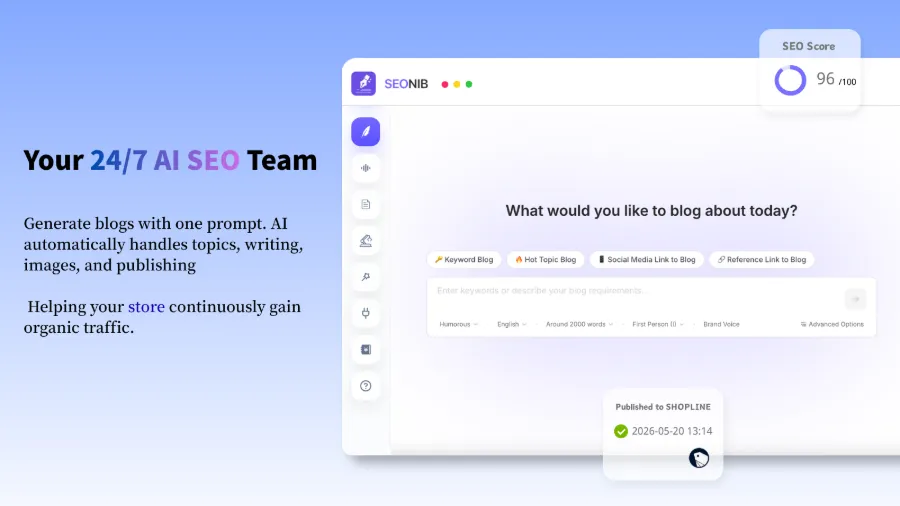
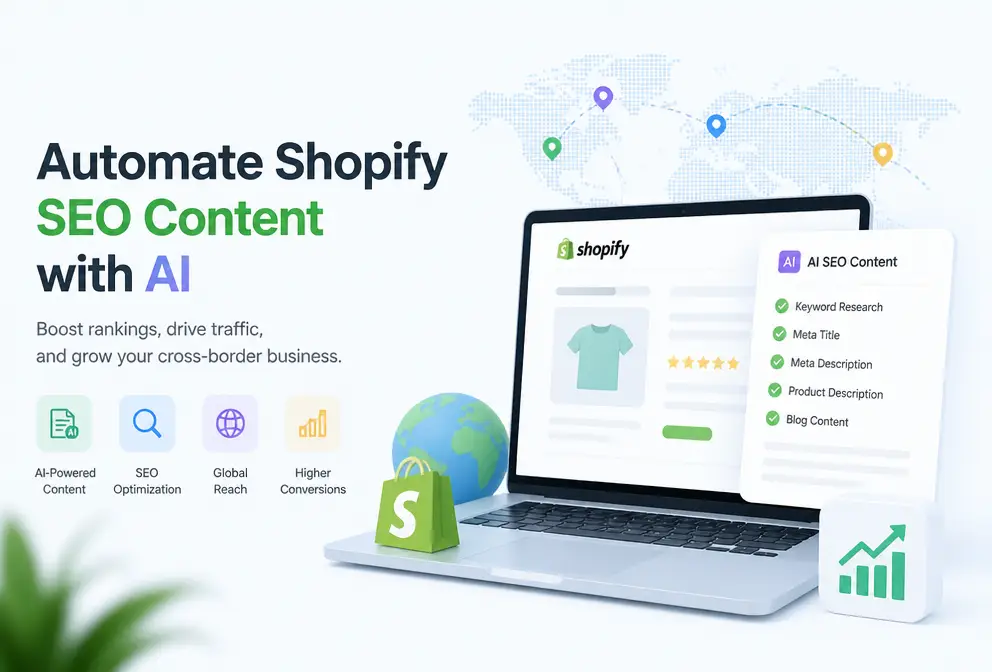
Following the product‑to‑blog guide, you can input a product link and AI will generate a buyer’s guide or tutorial‑style blog around the product, automatically filling in images, SEO optimization, and formatting. A single product link can be turned into a complete blog post with SEO metadata in seconds.
Beyond product links, you can trigger generation from other entry points: keyword‑to‑blog, hot‑topic‑to‑blog, social‑media‑link‑to‑blog, reference‑link‑to‑blog. These modes cover almost all content source types. The one I use most is social‑media‑to‑blog—drop a YouTube video or TikTok post in, and AI automatically converts it into a well‑structured blog article. This is extremely handy for cross‑platform content reuse, eliminating the need to start from scratch each time.
Batch generation is another time‑saver. If you need to cover multiple keywords or products, you can submit many tasks at once and AI will generate them one by one in the background. As the volume of content grows, your search engine coverage naturally expands.
Setting a Publishing Schedule and Syncing Automatically to Shopify
The content may be ready, but the publishing step is often the most overlooked bottleneck. Logging into the backend daily, copying and pasting, double‑checking—this repetitive process eats up a lot of time. After evaluating several tools, I chose SEONIB, which supports one‑click publishing to the Shopify backend and solves the core publishing problem: generate once, push automatically to all platforms.
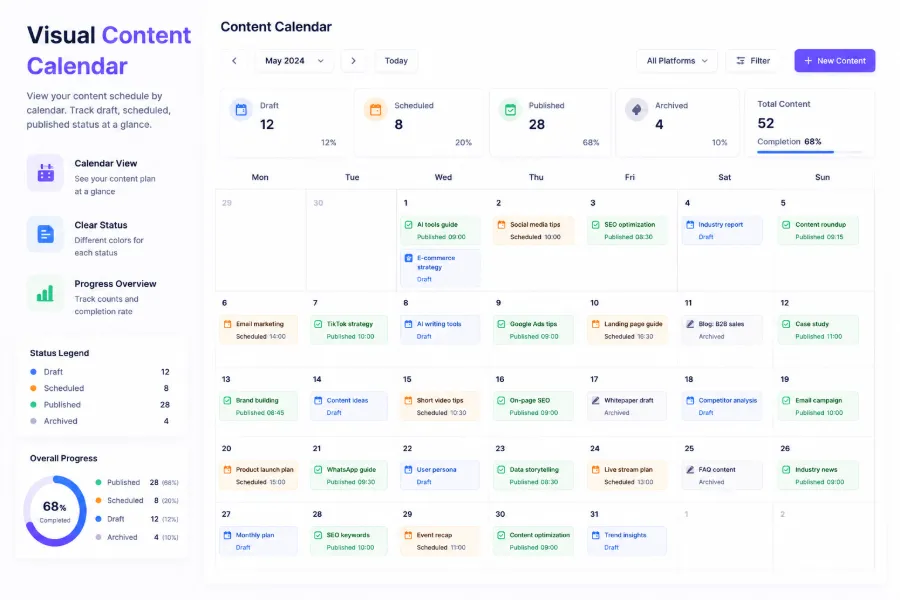
The automation logic for the publishing workflow isn’t complicated: set a publishing frequency, and AI executes according to the schedule. You can visualize daily and weekly publishing rhythms with a content calendar, seeing which articles are pending generation, which are ready to publish, and which are already live. The auto‑sync feature can save 3–5 hours of manual publishing each week.
I’ve also experimented with different growth models to supplement traffic, such as a “no‑ads” approach. After setting a cadence of three new posts per week, natural search traffic showed a noticeable increase within three months. The key isn’t how many articles you write at once, but maintaining a steady update rhythm. AI automation solves the “consistency” problem—once you set it up, you don’t have to worry; the system runs on schedule.
In terms of Shopify integration, generated articles are pushed directly to the blog backend, with categories, tags, meta descriptions, and featured images automatically filled. No need to log into Shopify and edit each post manually, eliminating that repetitive step.
Managing Content Quality and Brand Consistency
When I first tried AI content automation, I hit a snag: without brand context and internal‑link rules, the generated articles were stylistically inconsistent and contained wrong product links, costing me a lot of rework. This taught me that the key to AI content isn’t “generation,” but “planning.”
Brand context configuration solves tone‑inconsistency. In SEONIB’s settings, I added a brand overview, target audience description, a glossary of common terms, and product information. Subsequent articles had a much more consistent voice. With proper brand context, AI‑generated content’s relevance and accuracy improve noticeably, cutting editing time by about 60%.
Internal‑link rules are equally important. Without a pre‑defined linking strategy, AI‑generated internal links are random—sometimes pointing to irrelevant pages, sometimes none at all. By configuring rules—e.g., each article must link to a core category page, product recommendation sections must use specific URLs—you can avoid later rework.
A content review mechanism cannot be skipped. I still keep a preview and fine‑tuning step; I don’t blindly trust full automation. After AI generates an article, I skim it quickly to confirm tone, factual accuracy, and link correctness before publishing. This is far faster than writing from scratch, but it’s not a hands‑off process. If you need deeper details on configuration, refer to the detailed feature setup and usage guide.
SEONIB is already available in the Shoplazza App Store, making it a reference for merchants operating across multiple platforms.
FAQ
Will using AI to generate SEO content lower content quality?
It depends on your configuration. Without brand context and internal‑link rules, AI‑generated content can indeed be tone‑inconsistent and contain errors. With proper setup, AI output can consistently meet or exceed a passing quality level, often surpassing hastily written manual drafts. The key is investing time upfront to build a knowledge base, not letting AI generate from a blank slate.
Do automatically published articles need human review?
I recommend keeping a review step. My workflow is: after AI generates, I preview once, focusing on factual information and internal links, and tweak tone or phrasing as needed. This usually takes less than five minutes, saving a lot of time compared to writing from scratch. Publishing without any review risks brand inconsistency or broken product links.
Can AI‑generated Shopify blogs actually rank in search engines?
Yes, but there are prerequisites. AI generation is only the content creation stage; ranking also depends on topic quality, keyword strategy, internal‑link structure, and overall site authority. After three months of continuous AI‑generated content, some long‑tail keywords ranked in Google’s top 20, but that wasn’t overnight. AI solves the “continuous output” problem, not the “guaranteed ranking” problem.
Do I need programming or SEO expertise to set up AI content automation?
No programming skills are required. Most mainstream tools offer visual configuration interfaces—just fill in brand information, choose a generation template, and set a publishing schedule. However, a basic understanding of SEO concepts—keyword selection, internal‑link logic, site architecture—is necessary; otherwise, even automatically generated content may be misaligned with the right topics.
Share Article