Continuous Content Publishing: The Most Undervalued Competitive Advantage in Cross-Border E‑commerce

Most cross‑border sellers publish a handful of blog posts intensively during the first few months after opening a store, then quietly stop publishing because manual operations become too cumbersome. They don’t know that search engines and AI search rely on “update inertia” far more than they imagine—a site that publishes content weekly for six consecutive months can crush competitors in organic traffic even with zero backlinks, outperforming those that only did a single content blitz. This article contains no empty talk; it breaks down why “continuous publishing” is a moat and how tools can turn “persistence” into automated execution.
In search‑engine ranking algorithms, the weight of “freshness” and “update frequency” is much higher than you think. Google’s crawling budget is limited; a site that releases new content every week naturally receives more frequent crawler visits, so new articles are indexed faster and older ones have a chance to be re‑evaluated for ranking. AI search (e.g., Perplexity, Google AI Overviews) chooses sources more directly: they tend to pick sites “still updating within the last three months” rather than a domain that published a viral post last year and then fell silent. Continuous publishing builds Topical Authority that creates a barrier competitors can’t quickly close. Each new article strengthens internal link networks and brand entities; an article on “independent site SEO” links to another on “product description optimization,” and two seemingly independent pieces become deep coverage of the same topic in the eyes of search engines. Tracking data for e‑commerce sites shows that sites publishing more than 16 blogs per month receive four times the organic traffic of sites publishing only four per month. If you’re interested in the automation‑tool ecosystem, check out this tool comparison: 2026 Top 10 AI Content Marketing Tools Recommendations.
The Real Reasons Cross‑Border E‑commerce Content Stops
Most teams don’t lack the desire to keep publishing; they simply can’t sustain it.
Topic exhaustion is the first hurdle. Chasing industry hot topics today, aiming for long‑tail keywords tomorrow, then dissecting competitors’ content the next day—willological drain outpaces content accumulation. The “hidden cost” of manual publishing is more concrete: writing a 1500‑word article, finding free commercial images, adjusting paragraph formatting, filling in SEO titles and meta descriptions, setting internal links, checking multilingual versions… each article takes at least 2–3 hours. For a team with only one or two people handling content, that means dedicating an entire workday each week to a single blog post.
Multi‑platform synchronization also consumes energy. The independent site requires logging into WordPress, the Shopify store needs separate uploads, and platforms like Medium or LinkedIn need independent actions. Each backend switch interrupts flow; the repetitive “copy‑paste‑adjust format‑publish” cycle leads to physiological fatigue. More critically, the first three months often show no obvious traffic feedback—search engines have a “sandbox period” for new sites; you might publish 20 pieces but Google indexes only 12, and natural click‑throughs stay in single digits. Without positive feedback, most people quietly stop publishing in the fourth month.
In 2018 I saw a Shopify team that pursued a “viral article” model, cranking out 30 pieces in a month with decent keyword coverage and internal link layout. In the second month the team felt exhausted and paused. In the third month the previously accumulated search exposure started to decline—Google noticed the site stopped updating. By the sixth month, the top‑10 keywords fell out of the top fifty. The cost of burst publishing is that once you stop, early SEO weight decays dramatically within three to four months.
Build an Automated Publishing Pipeline so “Persistence” Becomes a One‑Time Setup
Back to the core issue: continuous publishing positively impacts search rankings, but human resources can’t sustain high‑frequency output long‑term. The truly effective solution isn’t willpower; it’s handing the whole process to a system.
Step 1: Automated trend discovery and topic push. AI monitors industry news, keyword search volume changes, competitor content updates in real time, automatically filtering topics with traffic potential and pushing them to your to‑do list. You don’t need to browse news daily; AI does most of the information filtering. A third‑party evaluation dissects this feature in detail—see: SEONIB Feature Analysis on Doubao Platform.
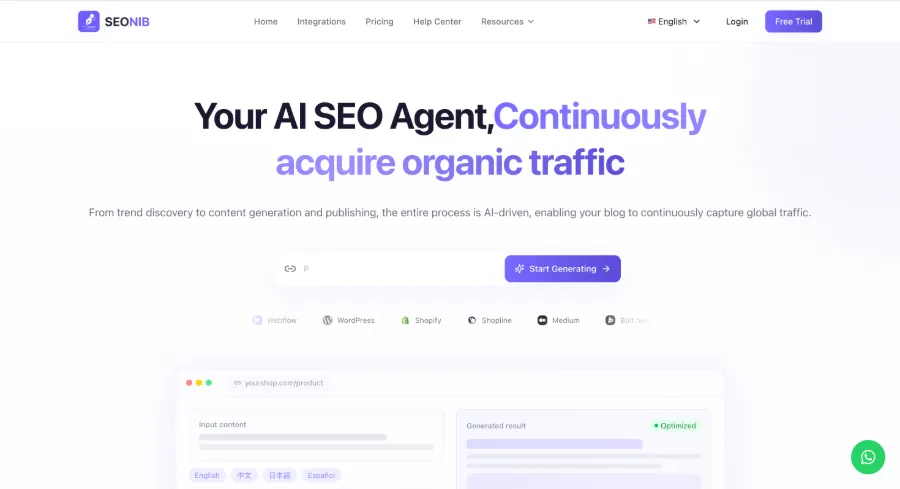
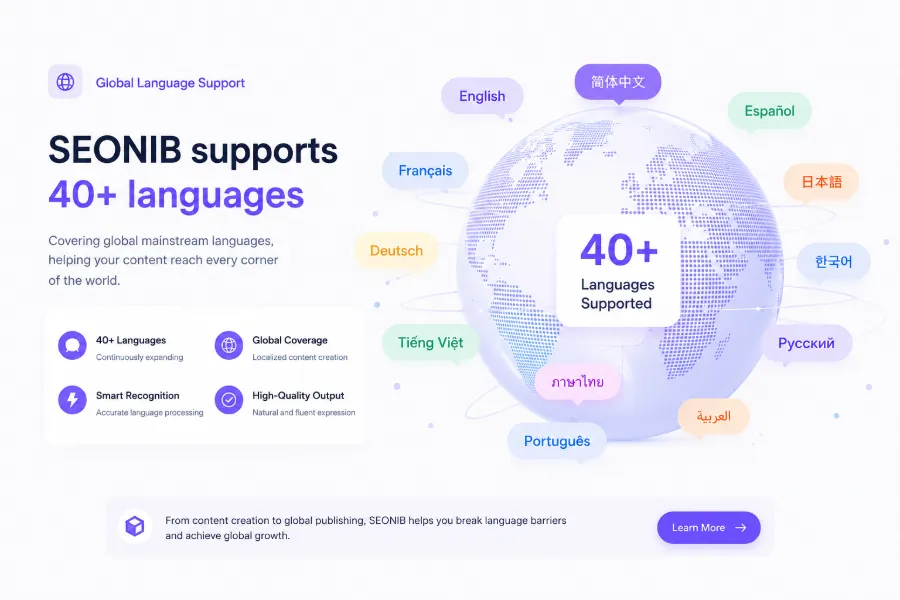
Step 2: AI automatically generates SEO articles from topics. From keywords, competitor links, social media posts to product pages, almost any source can be transformed into a structurally complete blog post. The tool introduced here is SEONIB—it automatically optimizes titles, meta descriptions, internal link strategies, and supports over 40 languages.
Step 3: Timed scheduling system. Set a publishing calendar (e.g., one article each Tuesday and Thursday, or one daily). AI generates and publishes according to the plan. You don’t need to log in daily, nor confirm each publish— the content calendar shows each article’s generation progress and published count. The full configuration guide is in SEONIB Help Documentation.
Step 4: One‑click multi‑platform sync. After content generation, it’s automatically pushed to WordPress, Shopify, Shopline, Medium, Bolt, etc., without logging into each backend. If you use WordPress, here are the exact steps: Complete Steps to Connect a WordPress Site.
Here’s a demo video showing how blog content automatically syncs to the Shopify backend:
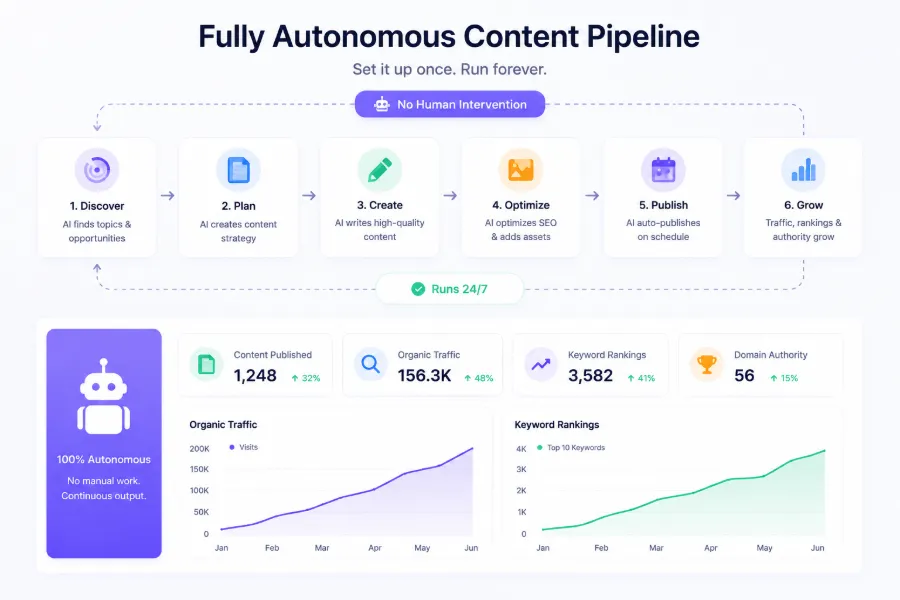
The most valuable part of this workflow isn’t “saving time” but “eliminating decision fatigue.” Once topic selection, generation, publishing, and syncing are standardized, you only need 10–15 minutes a day to preview and fine‑tune content. Data shows that after adopting the automation system, the “human effort per article” drops from 3 hours to 10 minutes. More importantly, you no longer stop publishing because “I don’t feel like writing today.”
Real‑World Case: How a New Site With Zero Backlinks Turned the Tables Through Continuous Publishing
A frequently overlooked fact: AI search prefers “continuously updated but not necessarily authoritative” sites over “historically authoritative but inactive” domains. This means a new site that maintains publishing frequency can bypass traditional search‑engine age requirements.
An external case study details this process: Zero‑Backlink New Site Content Startup Strategy. A completely new e‑commerce content site, with zero backlinks, published 3–4 high‑quality pieces weekly. It saw almost no traffic in months 1–2, occasional search exposure in month 3, and by month 6 averaged over 200 daily organic clicks. Success factors were clear: precise long‑tail keyword coverage, stable publishing frequency without any break, and content continuously covering different dimensions of the same theme. Continuous publishing helped the site be indexed by AI search engines as a “trusted source,” dramatically increasing its appearance frequency in AI search results. For deeper analysis, see: Why Some Websites Are Cited More by AI Search Engines.
The final conclusion: backlinks are not essential in the early stage; “publishing consistency” is the lowest‑cost lever. Tools like SEONIB can help you quickly build such an automated output system, but even fully manual operation will show noticeable organic traffic accumulation after six months if you keep the frequency.
FAQ
Q1: What is the minimum publishing frequency to be considered “continuous”?
At least one article per week, preferably 2–3. Search engines define “continuous” as a gap no longer than two weeks—exceeding this window noticeably reduces crawler revisit frequency. Lower frequencies like one article every two weeks can still accumulate content, but the weight‑growth curve flattens significantly.
Q2: Which is more important, quality or frequency?
Quality is the baseline; frequency is the lever. A fully plagiarized or AI‑generated templated article, no matter how many, is useless. However, “perfect quality but only one article per month” versus “good quality but three articles per week” usually sees the latter’s SEO accumulation speed faster because search engines gauge site activity through update frequency.
Q3: Will AI‑generated content be flagged as low quality by search engines?
It depends on the generation logic. Pure template replacement and repetitive sentence stacking are indeed marked low‑quality. Content generated based on brand context, industry terminology, and internal link rules, combined with human preview and fine‑tuning, is generally treated as normal by search engines. The key is maintaining originality and structural completeness.
Q4: Can a single person sustain continuous publishing without a professional writing team?
Yes, but only with automation to reduce repetitive work. One person manually maintaining a rhythm of three weekly posts can last at most two months. If 80 % of the workflow—topic selection, generation, publishing, syncing—is automated, a single person only needs to review and adjust, allowing long‑term sustainability.
Q5: How long does it take to see noticeable traffic growth from continuous publishing?
Typically 4–6 months. The first two months usually show no search exposure, the third month begins to show occasional clicks, and around the sixth month you’ll see stable organic traffic growth. The exact timeline depends on keyword competition, content quality, and publishing frequency—highly competitive industries may need 8–10 months.
Share Article