
Why Your Shopify Store Can't Get Organic Traffic?
I’ve seen far too many Shopify sellers spend huge amounts of time on product detail pages, ad campaigns, and social media, yet their store’s organic traffic remains stagnant. The problem isn’t that your product is bad; it’s that search engines can’t find you because your store lacks a continuously updated content engine.
Truth #1: Product pages aren’t content; search engines need “alive” content
Many sellers treat product detail pages as all the assets they have— a few hundred words, a few images, a price—then expect Google to obediently deliver traffic. Think about it: a small shop with only a few dozen static pages has no chance of ranking against sites that publish blogs daily. Search engines aren’t blind; they look at the breadth and activity of information.
The limitations of product pages are obvious: little information, lack of depth, almost zero update frequency. You list a product and never change a word for six months—how can a search engine keep crawling it? In contrast, a blog post written around a keyword can naturally expand long‑tail topics, embed internal links, and increase page relevance. Search engines love this “alive” content.
Data backs this up: sites with a blog index on average 434% more pages than sites without a blog. Don’t underestimate that number—index volume directly determines how many search results you can appear in. If your store has only 20 product pages, even if each is perfectly optimized, you’re limited to 20 entry points. A continuously updated blog can add dozens of pages each month.
If you want a systematic way to pick topics with search potential, check out How to Generate Blog Articles on Trending Industry Topics, which outlines a method based on competitive analysis and search trends.
Truth #2: 90% of sellers get stuck in the “unstable output” trap
I’ve fallen into this trap. I wrote a Shopify store blog every week for three consecutive months, unwaveringly, yet the traffic was zero. Zero. Later, after reviewing, I realized the content lacked focus, had no keyword research, seemed stable in frequency but varied wildly in quality, and only produced a handful of articles over three months—far from establishing topical authority.
The pain points of traditional content creation are now second nature to me: finding topics, writing articles, sourcing images, doing SEO, publishing—each step consumes time. Most people give up after two or three months. Search engine crawling budgets and topical authority require a steady, consistent flow of content. Sites that update a blog once a month get, average 47% less traffic than sites that update four times a month. If you can’t increase your publishing frequency, your site’s authority won’t rise.
Here’s a truth many overlook: content quality matters more than quantity, but if you have no quantity, quality can’t even be discussed. If you can’t manage one article per week, how can you talk about deep optimization?
Solution: Turn “product links” into “traffic entry points”
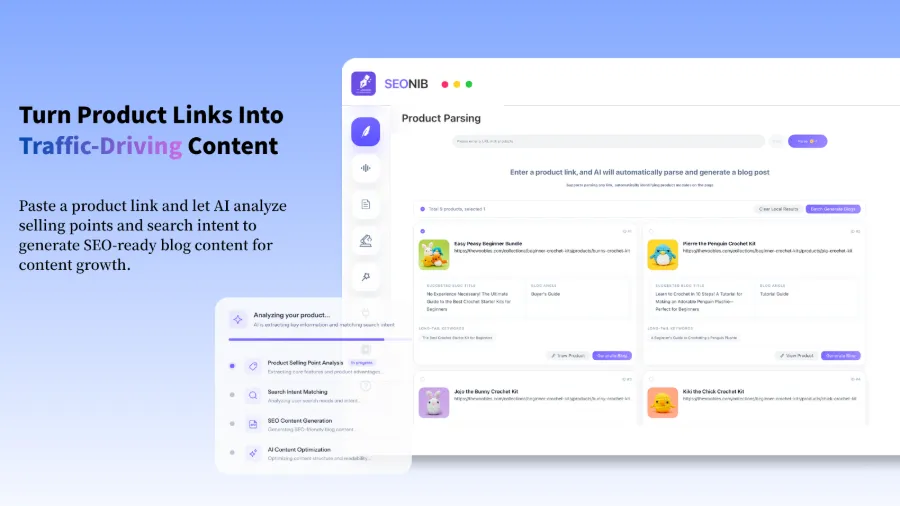
Most sellers don’t know that their “product pages” can themselves generate 3–5 articles from different angles to cover various search intents. For example, if you sell a Bluetooth headset, the product page can only list specs and selling points, but you could write articles like “How to Choose Noise‑Cancelling Headsets,” “Are Bluetooth Headsets Good for Running?” and “2025’s Best Bluetooth Headsets Comparison”—each article becomes an independent traffic entry point.
Now there are tools that automate this. I use SEONIB, which can start from a product link, automatically generate SEO articles, and sync them to multiple platforms. The first step is to treat your existing product information as a seed and expand it into multiple targeted blog posts.
A quick note on AEO (AI Engine Optimization), a concept that’s becoming increasingly important. When users ask questions via AI search tools like ChatGPT or Perplexity, traditional SEO content may not be prioritized. Your content needs structured data and the ability to answer specific questions directly. SEONIB‑generated content is automatically AEO‑optimized, giving you a head start.
Publishing the generated content isn’t as complicated as you might think. See this article “One‑Click Method to Turn Product Pages into Blogs”, which demonstrates the full workflow from product link to publication—essentially a few clicks.
Below is a demo video of SEONIB in action:
Continuous content output isn’t “motivation,” it’s a “system”
Once you start auto‑generating content, the real test is sustained output. I tried relying on willpower, and it ended up being three days on, two days off. The key isn’t “work harder,” it’s building an automatically running system.
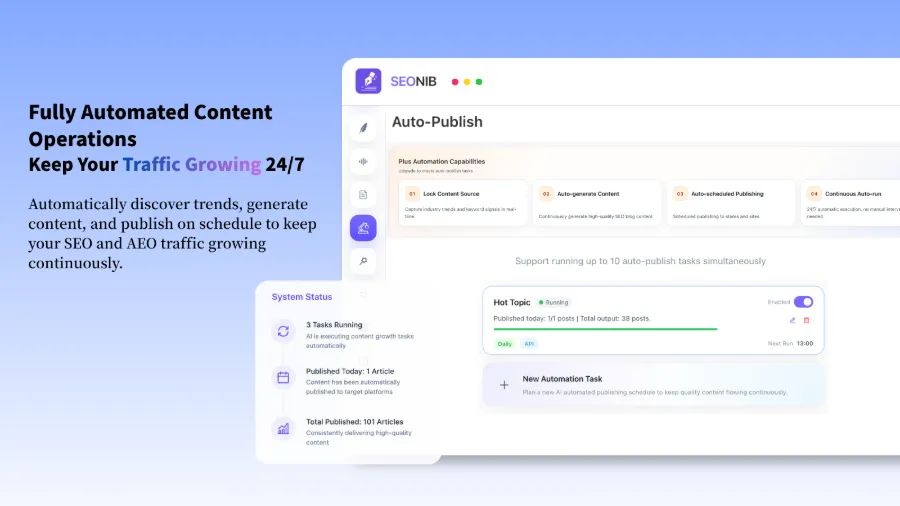
Set up a content calendar, assign topics to specific days of the week, and let the system execute. For example, auto‑generate a hot‑keyword article every Monday, convert a social media post into a blog on Wednesday, and auto‑create a product comparison piece on Friday. Sites that publish one piece of content every day for three months see their homepage authority increase by an average of 2.5×. This isn’t hype; it’s real data.
SEONIB itself supports auto‑publishing and scheduled tasks; once configured, no manual intervention is needed. Think of it as an assembly line for a content factory. For WordPress integration, refer to the Complete Guide to Bulk Publishing SEONIB Content to WordPress, which details setup and automatic syncing.
One more reminder: don’t put all your eggs in one basket. Besides a blog, you can sync content to multiple platforms (WordPress, Shopify, Medium, etc.) to spread risk and capture more search entry points. If you encounter issues during setup, check the official help documentation for many common operational details.
FAQ
Q1: I only have a few stores—is one article per week enough?
Yes, as long as the content quality is high. One article per week for three months yields 12–15 articles, which noticeably boosts site authority. That’s far more effective than publishing a few times a month. Consistency is key.
Q2: Will AI‑generated content be penalized by search engines?
Search engines penalize “low‑quality content,” not “AI‑generated” per se. As long as you perform some human review and editing to eliminate factual errors and ensure the content adds value for users, there’s no problem. Many well‑optimized sites already use AI heavily.
Q3: I don’t have a website—can I still do SEO?
You can, but it’s best to have your own independent site. If you lack a site, start with a simple content site using an automatic site‑builder, then publish the generated blogs there. SEO’s core is getting search engines to index your pages; without a site, there’s nothing to index.
Q4: How long does it take to see SEO results?
Typically 2–4 months. The first month shows almost no change; the second month may bring occasional clicks; by the third month, if the content aligns with user intent, traffic starts to climb. Don’t expect results in a week—SEO is a cumulative process.
Q5: Can product pages themselves be SEO‑optimized?
Absolutely. But the optimization scope for product pages is limited—title, description, image alt text, structured data. The real traffic boost comes from additional content pages. Product pages are the foundation, but don’t expect them to shoulder all organic traffic.
Share Article