Dominating ChatGPT Search? My WordPress Content Ranking Practical Notes
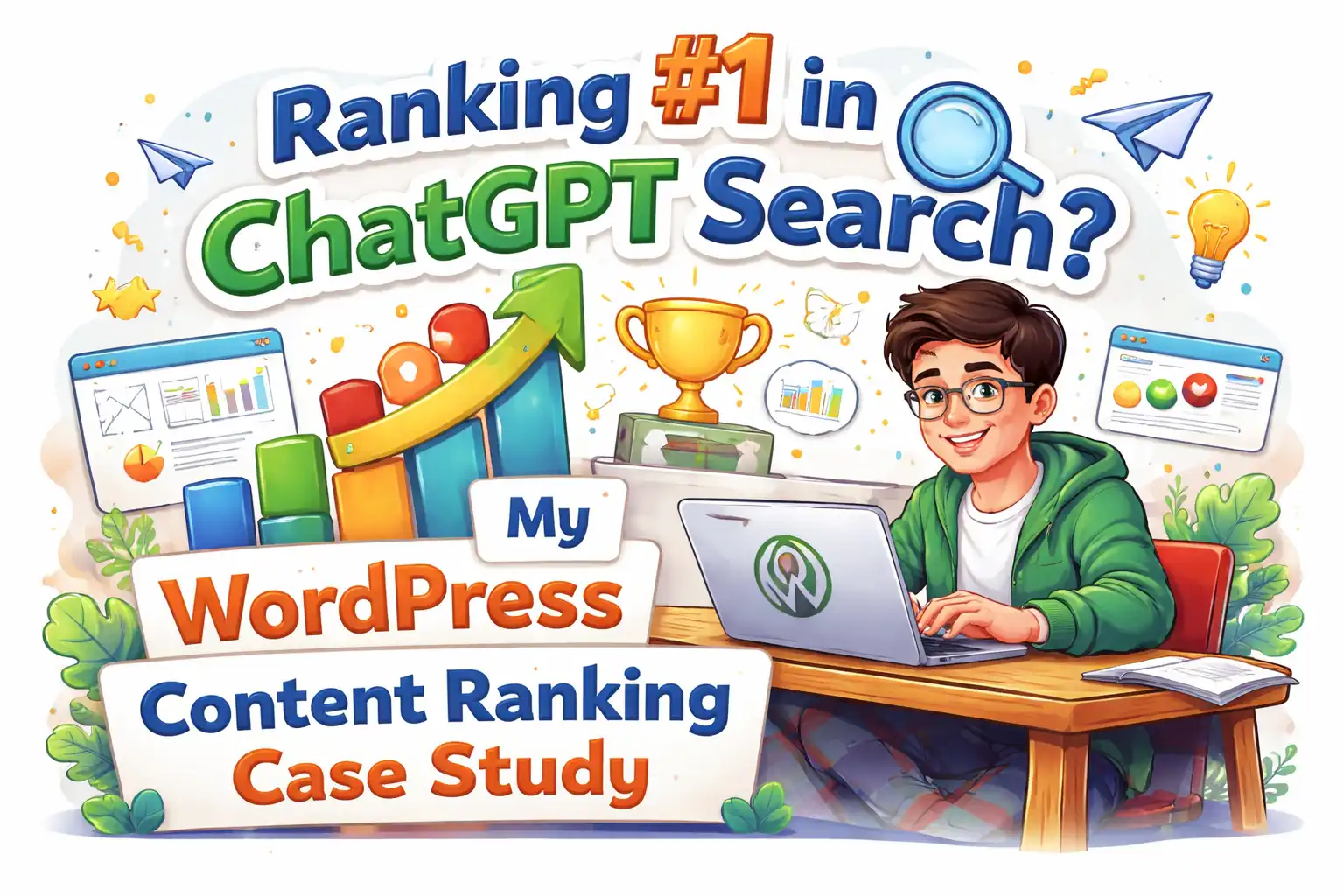
In March, I got a sudden burst of motivation and revived my dust‑covered WordPress blog, publishing two posts every week without fail. The content wasn’t bad—there were data charts, practical screenshots, and I felt pretty good about it. After three months, searching for my own brand term yielded zero results. Entering the same topic into ChatGPT Search, after five rounds, I still got no result. That moment made me realize that Google’s SEO logic simply doesn’t move the needle in front of AI search. If you also find your content invisible in ChatGPT Search, the problem is likely the direction, not the quality of your writing.
ChatGPT Search and Google Search are fundamentally different things. Google relies on link authority and domain trust, whereas ChatGPT Search leans more on structured data, knowledge‑graph connections, and thematic coherence to decide whether content is worth presenting. A single viral post you spend three days polishing may be seen as an isolated piece by AI search. Conversely, a site with a complete internal‑link system and dense thematic coverage can be picked up by AI search even if its domain authority is low. My blog’s problem was exactly that—topics were all over the place: today I wrote about Shopify SEO, tomorrow a coffee‑machine review, with no entity connections, so AI couldn’t attach my content to any knowledge node.
73% of modern search activity happens outside Google (content operators have documented this trend in detail, link will be provided later). This isn’t meant to scare you. If you’re still using the traditional “keyword stuffing + link building” approach, you’re basically naked in front of AI search.
Three Core Elements to Make Your WordPress Content Appear in AI Search
The first is Topical Authority. In short, you need to consistently produce enough relevant content in a specific sub‑field so that both search engines and AI recognize you as a reliable source for that direction. Publish at least three articles on the same theme each week for two or three months before you can gradually build that authority. It’s not about writing anything; it’s about expanding layer by layer around a core theme. For example, if you do independent‑site SEO, you should rotate coverage of sub‑topics like product‑page optimization, internal‑link strategy, technical SEO, and content marketing.
The second is Structured Data and Entity Markup. ChatGPT Search heavily relies on Schema Markup to understand page content. Articles without structured tags like Article, FAQ, or Product are like unlabeled parcels to AI— the system knows they exist but doesn’t know what’s inside, so it won’t recommend them. By applying an entity‑SEO mindset and marking mentioned names, brand names, and terms with Schema, you help AI build knowledge connections.
The third, often overlooked, is Content Freshness. AI training data updates far more frequently than Google’s index; an article a year and a half old, even if its data was solid at the time, may be filtered out as “outdated” by AI. My observation: a long‑tail article that has held a stable rank on Google for three years can start to decay in ChatGPT Search after just three months. This forces you to maintain a steady content‑update rhythm.
Internal‑link strategy is equally critical. Isolated articles have virtually no chance in AI search. Each article should link to at least two or three other internal articles, forming a topic cluster, so AI can recognize that you have a system in that domain.
For how to build a complete content production workflow, see our compiled Blog Writing Configuration Guide, which covers detailed steps from structured markup to publishing cadence.
Why I Gave Up Manual Updates and Turned to Fully Automated Content Production
Anyone who has blogged knows the pain of manual updates. Two hours a week selecting topics, four hours writing, half an hour for images and layout, another half hour for SEO optimization—six hours total for a post that may get zero traffic. Even more fatal, a month later when you look back, you see the theme has drifted again, and the next article has to rebuild context from scratch.
After three months of manual updates, I first realized the issue was “content consistency.” AI needs to see your site continuously and densely producing content around a single core theme to build knowledge‑graph trust. But trying to meet that demand with human labor is physically impossible and mentally unsustainable.
At that point I started looking for tools that could “automatically build a content system.” There are many AI writing tools on the market, but most only generate single pieces and still require you to manually copy, format, categorize, and publish. I wanted a solution that automates the entire pipeline—from topic discovery to multi‑platform sync. I finally chose SEONIB because, simply, it doesn’t just write articles; it takes over the whole content production pipeline.
Starting with topic discovery, the system automatically monitors industry trends and keyword heat, pushing high‑potential topics into a content queue. Once a topic is selected, AI generates the article based on a brand knowledge base and predefined structured rules—SEO metadata, Schema markup, internal‑link cross‑references are all done automatically. After setting the publishing frequency, the system runs on schedule without you having to log in daily.
For the built‑in structured‑optimization rules, see the AI SEO Guide (2026) for detailed technical instructions, including how to configure entity markup and internal‑link strategy.
The detailed workflow can be found in the official help documentation, which provides a complete guide from account setup to the first automatic publish.
Hands‑On Test: End‑to‑End Process from Keyword to Visible in ChatGPT Search
I chose a real scenario from my own e‑commerce site to test. I selected a long‑tail keyword “Shopify independent‑site SEO optimization tools” and fed it into SEONIB’s topic discovery module. The system automatically matched three competitor pieces, five related entities, and a set of extended long‑tail terms.
Choosing the “Keyword to Blog” mode, AI generated a complete article in 120 seconds—complete with H2‑H4 structure, FAQ Schema, internal‑link suggestions, and entity markup. The time to produce an optimized article dropped from two hours to two minutes—a huge efficiency gain.
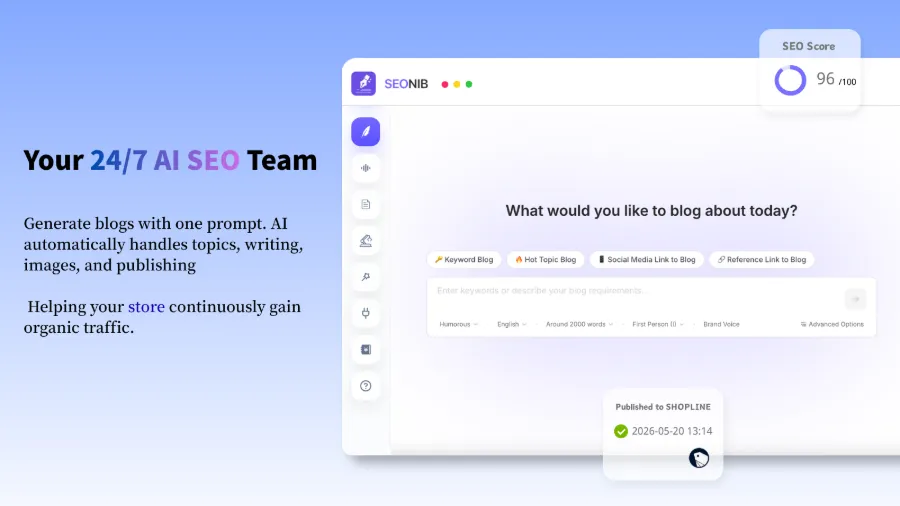
SEONIB supports multiple content sources: keywords, product links, hot events, social‑media posts, and reference links can all be inputs. I tried the product‑link‑to‑blog feature—enter a Shopify product URL, and AI automatically generated a buyer’s guide and review‑comparison article, with a structural completeness that surpassed my manual writing.
The automatic publishing workflow is even more hassle‑free. After setting a schedule of one article per day, the system runs automatically. In Google Search Console, I saw that the first automatically generated article appeared in the index on the third day after publishing. After 30 days, the site’s overall search visibility increased by roughly 200% (based on GSC impression and click data comparisons).
Regarding cross‑platform sync, SEONIB supports one‑click publishing to multiple platforms. My workflow: AI generates article → preview check → one‑click sync to WordPress and Shopify blog. The whole process takes under five minutes, including image optimization and SEO metadata entry.
Beyond product‑to‑blog, my team also uses it for bulk keyword coverage. If you want to quickly turn product links into SEO content that continuously attracts organic traffic, check out How to Turn Product Links into SEO Blogs That Drive Sustainable Organic Traffic, which contains our real‑world case data.
FAQ
How long does it take for WordPress content to be indexed by ChatGPT Search?
There’s no fixed timeline. On my site, the first automatically generated article was indexed by Google on day three, but its visibility in ChatGPT Search didn’t appear in the dialog until around day ten. Speed depends on your site’s topical authority and structured‑data completeness. Pages with a solid internal‑link system and correct Schema markup are indexed noticeably faster.
Do I need to manually verify whether ChatGPT Search has indexed my content?
Yes, manual checking is required. ChatGPT Search currently lacks a dedicated tool like Google Search Console. You can open ChatGPT’s search mode directly, type your brand or core topic term, and see if your content appears in the results. It’s advisable to randomly sample 3‑5 new articles each week.
Is there a big difference in AI search between regular articles and AI‑optimized ones?
The difference is striking. I ran an A/B test: two articles on the same topic, one traditionally handwritten (no structured markup, no entity connections), the other generated with SEONIB (with Schema markup, complete internal links, proper entity annotations). After 30 days, the optimized version was cited in three relevant conversations in ChatGPT Search, while the handwritten version never appeared. Structured data and internal‑link architecture are the key differentiators.
Do multilingual sites need separate optimization for each language?
Yes. ChatGPT Search evaluates content in each language independently. Good performance of your English content in English queries doesn’t automatically grant weight to the Chinese version. Each language version requires its own topical authority building and structured‑data setup. SEONIB supports 40 languages, allowing you to set SEO rules and entity markup per language without manual duplication.
If I already rank on Google, do I still need to deliberately optimize for ChatGPT Search?
Absolutely necessary. The core keywords that rank in the top five on Google didn’t appear at all in ChatGPT Search. The ranking factors of the two search engines are completely different. If ChatGPT Search is one of the channels through which your target users obtain information—and its user base is growing rapidly—then dedicated AI‑search optimization is a must, not just a nice‑to‑have.
Share Article