
AI SEO vs Traditional SEO Cost Comparison: Which Is More Cost-Effective?
I’ve been doing SEO for eight years, spent a lot of money, and fell into many traps. From the old method of manually writing articles and manually building backlinks to the various AI tools that claim you can “get traffic while lying down,” I’ve basically tried them all. To be honest, some AI products produce results that make me want to close the browser as soon as I open them. But does that mean traditional SEO is more cost‑effective? Not necessarily—human labor is expensive, iteration is slow, and often after writing a bunch of content, Google still hasn’t indexed everything after three months.
This article isn’t a sales pitch; it’s a look at the real accounting books I’ve walked through. If you’re hesitating about adopting AI SEO or wondering where to allocate your budget, this should help you avoid some wasted money.
What’s the biggest expense in traditional SEO? It’s not the tool subscription fee, not the backlink purchase—it’s people.
When I first started, I worked on content for a cross‑border e‑commerce team. The team had five people: two writers, an editor, a keyword researcher/strategist, and an operations person handling publishing and optimization. The labor cost alone burned about ¥40,000 per month. The output? Ten to fifteen articles a week, constantly revised, and the final publication was usually two weeks later.
AI SEO? I’ve done it hands‑on. One person, paying a few hundred dollars a month for AI tool subscriptions. The output volume multiplied several times—easily fifty to sixty articles a month, with almost zero intervention from topic selection to publishing. The problem is quality—early on I hit many traps: AI‑generated content went off‑topic, missed facts, sounded mechanical, and rankings stayed flat. So you can’t say AI solves everything; strategy and review stages still matter.
But on paper, the labor‑cost line is almost crushed by AI. Especially for global‑market content, the same article translated into four or five languages traditionally requires team coordination and outsourced translation, while AI is just a parameter setting.

Tool Subscription Fees: Both Sides Can’t Escape
Many people think traditional SEO has no tool costs; that’s a fantasy. The essentials for traditional SEO—Ahrefs or Semrush—start at $1,500–$2,000 per year. Screaming Frog is cheap but unusable for large sites. Add GPT subscriptions for content writing, Canva paid for for image creation, and formatting tools—tool costs alone easily exceed $10,000 a year.
Someone might say, “AI SEO also has subscription fees, right?” Yes, and good AI SEO platforms aren’t cheap either. The key difference is that traditional SEO tools are often separate, independent modules—content production, keyword research, rank monitoring, backlink analysis each have their own tool. With four or five subscriptions, you can’t tell which one is actually eating your money.
I’ve tried platforms that integrate content production, automatic publishing, topic discovery, and multi‑platform syncing into one. They’re convenient, but not without issues—my first month, I didn’t configure the automatic publishing schedule correctly, and on a weekend my Shopify store was flooded with more than twenty completely unrelated articles. It was so awkward I wanted to crawl into a hole.
From a cost‑structure perspective, if you only count tool subscription spend, traditional SEO’s total cost is likely higher. But that doesn’t mean AI SEO is automatically cheaper—you also have to factor in backend strategy work, review costs, and hidden expenses from switching tools.
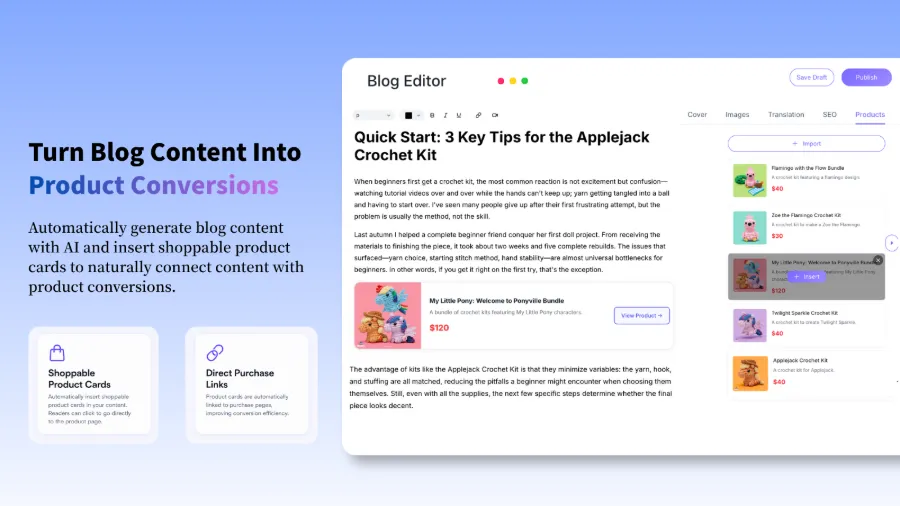
Below is an example from an actual workflow: a product link turned into an article and managed directly in the backend interface:
Continuity and Discipline: The Most Hidden Debt of Traditional SEO
Few articles mention this, but I think it’s the biggest cost difference.
Traditional SEO has a huge hidden cost called “people get tired and quit.” In 2019 I led a team that performed well for the first three months, with traffic climbing steadily. In the fourth month, the lead writer left, the content schedule broke for two weeks, and the replacement editor’s style didn’t match, causing rankings to drop. Humans get tired, quit, lose inspiration—people‑driven SEO sees marginal costs rise over time because human bandwidth is limited.
AI SEO wins hands down on “continuous output.” My current approach: set a topic strategy and style guidelines, hand the tasks to an automated system, and produce a fixed 3–5 pieces daily. The “machine” never complains about overtime, never says “I have no ideas this week,” and doesn’t stop because a competitor poached staff. You just need to regularly check direction and tweak rules.
However, there’s a counter‑intuitive finding—AI SEO is stable, but its traffic growth curve is much slower than traditional SEO. When I did traditional SEO, a good piece could show clear indexing and exposure within one or two weeks. AI‑generated bulk content, even when quality‑checked, is indexed more slowly by Google, with an inclusion rate hovering around 75%–85%; the rest stay in “discovered but not indexed.” In other words, AI SEO is only cost‑effective if you have the patience to wait for its cumulative effect.
When Is “AI SEO Not Cost‑Effective”?
Honestly, to write this article I did a serious side‑by‑side comparison of two products and even wrote a detailed comparison report to understand their real positions in the SEO workflow. Without a comparison you can’t see how the decision differences are larger than I imagined.
AI SEO also has its dead ends. If your site is highly vertical, niche, and requires extremely specialized deep content—like medical devices, legal text interpretation, or financial compliance—AI‑generated material is something I wouldn’t publish without senior editorial review. Once, to save time, I had AI write a set of articles explaining EU GDPR clauses. A knowledgeable reader sent me a lengthy email pointing out two legal concept inaccuracies. It didn’t cause a real problem, but I was scared enough to pull the articles and spent three days revising them. That lesson taught me that for high‑expertise content, human review isn’t a cost‑saving point; it’s a baseline.
Also, if you already have a site with decent traffic and a mature content system, switching entirely to AI SEO can be counter‑productive. I saw a peer whose site averaged 20,000 daily visitors; after buying an AI tool, he shut down the manual writing team and went fully automated. Two months later, traffic dropped 30%—not because of quality, but because the sudden style change alienated the existing audience, causing click‑through and dwell time to fall.
So you can’t just say AI is always cheaper and traditional always more expensive. It depends on the scenario.

At What Stage Should You Switch?
Based on my years of experience, I’d say:
Startup stage (daily visits < 1,000): AI SEO is clearly cheaper. You need volume, rapid content foundation building, and long‑tail keyword coverage. Pursuing “perfect” articles isn’t worth it; getting Google to know your site matters more. I used SEONIB for a batch content rollout, and in three months the indexed count grew from zero to over 2,000. Not every article got clicks, but the content architecture was established, and later I refined it gradually.
Growth stage (daily visits 1,000–10,000): A hybrid model is safest. Core authority and profit pages get the traditional, meticulous treatment; auxiliary blogs, Q&A, and product descriptions are covered by AI at scale. This keeps costs focused on the high‑impact areas rather than spreading thin across all content.
Mature stage (daily visits > 10,000): Keep AI for maintenance content, but don’t hand over brand reputation entirely to machines. Your readers already have expectations about your style; AI content that isn’t “human‑like” will be obvious, leading to high bounce rates.
Frequently Asked Questions
Is AI SEO completely hands‑off?
No. At least all the AI tools I’ve seen, including the ones I’ve used, still require initial strategy design and regular quality sampling. The most effective model is human direction, machine execution, human review. With zero intervention, the failure rate is roughly 30%.
How much does AI SEO cost per month?
It depends on the platform. A basic content‑generation tool might be around $100 per month. If you need keyword research, content generation, automatic publishing, and multi‑platform sync, monthly fees usually range from $200 to $600. Traditional SEO tools covering the same scope typically cost two to three times that, or even more.
Which traffic sources are best suited for AI SEO?
Long‑tail keyword traffic, Q&A‑style content, product‑related content, and multilingual content convert best. Highly competitive core keywords and topics requiring deep industry knowledge still favor human creators. My habit: after publishing any AI‑written article, I check Search Console within two weeks; if a core keyword’s clicks are unusually low, I manually rewrite that paragraph.
If my budget is limited, where should I invest first?
With a budget under $10k, start with AI SEO and spend the remaining money on keyword strategy. With $50k–$100k, consider a hybrid team—a strategist plus an AI platform—to balance efficiency and depth. Over $200k, your operational system is likely mature enough that you don’t need my advice; you probably already know what to do.
Share Article