Don't Be Fooled by AEO, GEO, AIO: The Pitfalls I Hit and the Practical Process I Discovered
In the past year, the entire search community has been shouting “AI will replace Google,” but when I opened the backend, the content I needed to write was written, and the traffic that should drop did drop. Once I searched my own brand keyword on Perplexity, AI recommended a competitor’s tutorial—in that moment I realized it wasn’t that my content was bad, but that my content wasn’t being recognized by AI at all. The top rank gets no views, and AI’s answer shows no trace of me. This article records my journey from “blindly chasing SEO rankings” to “being actively recommended by AI,” without mysticism, just operations.
First, AEO—Let AI Copy Your First Paragraph
AEO (Answer Engine Optimization) is simply getting AI tools to quote your content as the standard answer when answering user questions. When a user asks “How often should an air conditioner be cleaned?” Google AI Overview or ChatGPT will display a summary, and your brand name and link will appear right under that paragraph. My initial mistake was writing long articles where every opening paragraph was a story setup, without directly giving the answer. AI only grabs the first paragraph, so my valuable content was hidden in the later half—essentially writing for nothing.
Three Hard Metrics for AEO
- The first paragraph of each page directly answers the core question, kept within 60 characters, using clear sentence structures (“The most common method is…”, “You can do it like this…”).
- Use FAQPage structured data (Schema) so AI knows which content is a “question‑answer” pair.
- Create a dedicated FAQ page covering long‑tail questions. To find these long‑tail questions, refer to my previous Keyword Research Practical Guide, which contains specific methods.
After I updated the homepage FAQ, three days later my paragraph appeared in Google AIO. The effect arrived faster than I imagined.
Next, GEO—AI Turns from “Copying Answers” to “Recommending Brands”
GEO (Generative Engine Optimization) is harder. AEO gets you quoted; GEO gets you recommended. When a user asks “What tool should a 10‑person marketing team buy?” AI reads dozens of pages and then says “We recommend X brand.” If you’re not selected, no matter how good your content is, it won’t help.
My pitfall: I wrote blogs for half a year, Google rankings were decent, but ChatGPT and Perplexity never proactively mentioned my brand. That’s because my content was just “articles,” not “recommendation material.” AI selects brands based on: brand consistency (same name and terminology across all platforms), structured entity markup (marking you as “company,” “product,” “founder”), and authoritative external links.
What changed my mindset was a case study: someone used automated pre‑positioning, laying out structured content in places AI can crawl first. Check out this Content Creator’s Record of Pre‑Positioning with AI, which explains how to fill answers before being discovered. I started completing my brand knowledge base, unifying all “About Us” descriptions across platforms, and adding Product Schema to product pages. Two months later, Perplexity’s test results finally showed my brand.
Finally, AIO—Make LLM Remember You as a Person
AIO (AI Optimization) aims to have ChatGPT, Claude, Gemini mention your brand proactively in conversations. This can’t be solved with a single article; you need a “brand knowledge base” for LLMs to learn. Key actions: create an entity entry on Wikipedia or similar platforms, get citations from reputable media, and maintain consistent brand anchors across all relevant platforms.
I manually maintained knowledge bases on three platforms, which was exhausting and often out of sync. Later I realized I needed automation tools to manage and publish in bulk, ensuring the brand name, link, and description are identical everywhere.
If you’re interested in configuring deeper knowledge‑base details, check the SEONIB Help Documentation for more. Also, if you want to compare different AI SEO tools, this 7 Best AI SEO Tools for Fast Ranking in 2026 makes a good supplementary reference.
How I Combined These Three “O”s into an Automated Pipeline
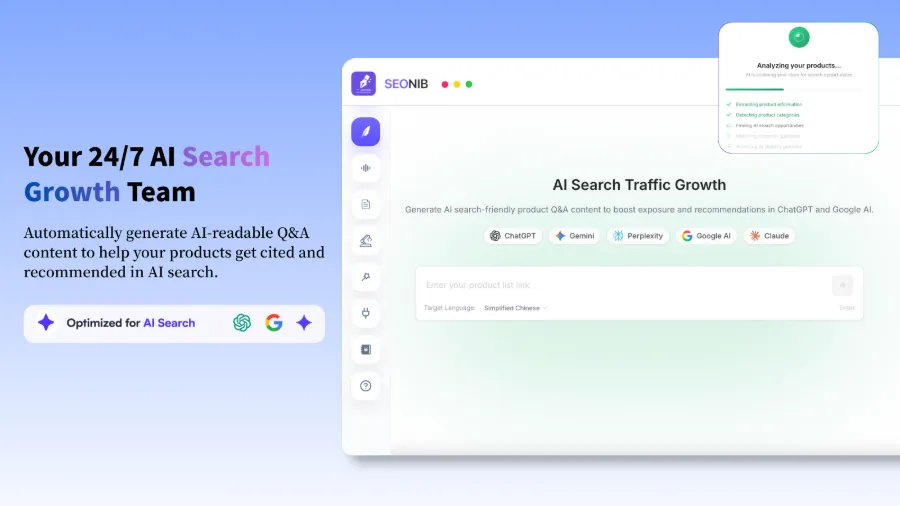
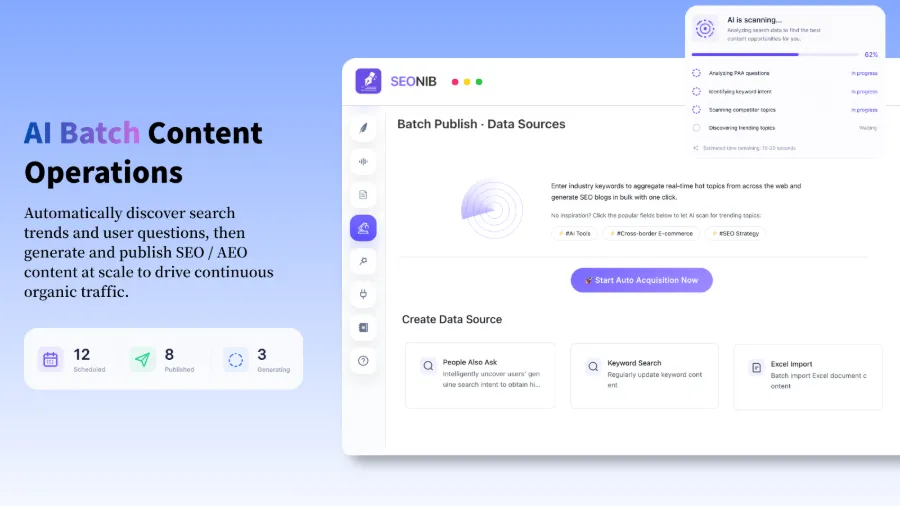
Doing AEO/GEO/AIO manually is exhausting—I used to write three articles a week until I was dead tired, then separately edit FAQs, check Schemas, and update external links. Then I built an automated pipeline, with the core tool being SEONIB. What it does is actually simple: it takes over the whole workflow from trend discovery → content generation → multi‑platform publishing → scheduled execution.
Rough workflow:
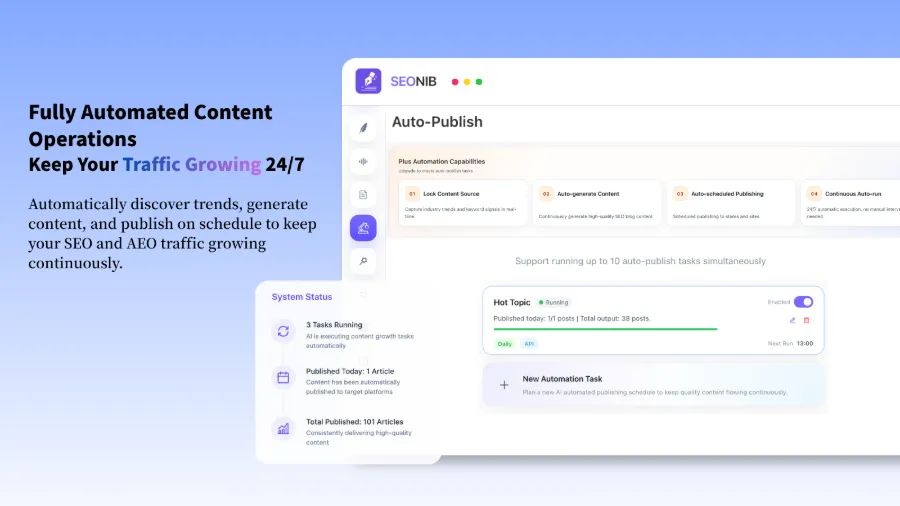
- Every early morning, automatically fetch industry hot topics and competitors’ newly released topics, pushing them into a task pool.
- I pick a few topics, fill in target keywords and brand info, and AI automatically generates articles with FAQPage Schema and embeds brand entity markup.
- Set a publishing schedule (I set one per day); SEONIB’s scheduled publishing saves me 90 % of the time, automatically pushing to Shopify, WordPress, and Medium, and even handling internal linking.
- Run a full‑platform content audit once a month to see which pages are most cited by AI, then adjust the next round’s strategy.
If you want to connect WordPress yourself, see the tutorial How to Connect a WordPress Site to SEONIB. Also, when you first start an independent site, don’t rush to cover big platforms; first validate your idea with a Simple Website Quick‑Validate Project to see if there’s demand, then scale up content.
The transition from manual to automated wasn’t smooth—Schema tags were wrong the first month, causing AEO to fail and wasting two weeks. After fixing, by the third month Perplexity showed my brand appearing 2–3 times per week, and AI‑driven traffic accounted for 12 % of total traffic.
FAQ
Q1: Which should I do first—AEO, GEO, or AIO?
Start with AEO because it’s the most direct—fix the opening paragraph and FAQ page, and you’ll see feedback in Google AIO within a week. GEO requires more external links and brand consistency, so start it in the second month. AIO depends on cross‑platform coverage and a knowledge base, so it’s a continuous effort.
Q2: I don’t have a website—can I still optimize for AI search?
Yes. AEO and GEO mainly rely on content being crawled by AI; you can publish content on Medium, LinkedIn, etc., and submit updates via IndexNow. Having a website is better, but not essential at the early stage.
Q3: Are these optimizations useful for B2B independent sites?
Very useful. B2B buyers tend to use ChatGPT, Perplexity for early research. If your product pages and case studies are cited by AI as “recommended solutions,” the sales cycle can shorten by over 30 %. After improving AEO, my own B2B inquiry volume increased by 25 % in two months.
Q4: How long after optimization can I see results?
AEO usually appears in Google AIO within 1–2 weeks. GEO needs 2–3 months because AI must accumulate enough brand citations to recommend. AIO is slower, 3–6 months, but once the brand entity is established, the effect is stable and lasting.
Q5: Do I need to know code to do this?
No. Structured data can be generated with Schema.org generators or CMS plugins that automatically add them. If you use automation tools, they come with built‑in Schema and brand markup configurations—just click a few buttons. I knew nothing about code six months ago and now run the entire workflow.
Share Article