From Keywords to Conversational Insights: Five Practical GEO Tips to Make Your Brand Stand Out in AI Search
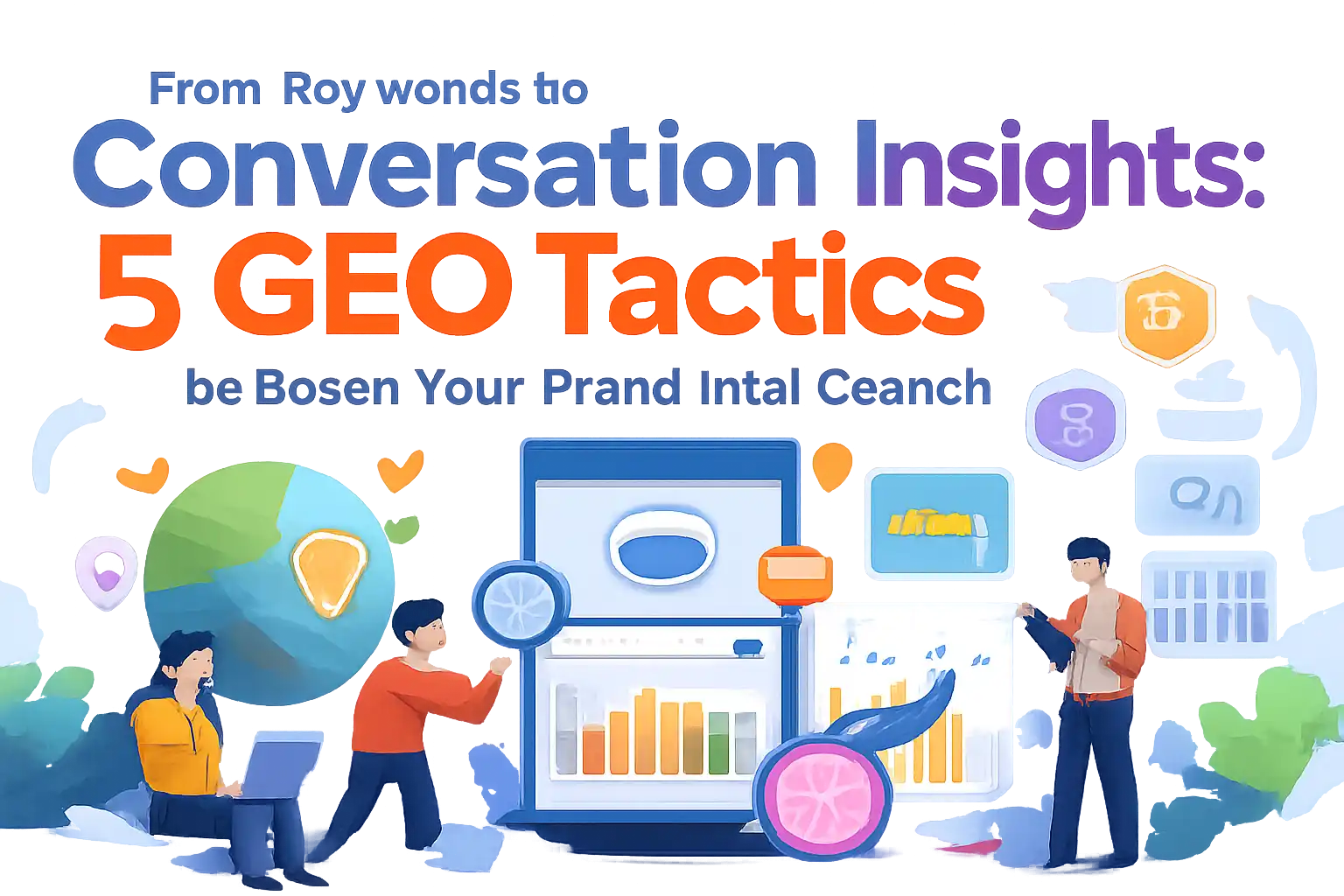
Are you still staring at search volume, stacking keywords, hoping a single “10 SEO Tips” article will get ChatGPT to mention you? Wake up—AI search doesn’t work that way at I spent three months obsessively optimizing long‑tail keywords, refreshing Google Keyword Planner daily. The result? When I tossed my brand name into GPT‑4 and asked “any recommended blog tools,” it didn’t mention it at all. Then I changed tactics—listening to sales recordings, pulling YouTube subtitles, reading real questions on Reddit. After three months, my brand was mentioned in AI search for the first time. The change didn’t come from “optimization”; it started with understanding conversations. I talked to five practitioners who are testing GEO (Generative Engine Optimization) on the front lines, and their answers made it clear: prompts are five times longer than keywords, and the real traffic lives in your sales recordings and YouTube subtitles. The five suggestions below come straight from practice—no mysticism, only repeatable actions.
Keywords Are Dead, Prompts Are King—Extract Real Intent From Conversations
I used to refresh Google Keyword Planner daily, thinking “SEO tool recommendations” had high monthly volume and writing articles around it. Then I realized users weren’t asking “SEO tool recommendations” at all; they were asking “Is there a blog tool that can automatically sync with Shopify?” The former is a keyword, the latter a prompt—at least five times longer.
Traditional keyword search can’t match the context of AI users. A person opens ChatGPT and types “My Shopify store sells pet supplies, I want to write a blog but have no time—what should I do,” not a short, snappy query. So Kevin’s advice is spot‑on: collect real conversations. Sales call transcripts, customer support chats, Reddit posts, email threads—feed these texts into an LLM and ask “What are customers really worried about?” “What words do they use to describe pain points?”
I tried this method. I fed transcripts of over thirty of our team’s sales calls into GPT and asked it to generate topic clusters. It uncovered a demand we had never seen in any keyword tool: “How to turn after‑sales FAQs into blog posts.” That quarter we produced five articles around that theme, and three months later our brand appeared in AI search results for the first time.
If you don’t have existing sales data, spend a week lurking on relevant Reddit subreddits or review your site’s live‑chat logs—those are full of live prompts. To systematically track and distill industry hot topics, see this Industry Hot Topics Blog Writing Guide and turn conversational insights into actionable article ideas.
YouTube Is Not the “Video Platform” You Think—It’s a Fuel Reservoir for AI Search
Louise just published a new study showing that the number of YouTube mentions is the strongest correlate of AI visibility, followed closely by YouTube impressions. That sounds counter‑intuitive—how does a video platform affect text‑based AI replies? Because OpenAI trained on over a million hours of YouTube subtitles. The AI model treats YouTube as a massive natural‑language corpus.
I tested it: I took a product tutorial we had recorded, fed the video directly into an AI tool, and turned it into a blog post. A few weeks later, someone asked about that feature in ChatGPT, and the AI’s answer quoted a sentence from that blog, whose core information originally came from the video script. The two‑way exposure happened automatically.
Now I convert every YouTube video’s script into both a blog post and an FAQ. SEONIB’s “Social to Blog” feature does exactly that, saving me the manual subtitle‑scraping and copy‑pasting step. If you haven’t turned your video content into text yet, start now—the sooner, the better.
Getting Listed Still Works—At Least For Now
Kevin says honestly, “It’s important now, but we don’t know how long it will last.”
Listicles have a visibly short‑term impact in AI search. When ChatGPT recommends tools, it often cites rankings from list articles. I saw a brand’s mention rate in AI search triple simply because it appeared on a third‑party “Top 10 AI Tools” list.
But there’s a side effect: you can’t control which lists you get written into, nor guarantee you’ll stay on them forever. Moreover, more teams are courting influencers to push their products, and list rankings are quickly becoming like traditional SEO backlinks—anyone can buy them, eroding their “authority signal” value.
Fairly speaking, actively creating high‑quality content, engaging communities, and getting reputable bloggers to feature you remain among the highest‑ROI actions. To see which AI content‑marketing tools are worth watching, check out this 2026 Top AI Content Marketing Tools List, but don’t blindly trust every ranking.
Don’t Only Focus on Google—The Underlying Logic of Multi‑Platform Exposure
Many assume AI search only pulls data from Google. In reality, ChatGPT, Perplexity, and other AI engines ingest massive amounts of content from Reddit, Amazon, YouTube, TikTok, and even Instagram. Research shows that 73 % of modern “search” happens outside Google. You may rank first on Google, but if users go to TikTok for answers, you’re still invisible.
The core of multi‑platform exposure isn’t “posting everywhere,” it’s getting your brand genuinely discussed on UGC platforms and communities. A professional Reddit answer, a detailed product review video, an Amazon review turned into a blog—these pieces stack up and gradually shape the AI model’s judgment of your “social signal.” The more your brand is discussed, the easier AI will treat it as a trustworthy source.
I tried a simple approach: set up a monitoring alert that collects every Reddit, YouTube, and product‑forum post mentioning our brand. Those pieces later became the most reliable source for my blog ideas. If tracking hot topics feels overwhelming, this Cross‑Platform Topic Discovery Practice offers plenty of practical ideas.
Let AI Run Your Content Pipeline—From Trend Discovery to Auto‑Publishing
Manually updating content can never keep up with AI search engines’ timeliness demands. You write a hot‑topic analysis today, but by the time you schedule, add images, and publish on third‑party platforms, the topic’s heat may already be fading.
I used SEONIB to automatically discover trends, generate articles, and schedule publishing—no need to open the website backend all day. Its pipeline has four steps: real‑time monitoring of industry hot topics → generate article ideas → input any source (keyword, product link, even a social‑media post) to produce an SEO article → set a publishing calendar that AI executes → simultaneous publishing across all platforms. The diagram below shows the complete automated workflow:
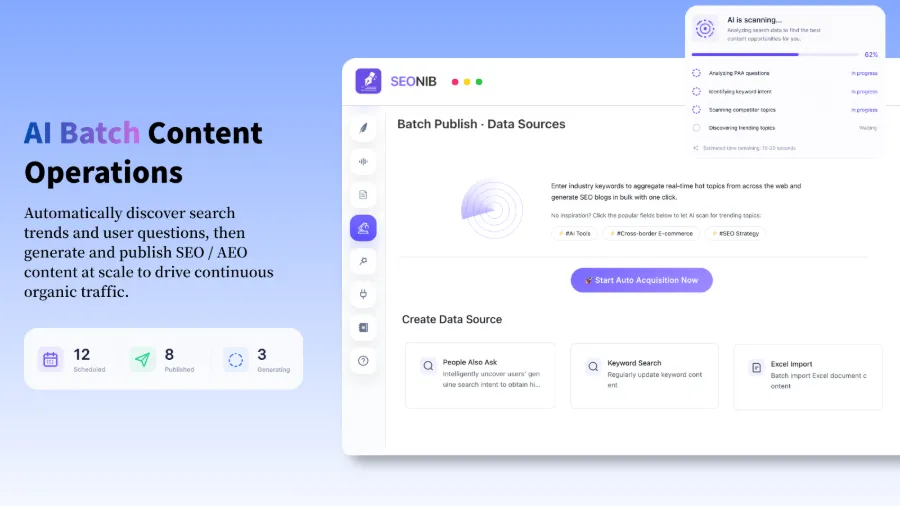
What used to be 7–8 hours each week of manual content handling is now zero. Consistent daily updates are indeed building topical authority—after 30 days of continuous publishing, Google Search Console showed query impressions rise from 47 to over 220. If you’re also struggling with daily content production on an independent site, this Daily Automated SEO Content Publishing Guide for Independent Sites records a process that matches my actual workflow.
It even supports a one‑click conversion of product links into blog posts without extra prompts—the feature originated from a CSDN post, Turn Product Pages into Blogs with One Click Using SEONIB. I tried it and it really saved effort.
If you want to try it yourself, start with the SEONIB Help Documentation. The tool isn’t complex; just connect your data sources and it runs.
FAQ
What’s the difference between GEO and traditional SEO?
GEO targets AI‑generated summaries and conversational replies; SEO targets traditional search‑engine result pages. SEO’s core is keyword rankings and backlinks; GEO’s core is how often AI models mention your brand and the breadth of topic coverage. The former looks at first‑page positions; the latter looks at whether ChatGPT mentions you.
Which platforms does AI search mainly reference now?
YouTube subtitles are the strongest current factor, followed by Reddit, Amazon, and other UGC platforms. Open‑web blogs and news are still heavily cited. Google AI Overviews rely more on high‑authority pages indexed by Google.
Can you do GEO without a website?
Yes. The frequency of discussions about your brand on YouTube, Amazon, Reddit, etc., already influences AI’s perception of your brand. However, for more stable results, having a website to accumulate entity, FAQ, and brand‑knowledge content is still advisable.
Should I prioritize optimizing Google or ChatGPT?
They don’t conflict. Traditional Google SEO actions (structured data, high‑quality blogs, authoritative links) are also referenced by ChatGPT models. It’s recommended to first secure Google visibility, then populate YouTube and UGC platforms, running both tracks in parallel.
Small team with limited budget—what’s the fastest‑acting GEO action?
Extract existing customer support chats and after‑sales emails, turn them into an FAQ page on your site. Then take a YouTube product video, convert its subtitles into a blog post and publish it. These two steps require no extra spending but are highly likely to trigger an initial AI‑search mention of your brand.
Share Article