Let ChatGPT Help You Sell: Survival Guide for Independent Sites under the 2026 AEO Trend
At the beginning of 2025 I stared at Google Search Console—an SEO article that took two weeks to write, was carefully illustrated, and had backlinks built, had only 40 clicks in three months. 40 clicks. The neighboring independent site selling a similar product had its product images appear in ChatGPT’s recommended replies. I searched my own brand name, and ChatGPT said “No relevant information.” At that moment I realized it wasn’t SEO that died; the rules for traffic distribution had changed. This is called AEO, AI Engine Optimization. This article is the practical thinking I summarized after hitting the potholes.
AEO, simply put, is making your content recognizable, trusted, and directly recommended by AI search engines to users who ask questions. The trend will only accelerate in 2026. I spent over half a year trial‑and‑error and organized my experience into the sections below.
Why the old SEO tricks are no longer effective in 2026?
Traditional SEO logic is: the higher you rank, the higher the probability a user clicks. But AI search doesn’t give you a list—ChatGPT Search, Perplexity, Google AI Overviews generate a single answer and place it at the top. Users read it and leave, never scrolling down.
Industry estimates say that for some product categories, AI search already diverts 20‑30% of traditional search traffic. My own experience is more direct—an article that got several hundred monthly visits in early 2024 dropped to double‑digit visits in early 2025 with the same effort. Traffic isn’t gone; it’s been hijacked by AI.
The core goal of AEO isn’t ranking; it’s getting the AI model to recognize your content entity and brand. In other words, when AI answers a user’s question, it considers your product information reliable and worth citing. This can’t be solved by keyword stuffing.
Buyers have changed: they no longer “search,” they start “asking”
The shift in user search behavior is the fundamental cause. Previously people opened Google and typed “Bluetooth speaker suitable for camping,” then clicked a ranking result. Now more people open ChatGPT and ask “Help me recommend a long‑battery‑life outdoor Bluetooth speaker”—the question is more specific, the intent clearer, and the required content format is completely different.
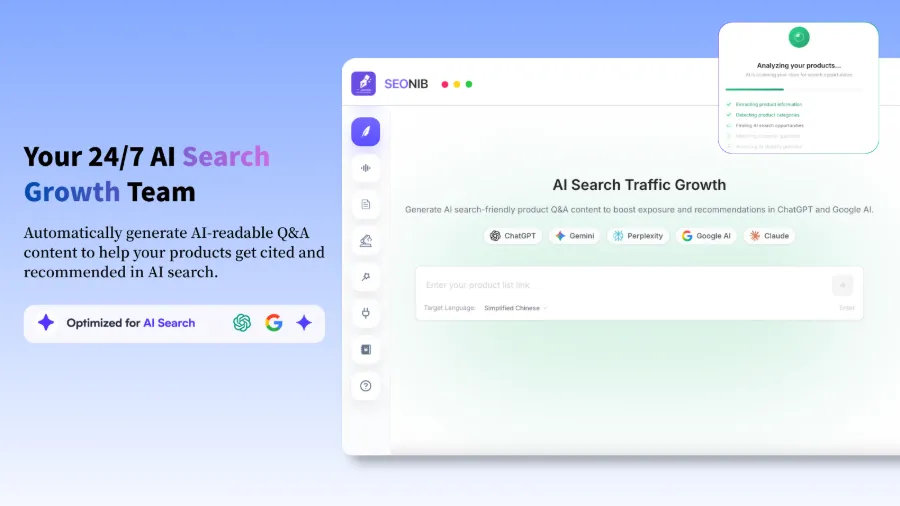
What I observed: AI likes FAQ, Q&A, structured answer formats. Break your product information into “Why is this speaker’s waterproof rating IPX7?” “How long does the battery last?” “What are the advantages compared to competitors?”—the finer the question, the easier AI can capture and cite it. The content isn’t harder; the content shape has changed.
A striking data point: 73% of modern “search” happens outside Google. This comes from an industry analysis video that explains users now make decisions on ChatGPT, TikTok, Reddit, Amazon, etc., with Google being just one of the sites. If you only focus on Google rankings, you’re abandoning the vast majority of decision‑making scenarios.
Practical: How to get ChatGPT to recommend my product to users?
Theory is abstract; let’s talk about the workflow I discovered after stumbling.
Step 1: Identify which keywords are suitable for AEO. Not every term is worth it. Long‑tail, question‑type keywords—“how to choose,” “how to judge,” “vs difference”—have high conversion and AI likes them. I searched competitor product names + “drawbacks” + “alternatives” and found AI would list them directly, while my product was never mentioned.
Step 2: Convert product links into an FAQ Q&A matrix. This is the most critical step. You don’t need to rewrite all content; just break your product information into a format AI can understand—structured questions and answers, entity descriptions, comparison tables. I tried a tool called SEONIB that directly turns my product link into a set of Q&A for ChatGPT, saving me from hiring freelancers. I invested a month and generated 200+ Q&A pages for the same product.
Result? Three weeks later, when I asked ChatGPT about my category, my product name appeared in the reply for the first time. That feeling was even better than ranking first.
| Traditional Approach | AEO Approach |
|---|---|
| Keyword research | Question‑type demand research |
| Long‑form article | FAQ + structured Q&A |
| Single‑site publishing | Multi‑platform sync |
| Manual updates, irregular frequency | Automated scheduling + continuous output |
| Reliance on search engine clicks | Direct AI recommendation |
Step 3: Automated internal and external linking strategy. AEO content needs an internal knowledge system to support it—each article points to product pages, FAQ interlinks, entity associations. I used the method described in the Batch Publishing and Data Source Setup Guide to turn the internal linking strategy into rules that AI executes automatically, saving manual checks.
Step 4: Keep a publishing cadence so AI continuously crawls you. Content update frequency is key for AI to judge site activity. I used to publish one article a month; after AEO I publish 3‑5 Q&A items daily. For how AI auto‑generates content rhythm, see this AI‑driven trending‑topic creation log, which discusses the same issue.
Specific scheduling and publishing configurations can be found in the SEONIB Help Documentation; I won’t elaborate here.
Don’t wait for AI to remember you—feed it your content first
This was my biggest mistake. I initially thought a batch of AEO content would be enough. Two months later, AI started recommending competitor information again.
AI crawlers tend to trust sites that are regularly updated and have an internal knowledge system. You can’t treat it as a one‑off. My current solution is to publish 3‑5 structured pieces daily—not pure blogs, but a mix of FAQs, comparisons, buyer guides. AI needs a steady stream of your content to build “trust” in your brand entity.
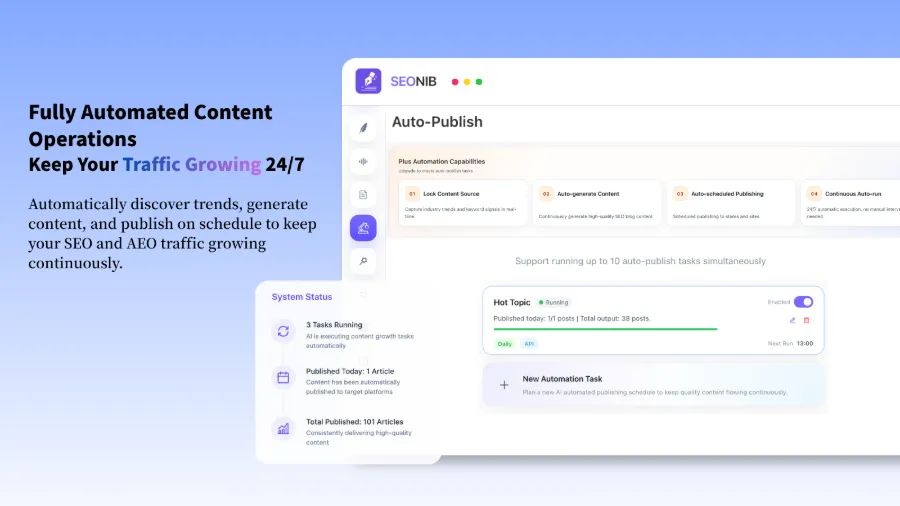
You can’t write every day, but AI can. After I set the schedule, it runs overnight and I check the data during the day. Currently I generate and publish automatically on Monday, Wednesday, and Friday. Sources can be industry articles or video links; I followed the method in How to Turn Reference Links into Blog Posts to convert competitor YouTube videos into text and publish on my site, and AI‑generated content is captured without error.
For turning product links directly into content sources, see this note on One‑Click Conversion of Product Links to SEO Blogs. The idea is similar; I just automate it now.
After three months, my brand entity knowledge base is basically formed. Now when ChatGPT searches questions related to my category, my information appears at least ten times more often than at the start.
Product Sync: Don’t just blog; turn every product page into a Q&A entry
AEO isn’t limited to blogs. Product detail pages themselves are the best AEO content carriers. Another pitfall I hit was focusing only on blogs and neglecting product page optimization.
The correct approach is to turn each product page into a Q&A entry. I sell a thermos cup on Shopify; originally the product page was just specs + a few images. I broke down selling points, user reviews, usage scenarios into entities, turning them into questions like “Is this thermos suitable for commuting?” “Is the lid material safe?” “How does its heat retention compare to competitors?”—each question gets its own page.
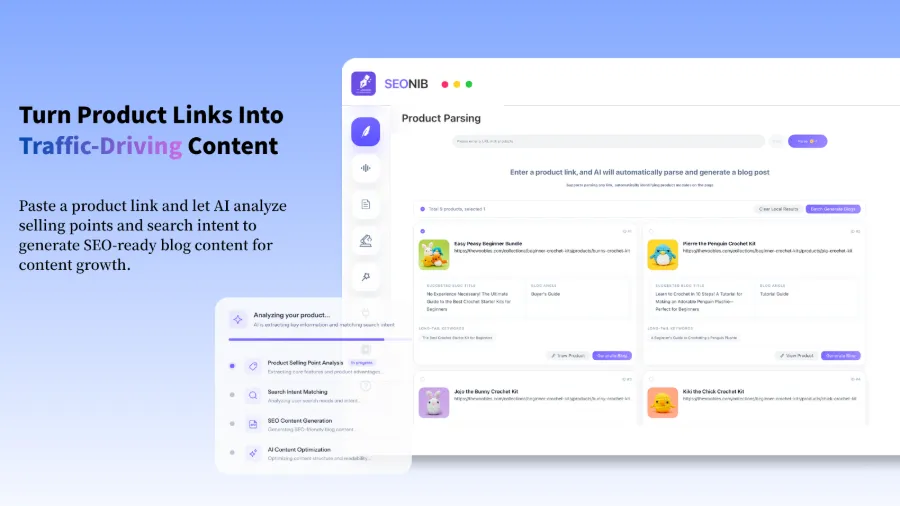
Using this thermos as an example, I generated one Q&A page + one buyer guide, and AI relevance noticeably improved. The product was completely invisible in AI search before; now searching “winter‑friendly thermos recommendation” puts my link as the third result.
After connecting Shopify, SEONIB automatically feeds product info to AI, so I don’t have to write any content myself. The sync process can follow the steps in How to Connect a Shopify Site to SEONIB. It’s the same for Webflow, WordPress, etc.—the more structured the product information, the easier AI can associate your brand with user questions.
FAQ
Q1: Does AEO conflict with SEO? Do I need to stop SEO?
No. My current practice is to keep the basic SEO content (blogs, long‑form articles) while launching a separate AEO line (FAQ + structured Q&A). They complement each other, not conflict. SEO captures traditional search traffic; AEO gets AI recommendations. Running both in parallel yields the best results.
Q2: Can a single batch of AEO content continuously generate traffic? Does it need maintenance?
No. After the first 200 Q&A pages, the first two months performed well, but the third month started to decline. AI models keep updating and prefer recently fed content. I now update 20‑30 Q&A items weekly to stay visible in AI search results.
Q3: I only have a few products—does AEO still make sense?
Actually, it’s ideal. I started with only 5 SKUs, breaking each product into 20‑30 detailed questions, and the content library grew quickly. Fewer products let you perfect every detail, which AI loves—clear entities increase recommendation probability.
Q4: How do I know if my product is suitable for AEO?
Open ChatGPT or Perplexity and search “your product keyword + recommendation” or “your product keyword + vs competitor”. If the AI reply contains no mention of your brand, you have optimization space. If it mentions competitors but not you, your competitors are already doing AEO.
Q5: I have no technical background—can I build an AEO workflow myself?
Yes. The core is three steps: connect your product to a content tool, set internal linking rules, and enable automated scheduling. I had zero coding experience; from zero to the first Q&A matrix live took less than two days. The technical barrier is far lower than traditional SEO.
Share Article