
Subscriptions, AI Licensing, Exclusive Data: Who Will Survive the Battle for the Moat in the Content Ecosystem?
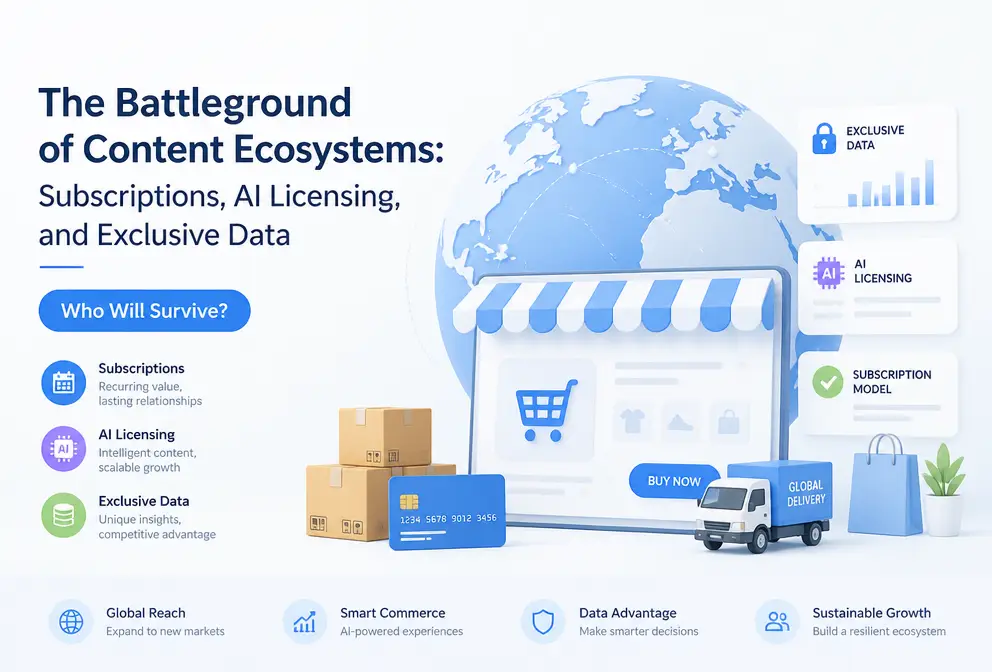
After 2024, a phenomenon that had rarely been discussed together emerged in the content industry: while subscription revenue growth slowed, legal departments started appearing frequently in meeting rooms, and the negotiation counterpart shifted from advertisers to AI companies. Meanwhile, platforms that hold exclusive data captured most of the traffic in AI search, with almost no marketing budget.
This is not an abstract strategic topic. For a content team, it directly determines where to allocate resources next quarter: continue optimizing the paywall, sign a licensing agreement, or focus on data that others cannot obtain. Each of the three models has its own structural strengths and weaknesses, and none is a naturally given answer.
Why the Moat Battle Suddenly Erupted in the Content Ecosystem
In the past year, subscriptions, AI licensing, and exclusive data have all become keywords for content platforms, driven by a single cause: AI search has reshaped traffic allocation. Content has shifted from a “consumer good” to a “training material,” and platforms’ roles have evolved from sole content producers to dual identities supplying content to both humans and machines.
OpenAI’s licensing agreement with Reddit reportedly reached tens of millions of dollars per year, and its partnership with News Corp is said to span five years with a value in the hundreds of millions. Anthropic and Google are also signing deals intensively. These figures make “content licensing” appear to be a good business, but its sustainability depends on whether the content retains value after training.
Assessing a moat uses three universal criteria: sustainability, defensibility, and cost structure. Applying these three standards to the three models reveals clear differences:
| Model | Revenue Predictability | Content Value Decay Speed | Entry Barrier | Main Risks |
|---|---|---|---|---|
| Subscription Model | High, predictable monthly/yearly | Slow, existing content continues serving readers | Medium, requires brand and trust building | Market size limited, growth peaks |
| AI Licensing Model | Low, one‑time or short‑term contracts | Fast, value drops sharply after training | Low, depends on negotiation leverage | Licensing fees are fluid; data supply is the stable part |
| Exclusive Data Model | Medium, relies on ongoing operation | Slow, structured data accumulates over time | High, requires unique data sources | Pressure from data scale and update costs |
This section only sets the standards, without conclusions. The real issue is that players of different sizes and stages find themselves in completely different positions across these three models.
Subscription Model: Stable Cash Flow, Underestimated Growth Ceiling
Subscriptions were the first moat built by content platforms. Their advantage is straightforward: predictable revenue and high marginal profit from retained users. The New York Times’ subscription revenue share has long surpassed its ad revenue, and the Wall Street Journal also relies on a similar model. Substack and The Information demonstrate that even small‑scale creators can sustain themselves through subscriptions.
However, the structural ceiling of subscriptions has been underestimated. The total market size is limited, and the willingness to pay is continually squeezed by the habit of free information. The slowing growth of NYT subscriptions year over year is a well‑known discussion, and the marginal effect of paywall strategies is diminishing. More problematic is that the user behavior data accumulated from subscriptions is rarely fed back into content production—most teams still rely on editorial experience to choose topics.
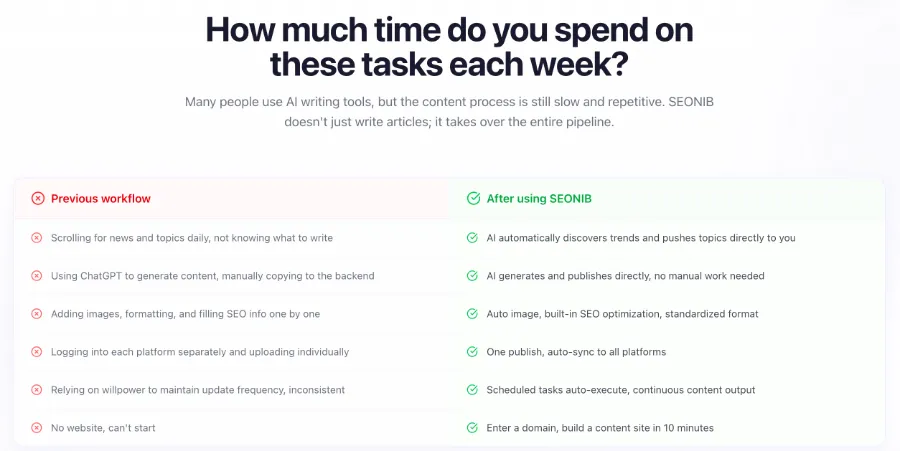
Subscriptions and AI licensing actually have a mutually supportive relationship: subscriptions prove that content has paid value, which serves as a bargaining chip in licensing negotiations; licensing revenue, in turn, subsidizes the ongoing production of original content. The problem is that if licensing revenue is one‑time and subscription growth has peaked, this loop breaks. For small and medium teams, subscriptions are more of a safety‑net cash flow than a growth answer. To gauge your site’s true position on the search side, you can compare it against the metrics in the 2026 mainstream page SEO analysis tools.
AI Licensing: One‑Time Transaction or Sustainable Revenue?
Licensing models operate in two ways: a one‑time licensing fee or ongoing revenue sharing. The former is more common for content platforms, but the issue lies here—after training, the commercial value of the content quickly diminishes.
The licensing agreement between Stack Overflow and OpenAI is said to be in the tens of millions of dollars, while its community data continues to grow. This shows that the real negotiation leverage is not “I have a batch of content” but “my data source keeps generating new data.” Wikimedia and the Associated Press have similar licensing logic: only continuously updated structured data qualifies for long‑term contracts.
This section clarifies a typical conflict. Between 2024 and 2025, some content platforms that signed AI licensing found themselves in a dilemma: original content was directly quoted by AI search, reducing their own search click volume, while licensing revenue was one‑time and did not create a new content production engine, instead eroding the value of the original channel. Licensing fees are fluid; data supply is stable—this means in practice that before signing, you must consider: after training, does the other party still need you?
Another overlooked issue is content substitutability. If the licensed content is generic information, AI companies can replace it with other sources; only exclusive, structured, continuously updated data has an advantage in negotiations. That is why many platforms are re‑evaluating and, instead of a one‑time sell‑off, turning data into a continuously supplied service. For content teams with a single traffic source, this mindset also applies—see the SEO approach that no longer relies solely on Google and distribute content to multiple entry points covered by AI search.
Exclusive Data: A True Moat or a Constructed Concept?
Exclusive data is repeatedly mentioned because it meets all three moat criteria: sustainability, defensibility, and controllable cost structure. Its value lies in feeding back into training, forming an entity‑relationship network—AI search (e.g., Perplexity, Google AI Overviews) tends to cite data sources with clear, structured entity relationships when answering questions.
The criteria for whether data forms a barrier are clear: scarcity, degree of structuring, and update frequency. All three are required. Scarce but scattered data has limited value; structured but never updated data is quickly replaced; frequently updated data that everyone has does not form a barrier. Knowledge bases, brand context, and user‑generated content are the three most common sources of accumulated data assets.
For small and medium players without large‑scale exclusive data, there is a path to build a local advantage: set up a brand knowledge base so that every piece of AI‑generated content includes brand entities and product context. This workflow is not complicated in practice—configure brand voice, industry terminology, and product information, then have content production revolve around these fixed entities rather than starting from scratch each time.
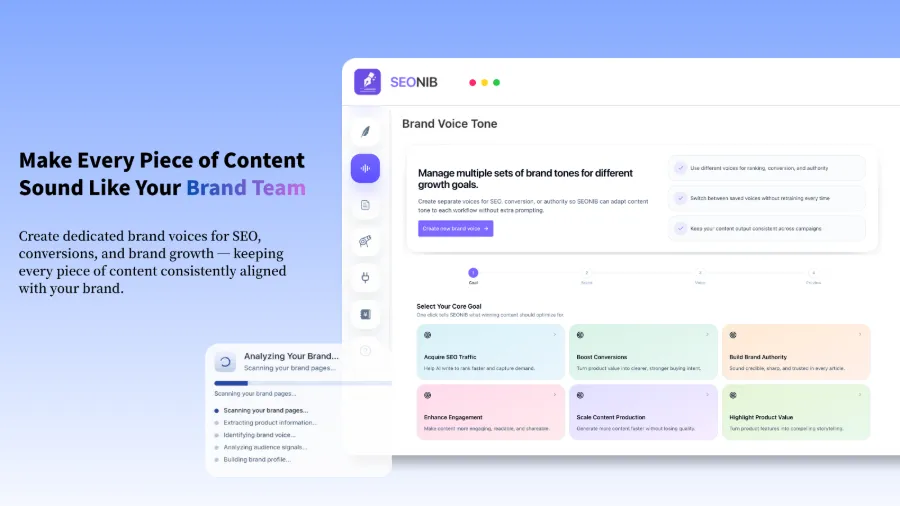
This is precisely where tools like SEONIB intervene: turning brand context and knowledge base configuration into a pre‑step for content production, rather than an after‑the‑fact patch. Structured, continuously updated domain data is far more defensible than one‑time licensed content—this is the core dividing line for assessing moat value. For small teams without exclusive rights, layering a knowledge base with ongoing output builds a modest yet real data asset. To learn traffic paths that don’t rely on ad budgets, see several ways to acquire organic traffic without ads.
Cross‑Border E‑Commerce Content Ecosystem: Whose Moat Can Actually Be Implemented
Applying moat logic to cross‑border standalone sites makes the issue concrete. Merchants on Shopify, WordPress, and SHOPLINE lack Reddit‑style community data and News Corp‑style brand barriers; their moat can only come from operational depth.
Content automation here does more than save labor; it makes “continuous output” possible. Sites that regularly update content accumulate topical authority more easily than those that publish a large batch once—this is a signal favored by both traditional and AI search. Merchants who embed product data and brand knowledge bases into their data assets, combined with a fixed publishing frequency, are building a modest yet real moat.
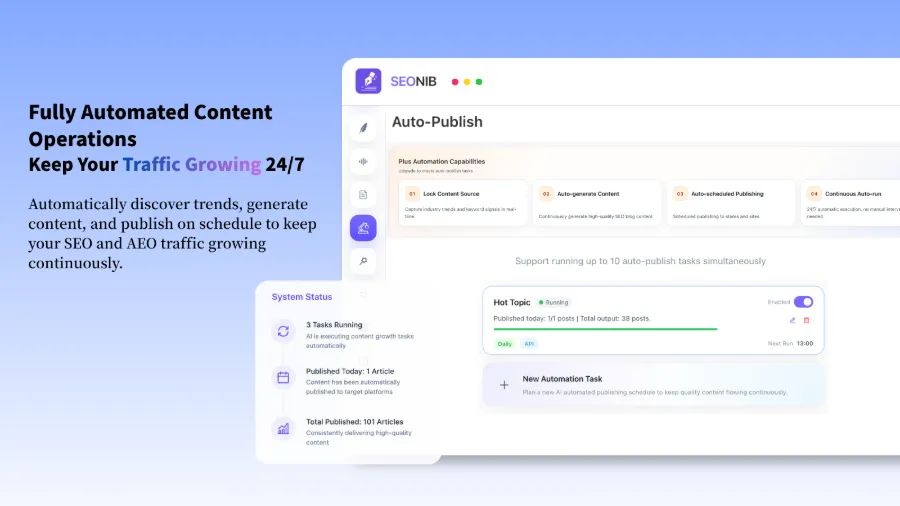
The practical workflow is not complex: set a publishing frequency, and content is automatically generated and synchronized to the store according to schedule. Tools like SEONIB turn “topic discovery, content generation, scheduled publishing, multi‑platform sync” into an automated pipeline; merchants only need to configure brand context and product knowledge base upfront. A full demonstration of this workflow can be seen in the video below:
For small merchants without a dedicated SEO team, the moat is not platform‑scale size but the layering of operational depth: the more complete the knowledge base, the more consistent the content; the more consistent the content, the clearer the entity relationships; the clearer the entity relationships, the higher the visibility in AI search. This is a snowball process, but the starting point is low—just a domain name and a continuously running publishing mechanism. For configuration details, refer to SEONIB’s help documentation.
FAQ
Why is exclusive data considered a deeper moat than subscriptions and licensing?
Because exclusive data meets all three standards: sustainability, defensibility, and controllable cost structure. Subscription revenue peaks as the market size caps, licensing revenue declines after training, while continuously updated structured data accumulates, forming an entity‑relationship network that is hard for others to replicate.
Is there a risk when a content platform licenses its content to multiple AI companies simultaneously?
Yes. The risk is not the licensing itself, but that the value of the original channel is diluted after licensing—AI search directly quotes the content, and users no longer click the original site. If the license is one‑time and the data supply does not generate ongoing revenue, the loss of traffic to the original channel is not compensated.
How can independent sites or small teams without exclusive rights build their own content moat?
By layering a knowledge base with ongoing content output. Configure brand context, product information, and industry terminology as fixed data assets, then publish content at a stable frequency to accumulate topical authority. This moat is modest in scale but real, and it grows over time.
Share Article