In the AI Search Era, Why Is My Website Getting More Visitors?

I recently attended a closed‑door meeting where everyone was a veteran in the content marketing field. After two rounds of coffee, someone threw out a statistic: over 60% of Google searches now generate no clicks. Users read the AI summary on the results page and leave without ever clicking into a site. You spent a week writing a blog, and a single AI sentence answered it for you, driving your traffic to zero. This isn’t a future trend—it’s already happening. But I found that instead of getting anxious, we should change our posture: don’t fight the trend, just ride along and pull traffic out of AI’s pocket.
What Is Zero‑Click Marketing? Your Content Is Being “Freed”
Zero‑click marketing doesn’t mean you should produce less content; it means your content “closes the deal” directly within the AI summary. When a user searches a question on Google, the top AI Overview provides the answer; when they ask ChatGPT “recommend a few website‑building tools,” ChatGPT reads out your brand name; when they finish watching your video on YouTube, the embedded CTA completes the conversion—users never leave the platform.
Is this “free riding”? It’s a bit of that. But think of it another way: if your content appears in the AI summary, you occupy an unignorable ad slot on the results page. Goldman Sachs predicts the YouTube creator economy will double by 2027, showing that this ecosystem is far from saturated.
Traditional content marketing relies on “external link traffic—getting users to click into a site,” whereas the zero‑click model requires you to deliver content and answers directly to the user, establishing trust right in the search box. To truly understand this shift, check out this analysis on how to get your content cited by AI answer engines, which details the citation logic for Google and ChatGPT.
My own approach is simple: stop spending energy chasing click‑through rates and invest in “making AI think you’re worth citing.” This isn’t a zero‑sum game—users not clicking your site doesn’t mean you’re not getting exposure and conversions.
Content Production in the Old Era: I Was Still Typing, AI Already Answered for Me
In recent years I followed a traditional workflow: manually gathering hot topics, checking Google Trends one by one; then opening the WordPress backend, manually writing articles, adding images, filling SEO metadata; after writing, copying to a Shopify blog and publishing again; finally manually syncing to Medium or other platforms. Each article took at least half a day.
The problem is that as soon as you publish, five minutes later ChatGPT has covered the same query with someone else’s content. Your content hasn’t been indexed yet, and AI has already hijacked it.
Most ironic, this model is a negative feedback loop for the zero‑click trend—the slower you are, the more AI steals your spot. Sometimes you spend three days polishing a deep article, only to find the next day someone used AI tools to generate 20 similar pieces, covering all long‑tail keywords. You can’t even get a sip of the soup.
If you want to check whether your pages are optimized, try this practical guide on auditing SEO. I discovered that 80% of my past articles lacked meta descriptions or had overly long titles, which are exactly the thresholds for AI summary citations.
The bottleneck of the old workflow isn’t writing ability, but the speed of manual tasks. No matter how hard you work alone, you can’t match AI’s per‑minute generation speed and automatic publishing frequency.
My “Automatic Faucet”: From Trend Discovery to Multi‑Platform Publishing All Handed Over to AI
Later I switched to a completely different approach—letting SEONIB take over the entire pipeline. Previously I spent tens of hours per week manually searching trends, writing articles, formatting, publishing, and syncing. Now I just set the keyword scope in the backend, and everything else is automated.
This workflow is divided into four stages, none of which require manual intervention:
- Real‑time trend discovery. SEONIB automatically monitors industry hot topics, competitor content gaps, and keyword search volume changes, pushing me a batch of high‑potential topics daily. I no longer need to browse Google Trends or Reddit for inspiration.
- Automatic content generation. Whether you input a keyword, a product link, a social media post, or extract a theme from a reference link, it can auto‑generate SEO‑optimized articles. Supporting 40 languages, I can even generate Chinese content from English keywords, and vice versa.
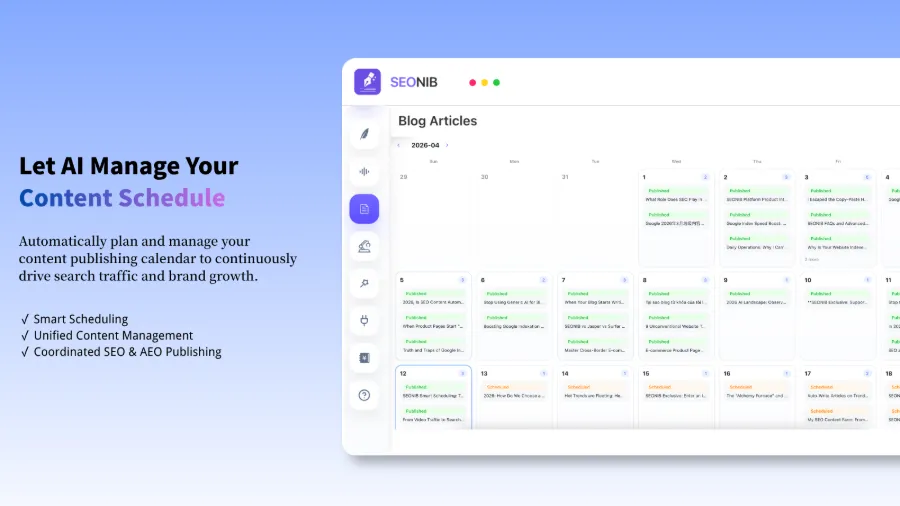
- Scheduled publishing and multi‑platform sync. I just set the publishing frequency on a calendar—daily or twice a week—and the system automatically publishes to Shopify, WordPress, SHOPLINE, Medium, etc., without logging into any backend.
- One publishing action covers all platforms. Previously I had to log into four backends to upload; now I only need to edit once.
This video demonstrates the full process from trend discovery to automatic publishing and multi‑platform sync. After watching, you’ll understand why I call it a “faucet”—turn it on and you don’t have to worry. A friend once wrote an SEO blog about converting product links into sustainable natural traffic with a single click; it follows a similar logic but its automation level is far lower than today’s.
If you’re interested in the specific operational details of each feature, check out the SEONIB help documentation, which breaks down trend monitoring, content generation, scheduled publishing, API integration, and more.
Controversial Strategy: Scraping Others’ Social Media Content into My Blog—Is That Cheating?
This may be the part that makes many people restless. SEONIB has a Social‑to‑Blog feature that can convert videos or posts from YouTube, TikTok, Instagram, LinkedIn, Twitter, etc., into blog articles with a single click. The process is simple: copy a video/post link, and the system automatically extracts the core points and outputs a structured, SEO‑friendly article.
In 2018, some bloggers were penalized by search engines and warned by platforms for copying others’ social media content verbatim into their blogs. The community called this practice “content substitute”—eating someone else’s leftovers without digestion or processing, then serving it as is.
But the nuance is: if you’re not just copying and pasting, but using the topic heat from social media as a hook, and then combining it with your brand voice, industry experience, and product data to create secondary content, the nature is completely different.
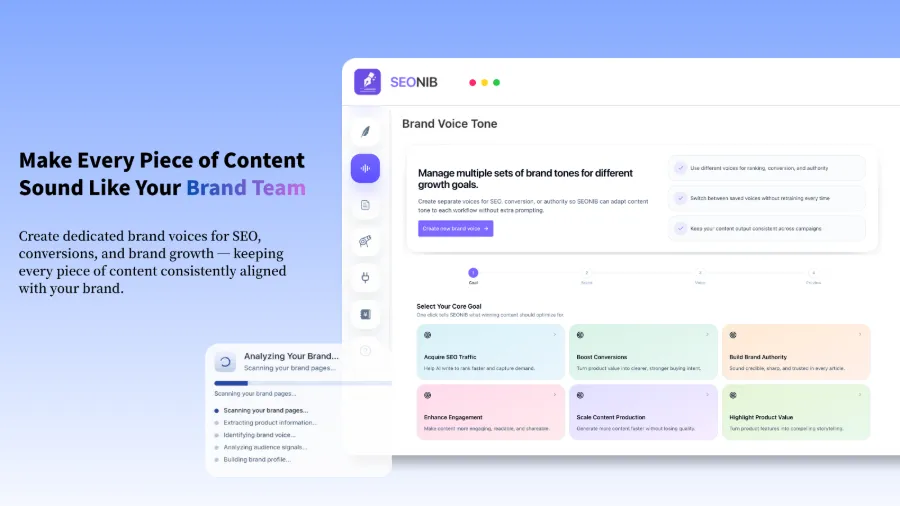
My personal stance is: instead of complaining that others are stealing traffic with this method, just use it yourself, but add brand consistency and secondary creation. After SEONIB receives social media content, it automatically matches it to your predefined brand voice—tone, terminology, product names, internal linking rules—rather than simply translating or rewriting.
There is a content creator’s “cheat sheet”: AI Beats the Trend, which directly shows how to turn a top‑50 YouTube trending video into an SEO article for your blog in 10 minutes, with keyword placement automatically handled.
I also read an interesting viewpoint that brand consistency is the hidden ticket for AI search—no matter how much content you generate, without a unified brand identity, AI search engines will treat you as noise and won’t list you as a trustworthy source.
Conclusion: this strategy indeed sits in a gray area, but if you don’t do it, others will. The key is whether you can distinguish yourself from pure “content thieves”—by adding product context, brand language, and user value, you’re leveraging the trend rather than exploiting it.
FAQ
Will zero‑click marketing make my website lose all traffic?
It won’t drop to zero, but click‑through traffic from traditional SEO will continue to decline. If your content is cited in AI summaries, you’ll still get brand exposure and indirect conversions. The shift is from “getting people to click” to “having AI answer for you.”
Will content automatically generated by SEONIB be penalized by search engines?
As long as the content isn’t pure machine translation or keyword stuffing, search engines won’t specifically penalize AI‑generated material. SEONIB’s output is structurally processed and brand‑matched, usually higher quality than generic AI output. Google has stated that they care about content quality, not the production method.
Does converting social media content into a blog involve infringement?
Directly copying someone else’s original content into your blog is obviously infringement. However, using topics and viewpoints from social media as inspiration, then creating independent, brand‑specific rewrites, falls under fair use. The key is how much of your own unique information—product data, customer insights, industry experience—you add.
I don’t have a website—can I still do zero‑click marketing with SEONIB?
Yes. SEONIB supports a 10‑minute site builder—enter a domain and the system automatically creates a structured content site. You can also publish directly to existing Shopify, WordPress, Medium, etc., without starting from scratch.
Is the controversial strategy worth using?
It depends on your goals. If you aim for long‑term brand trust and authority, treat Social‑to‑Blog as a source of inspiration and a material library rather than direct publishing. If you want rapid traffic validation and market feedback, this method can show results in two to three weeks. The key is to add your brand voice and secondary creation—don’t be a pure content mover.
Share Article