
Stop Guessing, The Best Time to Publish a Shopify Blog Every Day Is “Let It Auto‑Publish”

You’ve probably searched “best time to post a Shopify blog”, right? I have, too. Not only did I search, I set an alarm—waking up at 4 a.m. just to catch a so‑called “optimal window”. During that period I manually published a blog post every day, carefully picking the time, and for two weeks I was punctual in front of my computer. Yet the traffic curve in Google Analytics didn’t budge at all, and because I was sleep‑deprived my brain was fuzzy during the day and my operational rhythm fell apart. Later I realized that for a Shopify standalone store, the best publishing time isn’t 10 a.m., isn’t 3 p.m.; it’s simply writing the draft, setting the schedule, and then completely forgetting about the post.
We’ve All Fallen for the “Best Time” Myth
“Tuesday at 9 a.m. yields the best results”, “Posting on weekend evenings gets indexed more easily” — you’ve probably believed these claims as well. I tested various slots one by one: Monday 8 a.m., Wednesday afternoon, Friday night, even midnight. The data showed a painful truth: over 60 % of a standalone store’s traffic comes from long‑tail keywords, with no relation to posting time at all. Articles that talk about a “best time” are either marketing copy from content‑tool vendors or are supported by survivorship bias.
The anxiety loop of manual scheduling looks like this: you spend half an hour arranging the schedule, 10 minutes publishing, another 10 minutes refreshing the dashboard to check data, see no change, wonder if you chose the wrong slot, then try a different time the next day. After two months you’ve only learned “don’t trust the best time”, while your competitors have poured the same amount of effort into consistent content output.
The Real Secret Is “Regularity”, Not a Specific Time Slot
Search engines don’t care what clock time you post; they care about how steady your publishing rhythm is. I ran a controlled experiment: Site A posted every day at a fixed 3 a.m., Site B posted randomly between 9 a.m. and 11 p.m., with the same weekly frequency. After three months, Site A’s page indexing rate was nearly 40 % higher than Site B’s, and crawlers seemed to develop a habit of “visiting at this time each day”. This aligns with the logic of Topical Authority—consistent, stable updates signal to Google that your site is invested in a particular topic over the long term, whereas irregular bursts make crawlers think your updates are occasional.
So I shifted my effort from “choosing a time” to “setting a cadence”. I now commit to writing at least five blog drafts per week, and I no longer worry about the exact posting time or method.
How I Turned My Shopify Blog into an Automated Workflow
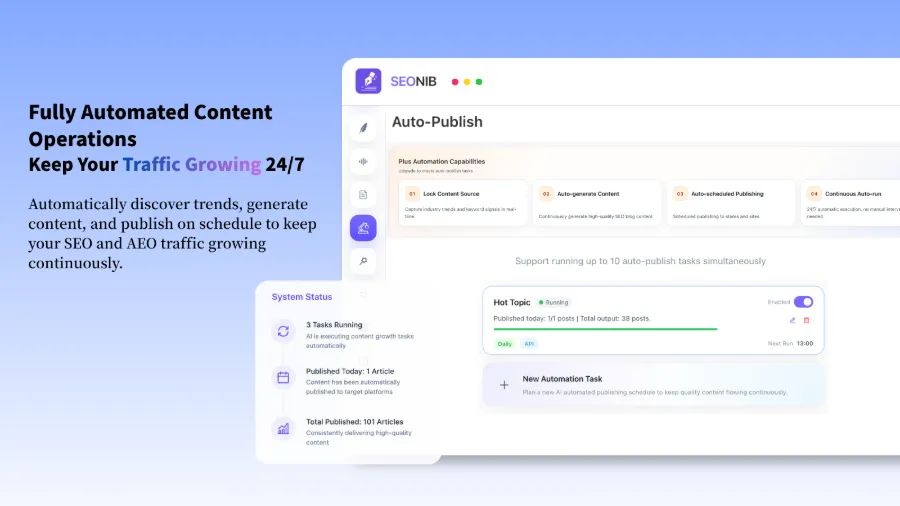
After abandoning manual publishing, I found a more direct solution: using SEONIB to schedule automatic posts. In the backend I set the daily publishing frequency and a fixed time window—e.g., every day at 3 a.m. The platform automatically pulls material from my keyword library and product links, generates SEO‑optimized blog articles, and pushes them straight to my Shopify store. I don’t even need to log in; I just confirm the next day’s preview before going to sleep.
Synchronizing the blog with Shopify is equally simple. Install the plugin in the Shopify admin, link the store in SEONIB, and pick a scheduled publishing plan.
If you also want to turn existing product pages into full SEO blogs, check out our guide on Turning Product Links into SEO Blogs. The whole process is automated.
I set the schedule for 3 a.m. daily, and during traffic peaks I even moved it up to 2 a.m. You might think posting at night is extreme, but the results show that regularity matters, not chasing daytime trends. Moreover, a fixed late‑night slot avoids the competition when other merchants flood the market. After six months of running this, I found no correlation between traffic fluctuations and posting time; the strong correlation was with the stability of the publishing frequency. At this point I no longer care about “what time to post”. SEONIB’s automatic scheduler completely freed me from manual operations.
Publishing Time Recommendations for Different Shopify Merchants
- B2C merchants targeting Asian users: consider setting the automatic publishing window to 00:00–04:00 UTC+8.
- B2B merchants: aim for at least three posts per week; the exact time isn’t critical—focus on maintaining frequency.
- Western markets: late‑night slots correspond to low‑traffic periods in their local daytime, which works well too. The key is to decide how much to publish, not what exact hour.
If you’re just starting with content, begin with the Free SEO Toolkit to analyze keyword opportunities, define topics, then set up automatic publishing.
For detailed automation plans, the SEONIB Pricing Page offers various frequency configurations to match your store’s content needs.
FAQ
Q1: My products target European and American customers. Will publishing at Beijing‑time early morning hurt performance?
No. Search engines don’t care about the clock time; they care about whether your content is updated regularly. Even if you set the schedule for 3 a.m. Beijing time, as long as it’s consistent, crawlers will adapt to that rhythm. The real factor affecting European/American user experience is content quality, not posting time.
Q2: I just opened a store and have little content. Do I need to publish a blog every day?
Not necessary. Start with 2–3 posts per week and use automatic publishing to build a content library. Once your site’s indexing rate exceeds 80 %, consider increasing frequency. In the early stage, quality outweighs quantity. You can set a “three posts per week” task and reassess after three months.
Q3: Will automatically generated content be treated as spam by search engines?
It depends on the source. If the auto‑generated articles are genuinely written around your products, keywords, and industry information, with proper structure and originality, search engines will index them normally. The key is to avoid full‑text copying and keyword stuffing. Automation’s value lies in consistent output, not in flooding with low‑quality material.
Q4: After enabling automatic publishing, do I still need to manually check each article’s quality?
It’s advisable to review every post during the first week to confirm formatting, internal links, and images meet expectations. After that, a weekly spot‑check of 1–2 articles should suffice. Automation doesn’t eliminate quality checks, but the time spent can shrink from 10 minutes per article to 10 minutes per week.
Q5: If I publish several blogs at the same time, will search engines penalize me?
As long as each piece is original and provides independent value, publishing multiple posts at once won’t cause a penalty. However, it’s best to limit simultaneous posts to three and to spread them across different hours or use a queued schedule. Most auto‑publishing tools support sending one article at a time; just set the interval accordingly.
Share Article